Exploiting WiFi Channel State Information for Residential Healthcare Informatics
Detection and interpretation of human activities have emerged as a challenging healthcare problem in areas such as assisted living and remote monitoring. Besides traditional approaches that rely on wearable devices and camera systems, WiFi based tech…
Authors: Bo Tan, Qingchao Chen, Kevin Chetty
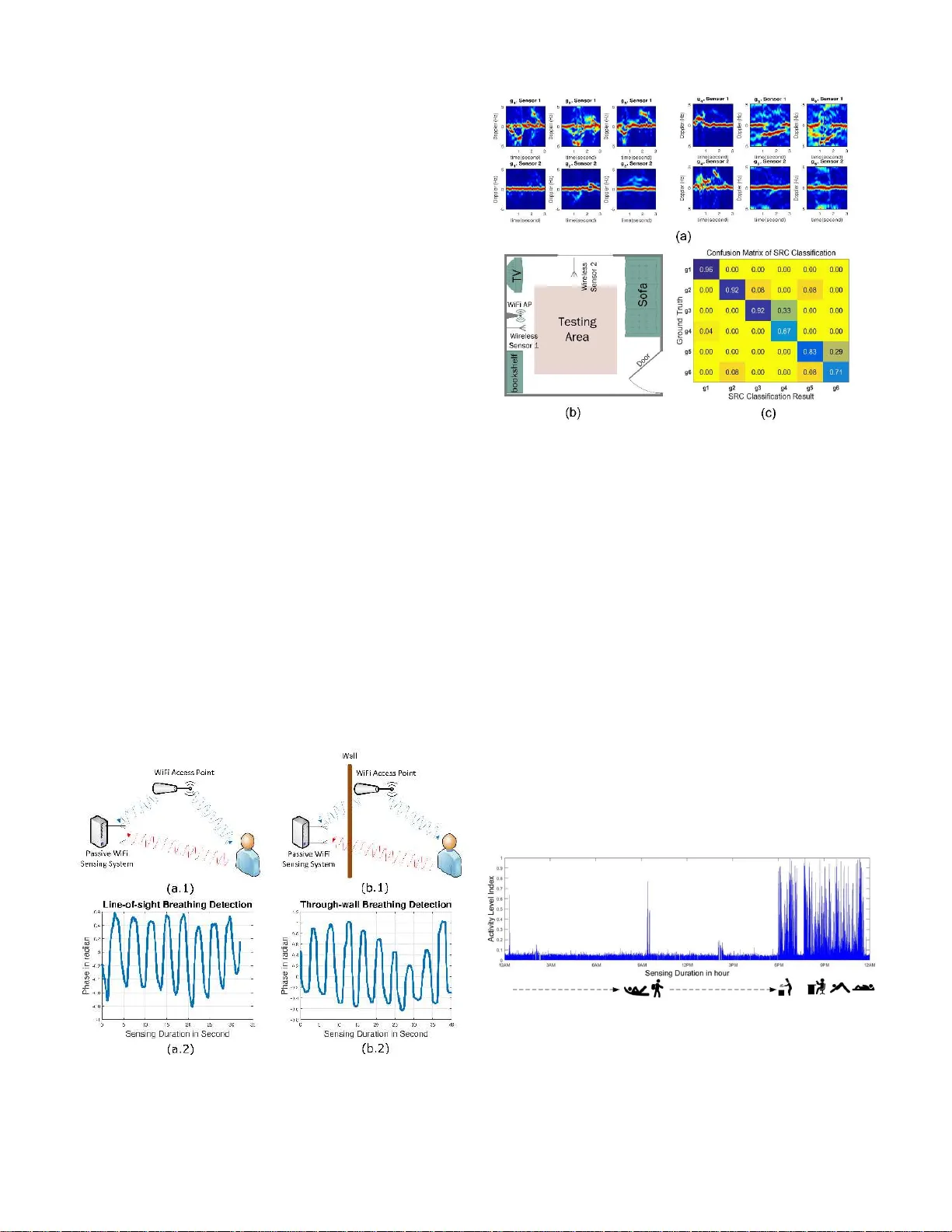
1 Exploiting W iFi Channel State Information for Residential Healthcare Informatics Bo T an ∗ † Qingchao Chen † Ke vin Chetty † Karl W oodbridge † W enda Li ‡ Robert Piechocki ‡ ∗ Coventry Univ ersity † Univ ersity Co llege Lond o n ‡ Univ ersity o f Bristol Abstract —Detection and interpreta tion of h uman acti vities hav e emerg ed as a challenging healthcare problem in areas such as assisted living and remote monitoring. Besides traditional approaches th at r ely on wearable devices and camera systems, WiFi based technologies are e volving as a promising solution for indoor monitoring and acti vity recognition. This is, in part, due to the p erv asiv e nature of WiFi in residential settings such as homes and care facilities, an d unob trusiv e nature of WiFi based sensing. Advanced signal p roc essing tech niques can accurately extr act WiFi channel status information (CSI) using commerc ial off-the- shelf (CO TS) d ev ices or bespoke hardware. This includes phase variations, frequency shi fts and signal lev els. In this paper , we describe the h ealthcare appli cation of Doppler shift s in the WiFi CSI, caused by hu man activities which take place in the signal cov erage ar ea. The technique is shown to r ecognize differe nt types of human activities and behaviour and be very su itable fo r applications in healthcare. Three experimental case studies are presented to illustrate the capabilities of WiFi CS I Doppler sensing in assisted l iving and residential care env ironments. W e also discuss the potential opportunities and practical challenges fo r real-world scenarios. Index T erms —WiFi, CSI, Behav ior Recognition, Healthcare, Sensing I . I N T RO D U C T I O N H EAL THCARE demands are becoming an increasing co n- cern in mo dern society due to the ageing po pulation, an d rising levels o f o besity , card iovascular d isease, depression and mental health pro b lems. This ha s led to significa n t resou rce and financ ial constraints o n healthcar e services globally . New technolog ies for sensing daily activities and beh a vio urs in res- idential settings and care hom e s are p r oviding insightf ul d ata relating to both p attern-of- lif e, and sho r ter term mon itoring such as in a c ti vity an d falls. These metrics ar e especially useful for identify ing health issues and chron ic diseases, for which early treatment interventions ar e critica l. In th is c ontext, measuring and mo d elling huma n behaviour and routine activities with both passive an d active in- h ome sensors has beco me increasingly important. The SPHERE Healthcare project [ 1] h as designed and developed a m u lti- modal sensor sy stem that will be d eployed across 100 residen- tial ho mes in Bristol, U K fo r monito ring the daily a c tivities of particip a nts. The overall sy stem le verages a wide rang e o f sensors including passive inf ra-red (PIR) detectors, wearab le accelerometer s, mo tion c a m eras, and Wi Fi based passive ges- ture sensors. Among the sen sing tec hnologies used in huma n activity mode llin g, 802 .11 (WiFi) based acti vity sensing is drawing significant research attention owing to operatio nal advantages b rought about by its u b iquitous nature, and stro ng signal coverage throug hout h o mes an d urban en viro nments more g enerally . Additionally , the unobtru si ve nature o f the technolog y , and its inability to generate an im age o f p erson is fa vourable in terms of pri vacy , which is an importan t con cern of many end -users. The presence of a person (either static or in motio n) within a WiFi signal field affects the char acteristics of the com- munication chan nel, fo r exam p le b y increasing pro pagation paths, attenuating th e sign a l, inducing a freq uency shift etc. This results in time-varying ch aracteristics tha t correspo nding to real-time b ody movements or physical gestures. Chan nel state inf ormation ( CSI) is typically u sed to d escribe signal propag ation pr operties which includ e the distortion s induced by human activities. This has stimulated research into the use of CSI data obtain from of f-th e-shelf network cards or customized sy stems to interp ret various typ es of human behaviour . T radition al received signal streng th (RSS) based metho ds have d e m onstrated the capability of using WiFi signals for localization and a cti vity reco gnition in residen tial ar e as. How- ev er, these systems must und ergo labour inten sive offline training, an d suf fer from co arse resolutio n. Researche rs have therefor e begun to leverage WiFi CSI to obtain mor e accuracy and a lar ger application space. Th is appro a c h differs from wireless and mobile comm u nications which ty pically employs the statistical ch aracteristics of the wirelese ch annel, for ex- ample Rician, Ryleigh a n d Naka g ami channe ls [2]. Several advances have recently been m ade in W iFi CSI research . A subspace b ased method en titled Matra c k [3] u tilises angle of arriv al (AoA) an d time of arriv al (T o A) mea surements for fine-gr ained device free localisation . In [ 4] the author s employ phase infor m ation an d RSS profiles to identif y peop le falling for applications in tele- healthcare, while the appro ach propo sed by Z h ang [5 ] first explo its Fresnel z ones to ex- amine the effect of the location and o rientation in h uman respiration monito ring and d e te c t human walking directio n. CSI mea su rements h a ve also been integrated in to wearable technolog ies such as Headscan [6] to mo nitor activities which in volve to rso, head an d mou th movements, an d Bodyscan [7] for sensing everyday activities, includ in g vital signs. Here, the authors d e m onstrate activity re cognition while subjects car ried out activities such as walking , be nding over , shaking, chewing, cough in g and drinkin g. W ithin the litera tu re concern in g CSI b a sed ac tivity recogn i- tion, th e Dopp ler inform ation in th e W iFi chan nel state a rising from human acti vities has gaine d significant attenuation. For example, W ifiU [ 8] can iden tify W iFi Doppler shifts f or in- 2 home hum a n gait reco gnition ap plications by filtering ou t the hig h freq uency jitters and d enoising of WiFi CSI profile. Passi ve W iFi detection is a nother Dopp ler-based methodolo gy and in [9] the a u thors d emonstrate the throu gh-wall d e tection capability by applyin g c r oss-ambiguity functio n proc essing on W iFi sign als reflected from targets of interest. I n [ 10], researchers use the Sho rt-T ime Fourier Transform (STFT) an d Discrete W avelet Transform (DWT) to separa te reflection s from d ifferent bod y p arts in th e freq uency dom ain. Then, activity is m odelled by pro filing th e e n ergy each freque ncy compon ent. Considering the para meters inheren t to W iFi CSI such as the tim e delay , RSSI and phase shift/f r equency , the Doppler shift o r th e fr equency comp onent is the only m e tric that reflects d ynamic states and thus h as th e poten tial to monitor the m ovements of peop le an d objects within WiFi enabled areas. In som e cases, CSI can b e used d irectly to determine behaviour metrics, f o r example, r espiration rates of per so nnel [11], or to capture the trace o f a movin g h and by synthesizing AoA in formation [3]. I n many cases howev er, par ameters within the CSI matrix cannot b e easily used to m ake inferen ces about the type of activity or hum an behaviour occ urring. In these cases, machine learning methods are ap plied to a n alyse the pattern o f CSI change s and relate d th ese to gesture and other activities. In [7], statistical classification metho ds such as suppo r t vector machin e ( SVM) a n d k-nearest neig hbour (k- NN) are used to recog nize key strokes on a keyboard a n d hand wa ving gestu r es. Some studies have also determ in ed a time sequ e ntial rela tio n between two or more human gesture s or activities. A Hidden Markov Model (HMM) is introduced in [10] to improve recogn ition perfo rmance. This study is concern ed with th e explo itation of fr e- quency/Dop pler data in th e W iFi CSI to provide info rmation on h uman activities within indoor environments, with a focus on h ealthcare monitorin g. The paper is organized as follows: firstly in Section II we ou tline key c h allenges that exist with activity and behaviour reco gnition within reside n tial h ealth- care. Section III then describes how hum an activities impact the WiFi CSI parameter s, and th e subsequ ent methodo logy f or perfor ming the recognition. I n Section IV, three case studies are pr ovided to illustrate the use of Dop p ler based W iFi CSI for activity reco nition in hea lth care m onitoring . Finally , in Section V, we d iscuss th e implication s of ou r results and possible dir ections for f uture research b e fore summarizin g the main finding of the work. I I . C H A L L E N G E S O F B E H A V I O R R E C O G N I T I O N I N R E S I D E N T I A L H E A L T H C A R E A. Challenges in Re sid ential Health Monitoring 1) V ital Signs: V ital sign s such as respiration and the heart beat a re the am ongst the mo st useful indicato rs o f a person’ s ge neral health. Equipm ent like chest belts, electro - cardiogr am (ECG) or photopleth ysmogram (PPG) sensors ca n accurately reco rd respiration and heart r ates and ar e used in some spec ific controlled scenario s such as hospitals and care homes. However , there is a low acceptanc e lev el associated with these devices in norm al residential application s d ue to the inconvenience it causes when integrated in to everyday routines. Newer wearable devices, like smart watches and wristbands can keep a record a user’ s heart rate d uring spo r t by using a physiolo gical sensor . Howe ver , users often use these for a specific pur pose e.g. exercising and th erefore go th rough long p eriods of n o t bein g monito red. There is therefo r e a strong requirem ent for long term daily mo nitoring of vital signs. 2) Life Thr eaten ing Events: Besides vital signs, detec tion of events th at cou ld lead to serio us injur ies, and even fa- talities is ano ther im portant aspe c t in residential healthc are. Fall detec tion in o n e of th e mo st cr itical capa b ilities in this context. Cur rently available fall detectio n alert devices r ely on the u ser wearin g a wristband or necklace a n d u se on- board accelerometer and gy roscope data to ind icate sudden chang es of m ovemen t, direction o r position. However , wear a b le devices tend to have limited battery life and have high risk of non- complianc e , especially amo ngst the elderly . Th us, solutions are needed that can provide seam less mon itoring of life threatening events in residential settings e specially those wh ich accommo date th e eld erly or peo ple with mobility d isabilities. 3) Daily Activities: A log of daily activities is of g reat interest in health care be c a use it con tains d i verse h ealth related informa tio n. For examp le, th e activity of mak ing a cup of tea will be an in dication of water intake, and p otentially ev en sug ar and milk. In o ther appro aches, data fro m different smart ho m e sensors wer e fu sed. This in cluded: water , g as, electricity meters an d even h umidity readin gs to reco gnize physical activities. Th ere are other sensors in smart ho mes which can dire c tly m onitor human motion , such as PIR sensors, but these o nly deliver limited information that indicate presence of a per son. Camera o r other optical sensors can accurately recog nize gestures and activities, but under pe rform in subop timal light con ditions and raise p ri vacy concern s. W earable devices like accelerom e ter and on body RF sen sors [7], [6] can be u ncomfor table, and are liable to be misplaced , damaged or forgo tten. Uno btrusiv e monitoring techno logy like W iFi based gestu r e recogn ition that can fill these gap s is therefor e a promising area to explore. 4) Chr o nic Activity Level: Apart f rom the above informa- tion, long er term ac ti vity da ta over days, we e ks even mo nths, is also valuable in the context of he althcare. Research in [12] reveals that cha nges in levels of activity are an imp ortant signs of various ph y sical and mental health p r oblems like chronic p a in and depression. An early and acc u rate awareness of decreasing activity lev els can act as a warnin g sign to trigger early interventio n. Multimodal data fusion over lon g time perio ds is a requ irement in these types o f healthcar e applications, and the passiv e natu re of W iFi based CSI sensing could be an important contributor in this area. B. T axono my of W iF i CSI in Health c ar e App lications From the above we can see that W iFi CSI based me th ods have some obvious po tential to fill the ga p s in data lef t by other sensors. Th ere are howev er some limitation s of this tech nology and some of advantages and disadvantages ar e listed b e low . 3 1) Advan tages: The mo st o bvious advantage o f th e W iFi CSI based method is th at it removes the r equiremen t f or wearing sen sors. This acts to in crease user uptake and cap - tures activities an d b ehaviors in na tu ral r a th er th an ar tificial condition s. Seco n dly WiFi b ased systems av oid many of the the privac y con cerns associated with other sensors suc h as CCTV . Third ly , within the coverage ar e a of the W iFi signal, the W iFi CSI based meth o d can provid e pano r amic monitor ing indepen d ent of ligh t condition s. Finally , recent p rogress in signal processing and machine le a r ning h as made it p ossible to extract detailed behavior inf ormation from W iFi CSI data. In this paper, we emp hasize the frequ ency compon ent in CSI as it is directly related the motion of a subject of interest. 2) Disadvan tages: Although W iFi CS I based behavior recogn itio n is a pro mising appro ach there ar e some limitations of the tec hnology . Fir stly , lo ts o f curr e nt W iFi based CSI ges- ture/activity re c ognition ap proaches are carried out in highly controlled en viro nments. I n prac tice chan g es of geometr y may also degrade the recognitio n p erforman ce. Secon dly , the W iFi CSI ba sed r esearch mention ed in the previous sections r equire the W iFi AP and clien ts to work in data transmission m ode in order to ob tain th e OFDM signal needed for the p rocessing. This c ondition can n ot be guaran teed in many situations as the W iFi AP may only b roadcast a beacon signal in 10 short bursts over 1 secon d if the W iFi AP is in idle status. Even when the W iFi network in being used, th ere may on ly b e very sparse W iFi tra n smissions that are insufficient to accu rately estimate the require d parameter s. It is theref ore unlikely that one single technolog y will meet all challeng e s in residential healthcare. In practice , W iFi CSI based be h avior recogn ition data n eeds to be integrated and f used with da ta fr om oth er sensors fo r better activity recog nition perfor mance or to fill the gap s in time an d location coverage for contin uous and seamless monito ring. I I I . W I F I C S I S I G N A L P RO C E S S I N G A N D B E H A V I O R R E C O G N I T I O N M E T H O D S Both signal p rocessing an d m a chine learning techniqu es are u sed in conjun ction with W iFI CSI measu rements for behaviour recog nition and activity m onitoring . In this section we outlin e various approaches which hav e been employed to extract W iFi CSI, includin g those which have been used to identify frequ ency (Doppler) shifts caused from phy sical body movements in the vicinity o f a W iFi AP . W e also discu ss methods used to classify CSI/Doppler signatur e s inherent to a g i ven motion , and the potential im provements afforded by making use of temporal pattern s with in the frequ ency data . Figure 1 illustrates the main processing and classification steps in scenarios where people move throu gh W iFi fields. A. Extracting the W iF i CSI 1) Commer cial Off-the-Shelf Devices: The majority of commercia l WiFi-enabled devices are able to parse WiFi signal data and outp ut inform ation abou t the state o f the channel, the most co mmon being th e r e cei ved signal stren gth indicator (RSSI). Howe ver factors such as the orientation of scatters, multipath and sh adowing act as major sources of error in RSS measure m ents. T echnique s such as ’Fing e rprinting’ therefor e requ ir e initial characterization proced ures within an en viro nment, prior to carrying out any localization tasks. More recently , resear c hers have taken advantage of th e I n tel 5300NI C to captu re WiFi CSI. It uses pilot OFDM symbols in 8 02.11n signal to estimate the CSI, and re ports the ch annel matrices for 30 subcarrier groups fr om 3 receiving anten nas. Each m a tr ix consists of com plex en tries with signed 8- bit res- olution each for both th e real and imag inary parts. Each entry can b e written as | h i j | e − j φ i j , wher e h i j and φ i j are the chan n el amplitude an d phase prop erty of the i t h receiving antenn a an d j t h subcarrier . The measured phase on each receiving an tenna and sub carrier provide s an oppor tunity to use well-establishe d signal p rocessing methods, a popu lar techniqu e b eing the subspace based jo in t angle and time estimation techn iq ue on the basis of Schmidt Orthogona liza tio n [13] and [14]. 2) Dedicated Devices: In ad dition to CO TS solu tions for extracting W iFi CSI, bespoke systems ded ic a ted to isolating more d etailed info r mation r e la tin g to only 1 or 2 chann el parameters have appear ed in the literatur e . In these cases software d efined radio (SDR) systems have typically bee n used to acquire raw W iFi d ata in or der to app ly customized signal processing for extractin g CSI. For example, x Dtrack [3] applies a subspace sear ch m e thod on raw IQ samp les to determ ine phase variations for h ig h-resolution T oA a n d AoA estimates. By takin g m ore IQ sam ples, passive W iFi sensing [9] is able to ascer tain chann el Dopp ler shif ts at very high reso lu tion as w e ll. The signal proce ssing method in [9] employs the cross ambiguity fun ction (CAF) to compare the or iginal WiFi transmission with measured reflections to identify sm all Dopp ler shifts r e sulting from moving peo p le. Particularly fo r Dop pler shift an d fr equency comp o nent, there are two main appr oaches. On e approach is to app ly STFT or DW T on CSI f or extracting f requency com ponent. Ho wever , this appr o ach h a s a limitation on discriminating moving target reflections an d station ary reflectio ns. Anoth e r a pproach wh ich is based on p assi ve radar p rinciple applies CAF proc e ssing o n sampled sign als from r e ference and surveillance ch a n nels that contains stationary sou rce signal and moving target r eflection respectively . The passive ra dar approa c h shows goo d p erfor- mance on cancelling the impact from station ary reflection. In Section IV we presen t a high r e so lution passiv e W iFi Doppler ^ŝŐŶĂůƉƌŽĐĞƐƐŝŶŐĨŽƌ ĞdžƚƌĂĐƚŝŶŐ ŚĂŶŶĞůƉĂƌĂŵĞƚĞƌƐ ,ƵŵĂŶ >ĂƉƚŽƉ tŝ&ŝW ; Ă Ϳ ^ ŝ ŐŶĂ ů Ă ƵƉ ƚƌ ŝ ŶŐ ; ď Ϳ ^ ŝ ŐŶĂ ů W ƌ ŽĐ Ğ Ɛ Ɛ ŝ Ŷ Ő Ĩ Žƌ ^ / ; Đ Ϳ D Ă Đ Śŝ ŶĞ ů Ğ Ă ƌ Ŷŝ ŶŐĨ Žƌ dŽ& Ž Z^^ WŚĂƐĞƐŚŝĨƚ ŽƉƉůĞƌƐŚŝĨƚ &ĞĂƚƵƌĞĞdžƚƌĂĐƚŝŽŶ ůĂƐƐŝĨŝĐĂƚŝŽŶ dŝŵĞƐĞƋƵĞŶƚŝĂů ĞŶŚĂŶĐĞŵĞŶƚ ƵƐƚŽŵŝnjĞĚ ĚĞǀŝĐĞƐ Fig. 1: The gener a l composition and pro c ess o f WIFi CSI based hu man beh a vio r . (a) Sign al capturing , (b) Signal pro - cessing for CSI extraction , (c) Machine le a rning to recog n ize the behavior . 4 time WiFi CSI parameter A gesture cycle (a) (b) time WiFi CSI parameter (c) Fig. 2: The param eter chang e during an exam ple gesture cycle. ( a) Example g esture cycle, (b) Change of recogn izable parameter value d uring one gesture cycle, (c) Change of the unreco g nizable parameter value dur ing on e g esture cycle. radar system and experimental recognition r esults. B. Behavior Recognition 1) T emporal Channel State V ariations: At any given in- stant, a measurem ent o f the W iFi c h annel state p rovides little informa tio n relating to the beh a vio ur of a person in the signal propag ation path. Howe ver , analyzin g the CSI as a fu nction of time offers this po ssibility: a ph ysical c hange in a persons position, speed an d /or dir ection will affect pr opagation paths, Doppler sh if ts and arrival angles. Th e effect is a distortion in the chan nel with a character istic tempo ral signature. Even if a person attempts to stand still, the movement o f their torso (e.g. swaying, ben d ing etc) or limbs (e.g. lifting a cup etc) will giv e rise to tim e -varying comm ensurate ch anges in the phase, frequen cy and amplitude ch aracteristics of the reflected signal. In practice a typical g esture cycle such as th at shown in Figure 2 will be made up of a combination of m otions fr om various parts o f the body , leading to a complex tempo ral signature. W e find that particular CSI parameter s actually sho w a clea r change in their temporal trace du ring one gesture cycle when there is one domina n t motion and min imal interfere n ce and noise - see Figu r e 2 (b). Howev er, as illustrated in Figure 2 (c) when th ere are multiple contributory motion s du ring a gestu r e cycle, CSI p arameters ch ange in a m ore complex mann e r . 2) F eature Extraction: The perf ormance o f a c lassifier for r ecognizing activities and behaviours depen d highly on approp riately d efining a n d extracting discrim inate featu res within a gesture cycle measurem ent. Our method focuses on extracting (i) intuitive time d omain fe atures; (ii) em p irical features de termined f rom char acteristics of the tim e dom ain signal; and (iii) featu res d e r i ved from m a trix a n alysis methods. The time d omain f eatures are always th e correlations amo ng time domain signals, with th e consideratio n of time m is- alignment among intra-class samples. As can b e seen from Figu re 2(b) , so m e CSI param eters show a recog nizable pattern durin g the gesture cycle. The selection of feature s to use such a s the p eak value, span, slope, zero-cro ssing a n d inflection points of a m easured cu rve must be based on empir ic a l d ata. While it is impossible to extract intuitive f eatures in a gener al case as shown in Figur e 2(c), m atrix analysis can be utilized to ana ly ze structural proper ties du ring a gesture cycle, and typic a l app roaches include Principle Compo nent Ana lysis (PCA) and the Singu lar V alue Dec o mposition (SVD) . 3) Classification of Ge stu r es/Activities: Many h ealthcare applications require real-time classification of a g esture o r activity , such as falling d own, so th at an ale r t can b e instan tly triggered . A number of class ifiers a r e ab le to meet this requirem ent but their app licability also depend s on the type of input fea tu res cho sen. In gener a l, the most p o pular clas- sification methods are the Na i ve Bay esian classifier, suppor t vector machine (SVM) classifier and th e sparse representation classifier (SRC). The Naiv e Bayesian classifier is simple and flexible to f eature types but only suitable fo r small number of features. SVM is widely used for different problem s beca use it is app licable to both linear and non linear data . In this work we u tilize SRC ap p roaches becau se of its robustness to low signal to noise ratios, and misalign ed data. Ho wever , SRC is more complex than SVM an d oth er com m only u sed c la ssifiers. I V . C A S E S T U DY In Sectio n II, we describ ed the ch allenges of hu man be- havior recognitio n in residential h ealthcare. This include d detecting vital sig n s, po tentially fatal events, d aily activity recogn itio n and long er term p attern-of- life mon itoring. In this section , we p resent three cases sup ported with practical experimental data to demonstrate h ow W iFi CSI based human behavior rec o gnition, esp e cially D o ppler and ph ase variations, fit these challenges in residential healthcare. A. Case 1: Thr ou gh-W all Detection of V ita l Sig ns As mentio n ed in Section III, useful medica l in formation can be ide ntified du ring a g e stu re cycle. For example, do ctors may want to k now the respiration rate of patients dur in g sleeping . The dom inant chest-wall movement caused b y respiration has a 0 .5 to 2 centimeter displac e m ent. This small movement will generate a 0 . 25 to 1 radian phase chang e on the 2.4 GHz W iFi signal, or genera te a 0 .6 to 2 .4 radian p hased change o n a 5.8 GHz W iFi signal. In this case, we can le verage th e h ome W iFi signal to pr ovid e a no n-contact respiration monitor ing solution. W ith the experimental setting in [ 1 1], detailed phase variation can be extracted from cr oss-correlated ref erence an d surveillance signa ls with help fro m a Hamp el filter which removes the outliers cau sed by p hase noise. passi ve W iFi sensing has been d e m onstrated to detect huma n resp iration, ev en through a 33cm b rick wall as shown in Figu re3. Th ese results d emonstrate th at we can observe accur a te respira tion behavior without the use o f complex classification algorithms. B. Case 2: Daily Activity Recognition in Reside n tial Ho me W e have ap plied machine learnin g meth o ds to recogn ize a nu m ber of behavior pa tter ns in a residential h e a lthcare situation. Th e exper iments were carried out in the SPHERE house [1] (Bristol, UK ) u sing a CO TS W iFi AP and SDR based passive WiF i radar . T he CAF functio n [9] was applied 5 to extract small Doppler shifts, and the r esults obtain ed ar e summarized below . First, a gro up of gestures that ar e deemed importan t in residential health care were selected . T he gestures are as fo llows : g 1 : picking up an item fr om the flo or , g 2 : sitting down o n a chair , g 3 : stand ing up fr o m a sitting p osition , g 4 : fa lling down on the fl o or , g 5 : stan ding up after a fall , g 6 : get up and out of a bed . The CAF metho d intro duced in Section II I-A2 is a p plied to a two receiver passive W iFi sensing system to extract accu r ate an d high r esolution fre- quency (Do ppler) p erturbation s ca u se b y human movement. The extracted Dopp le r tr aces fro m the two sensor s d uring each ge stu r e cycle are sh own in Figure 4 (a). T ak in g g 1 for example, picking up an item from flo or often includes lean in g over , picking and g e tting up. W e can observe from Senso r 1 in the Doppler-time spectrum in Figure 4 (a) that th ere is an obvious negative Dopp ler tra ce, short duratio n at zero Dopp ler and positiv e Doppler sh if ts. Th is ob ser vation illu stra te s a clear correlation b etween activity and the Doppler-time spectrum. T o systematically interpret human activity from W iFi Do ppler detection, we apply SRC classification on the PCA f eatures of each Do p pler signature. The behavior recognition result is shown in Figur e 4 (c ). Note th at the CAF based freq uency estimation can also be ap p lied to b oth W iFi data bursts and W iFi beacon signals for Doppler informatio n extraction. Falling is an impo rtant activity in health care ap plications [4]. Falling events of te n occur dur ing a relatively short period and exh ibit large intr a-class variations. Important f eatures are easily missed. The use of SRC in fall detection is advantageous as the spar sity co nstraints exhibit de- noising p roperties, wh ic h are able to enh ance the captur e of importan t local features fo r classification. Although the reco gnition rate of the fall motion is still not ideal from Figu re4 (c), it ca n be imp roved by considerin g the correlatio n s am o ng th e motions before and Fig. 3: The line-of -sight and thr o ugh-wall respiration sensing based on W iFi p hase mea surement. (a.1) , Layout o f LoS W iFi respiratio n sensing, (a.2 ), L oS respiration detected result, (b .1) Layo ut of thro ugh-wall W iFi respiration sensing, (b.2), Throu g h-wall respiration detected result Fig. 4 : SRC c la ssification of 6 daily behaviors in SPHERE House. (a) Do ppler spectrum of g estures capture d b y two wireless sensor s in different angles, (b ), SPHERE ho u se ex- periment layou t, (c ) SRC recog nition result based PCA featur e extraction. after the fall tha t lead to time seq uential mo delling. C. Case 3: A c tivity Monitoring in a Residentia l Envir onmen t and Sequential Infer ence 1) Activity Mo n itoring in a Reside ntial Envir o nment: As discussed in Section IV -B and IV - A the sensing system c an detect vital signs b y extractin g phase inform ation in W iFi CSI and r e c ognize different daily a cti vities b y discriminating frequen cy signatures. These capabilities provide a n o pportu- nity to monitor the residential activities in a longer time scale from days to weeks ev en months and beyond. Fig u re 5 shows 24 ho urs activity monito r ing of a person at h ome with o nly CO TS ho me W iFi AP be a c ons, on the basis of CAF frequ e n cy estimation. Fig. 5: An examp le of 24 hours m onitoring b ased W iFi in a residential house The vertical axis in Fig ure 5 shows the activity inte n sity which cor r elates to the activity velocity and the relative size of the bo dy . For example walking and the motion of a tor so leads to higher inten sity values than those produc e d by arm and head movements. The en velope of the trace is direc tly related to th e 6 activity of th e subject. Thu s, the in tensity data acts as a go od candidate to assess the daily lifestyle and activity level. By defining 3 levels accord ing the vertical axis values: sedentary (0.0 ∼ 0 .3), m oderate (0.3 ∼ 0 .7) an d vigoro us actio n (0.7 ∼ 1 .0). The summ ary of the person ’ s p hysical activity inte n sity is presented as in T able I. T ABLE I: Activity Level Statistics of Daily life Class Sedenta ry Moderate Action V igorous Action T otal Action Amplitude of acti vity lev el 0-0.4 0.4-0.7 0.7-1 0-1 Time of acti vity (mins) 662.5 (122.5) 156.5 83 902 (362) 2) Inferring Se q uence of Activities: Th us far we have discussed instan tan eous activity recognitio n, insofar various classifiers have been applied to the Doppler data, and the prediction s were mad e "batch by batch ". Exa mples of such activities are shown at th e bottom of Figure 5. It is accepted [15] that a seq uence of activities is correlated in a sense that certain activities are m ore likely to fo llow others, and likewis e, some are impossible to occur one after another, e. g. a person cannot tra n sition from sitting to runnin g with out standing fir st. Such a sequen ce of activities can be rep resented b y Hid den Markov M odel (HMM) (or related mo dels such as Gaussian Random Processes or Con ditional Ran dom Field ( CRF)). These sequential m ethods incorp orate future an d past obser- vations ( h ere Doppler inform ation) to im prove prediction s for the cur rent estimate. It is widely r e p orted in other areas where HMM are used (e . g. speech recognition ) that such strategies can lead to improved perfo rmance compar ed to techniqu es that rely only o n curr e nt observations. In the context of residential healthcare, sequ ential predic tio n of activities can plau sibly help in pred ic tio n of futur e ac tivities or warn of increased risk of a given e vent. V . C O N C L U S I O N S In this article we exp la in how W iFi CSI can add ress the challenges of beh a vior recog nition and activity monitor ing in residen tial healthcar e. State-of-the- art signal processing technique s make it possible to extract accurate Dopp ler d ata, allowing us to character ize activities and behaviours of mo n - itoring huamn sub jec ts. W e have presen ted th ree case studies to illustrate the cap abilities o f a passi ve W iFi Do ppler sensing system within a healthcar e settin g including : m onitoring of vital signs, fall detection , an d pattern -of-life monitorin g . The result confirm tha t WiFi based CSI sensing tech nologies show goo d potential f or h e a lthcare ap plications. W e have also identified f our key c h allenges tha t mu st be overcome to facilitate a transition o f the techn iq ues into real-world a ssisted li vin g applica tio ns. (i) WiFi Si gna l Processing: Many existing technique s SpotFi [14] and Matrack [ 3] rely o n h igh data-rate OFDM W iFi tran sm issions to extract CSI data. However , only a few methods su ch as [9] can be applied to lower bit- rate or WiF i beacon sign als, albeit with perform ance deterio r ation. High-resolu tion algor ith ms f or processing low date-rate sign als are therefo re cr itical. (ii) T ime Alignment: T he classification perfor mance has been sh own to depen d on accu rate time alignment du ring the gesture cycle. Thu s, d etermining the time po ints o f of start an d end of a g esture or behavior is crucial to perfo rmance. (iii) Multiple Users: Previous studies such as [ 4], [9], [8 ] and [1 0] h a ve only co nsidered sensing individuals, and extrap o late to m ultiple users by pr oposing additional devices. Howe ver, add itional users significantly add to the sensing com plexity in terms of shielding and multipath , sensor deploym ent, cost e tc and is a challeng in g next step. Finally , Sensor Fusion h as shown prom ising results in W iFi CSI based behavior recogn ition. It is generally accepted th at a variety of sensors will be deployed in futu re smart homes. Fusing W iFi CSI b a sed recogn itio n data with oth er sensors like cameras, acceler ometers, or electr icity , hum id ity and water meters will provide more accu rate, and seamless recognizin g and modelling of human behavior . R E F E R E N C E S [1] P . W ozno wski, A. Burro ws, T . Diethe et al. , “Sphere: A sensor platform for healthca re in a residential en vironment, ” in Designing , De veloping , and F acilitati ng Smart Citie s: Urban Design to IoT Solution s , V . An- gelaki s, E. Tragos, H. C. Pöhls et al. , Eds. Springer Internati onal Publishing , 2017, pp. 315–333. [2] F . Babich and G . Lombardi, “Stati stical analysis and chara cterizat ion of the indoor propagati on channe l, ” in IEEE T rans. Comm. , vol. 48, no. 3, Mar 2000, pp. 455–464. [3] X. Li, S. Li, D. Z hang et al. , “Dynamic -music: Accurate de vice-free indoor localiz ation, ” in 2016 ACM UbiComp . Ne w Y ork, NY , USA: A CM, 2016, pp. 196–207. [4] H. W ang, D. Zhang, Y . W ang et al. , “Rt -fall: A real-time and contac tless fall detec tion system with commodity wifi de vices, ” in IEEE T rans. Mobile Comput , vol. 16, no. 2, Feb 2017, pp. 511–526. [5] D. Zhang, H. W ang, and D. Wu, “T ow ard centimeter -scale human acti vity s ensing with wi-fi signal s, ” in Computer , vol . 50, no. 1, Jan 2017, pp. 48–57. [6] B. Fang, N. D. Lane, M. Zhang, and F . Kawsar , “Headscan: A wearable system for radio-ba sed sensing of head and mouth-relat ed acti vities, ” in 15th ACM/IEEE IPSN , April 2016, pp. 1–12. [7] B. Fang, N. D. L ane, M. Zhang et al. , “Bodyscan: E nabli ng radio- based sensing on wearable device s for contactle ss acti vity and vital sign monitoring , ” in 14th ACM MobiSys . New Y ork, NY , USA: A CM, 2016, pp. 97–110. [8] W . W ang, A. X. Liu, and M. Shahzad, “Gait recog nition using wifi signals, ” in 2016 ACM UbiComp . New Y ork, NY , USA: ACM, 2016, pp. 363–373. [9] B. T an, K. W oodbridge, and K. Chetty , “ A wirele ss passi ve radar system for real-time through-wal l moveme nt detec tion, ” in IEEE Tr ans. A er osp. Electr on. Syst. , vol. 52, no. 5, October 2016, pp. 2596–2603. [10] W . W ang, A. X. L iu, M. Shahzad et al. , “Understan ding and modeling of wifi signal based human activ ity recogni tion, ” in 21st AC M MobiCom . Ne w Y ork, NY , USA: ACM, 2015, pp. 65–76. [11] Q. Chen, K. Chet ty , K. W oodbridge, and B. T an, “Signs of life detection using wireless passiv e radar , ” in 2016 IE EE RadarConf , May 2016, pp. 1–5. [12] S. B. Harv ey , M. Hotop f, S. Ã Ÿverlan d, and A. Mykletun, “Physical acti vity and common m ental disorders, ” in The British Journa l of Psychia try , vol . 5, UK, Nov . 2010, pp. 357–364. [13] R. Schmidt, “Multiple emitter location and signal parameter estimation, ” in IEEE T rans. Antennas Pr opag. , vo l. 34, no. 3, Mar 1986, pp. 276–280. [14] M. Kot aru, K. Joshi, D. Bharadia , and S. Katti, “Spotfi: Decimeter le vel local ization using wifi, ” in SIGCOMM Comput. Commun. Rev . , vol. 45, no. 4. New Y ork, NY , USA: ACM, Aug 2015, pp. 269–282. [15] A. Pentlan d and A. Liu, “Modeling and prediction of human behavi or , ” in Neural Comput. , vol. 11, no. 1. Cambridge, MA, USA: MIT Press, Jan. 1999, pp. 229–242. 7 Dr Bo T an is a Lecturer at Scho o l o f Com puting, Ele c - tronics and Mathem atics, and membe r of Research Centre for Mo bility and Transportation at Coventry Univ ersity . His research focu ses on signa l processing fo r radar an d wireless commun ications systems, an d wireless sensing application s in healthcare, security , r obotics an d indo or p ositioning. His research in passive W iFi sensing and has led to a series of IEEE co n ference and jour nal publicatio ns, in d ustrial awards and patent. Qingchao Chen rece i ved th e B.S. degree in T elecomm uni- cation Eng ineering with Manageme n t in 20 09 f rom Beijing University of Posts and T elecommu nications, Beijing , China. He is cur r ently p u rsuing his PhD degree in University College Londo n. His research inclu des MIMO ra d ar system and ph ased array design, MIMO imaging alg orithms, micro - Doppler clas- sification and domain adaptation algorith m s. Karl W o odbridg e is Professor of Elec tronic and Electrical Engineer ing at Uni versity College London . Research inter e sts include multistatic and so ftware-defined rad ar system s, passive wireless sur veillance and micro - Doppler classification . Cur r ent research is focused on p a ssive wirele ss movement detection for Healthcare a n d Security app lica tio ns. He is a Fellow of the IE T , a Fellow of the UK Institute of Physics, a Senior Member of the IEEE an d has pu blished or p resented over 200 journal and conferen ce papers. Dr Ke vin Che tty is a Senior Lectu r er (Associate Pro fessor) at University College Lo ndon. His research focuses on RF sensors an d signal processing techniqu es that exploit wireless commun ications for passive sensing and behaviour classifica- tion using micr o-Doppler signatures. Other research interests include throu gh-the-wall radar, software defined sensor sy s- tems an d recon figurable antennas. He is autho r of over fifty peer reviewed pu blications an d has been an inv estigator on grants funded by both government and industry . W enda Li re c ei ved the MEn g degree from the Departmen t of Electrical En gineering , Un i versity of Bristol, in 20 13. Cur- rently , he is a PhD studen t in th e Dep artment o f Electrical En - gineering , Un i versity o f Bristol. His research inter ests in c lude context aw aren ess, system research and locatio n determina tion system. Dr Robert Piecho cki is a Reader at the University of Bristol. His resear c h interests span all areas of wireless connectivity and sensing, with em phasis o n applications to eHealth and transportatio n. He h as p ublished over 120 p apers in p eer revie wed internation al journ als and con ferences and holds 13 patents in these areas. Robert is leading the development of wireless co nnectivity an d sensing f o r the IRC Sphere p roject (winner of 2016 W orld T echn ology A ward).
Original Paper
Loading high-quality paper...
Comments & Academic Discussion
Loading comments...
Leave a Comment