Discrimination of the DPRK underground explosions and their aftershocks using the P/S spectral amplitude ratio
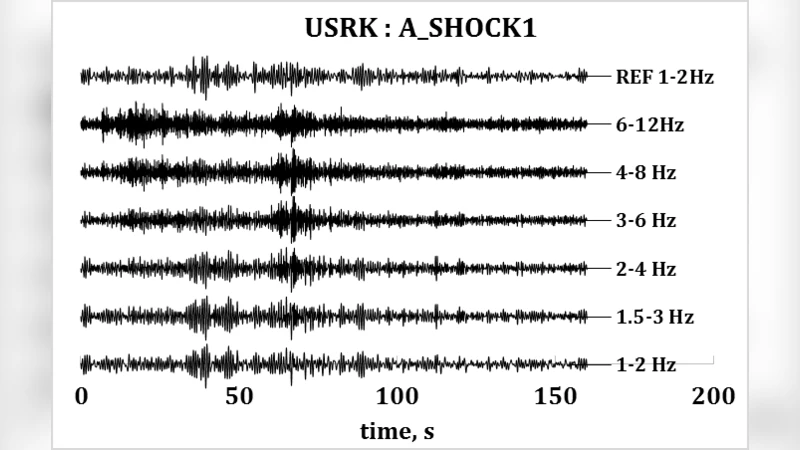
We have estimated the performance of discrimination criterion based on the P/S spectral amplitude ratios obtained from six underground tests conducted by the DPRK since October 2006 and six aftershocks induced by the last two explosions. Two aftershocks were detected in routine processing at the IDC. Three aftershocks were detected by a prototype waveform cross correlation procedure with explosions as master events, and one aftershock was found with the aftershocks as master event. Two seismic arrays USRK and KSRS of the IMS and two non-IMS 3-C stations SEHB (South Korea) and MDJ (China) were used. With increasing frequency, all stations demonstrate approximately the same level of deviation between the Pg/Lg spectral amplitude ratios belonging to the DPRK explosions and their aftershocks. For a single station, simple statistical estimates show that the probability of any of six aftershocks not to be a sample from the explosion population is larger than 99.996% at the KSRS and even larger at USRK. The probability of any of the DPRK explosion to be a representative of the aftershock population is extremely small as defined by the distance of 20 and more standard deviations to the mean explosion Pg/Lg value. For network discrimination, we use the Mahalanobis distance combining the Pg/Lg estimates at three stations: USRK, KSRS and MDJ. At frequencies above 4 Hz, the (squared) Mahalanobis distance, D2, between the populations of explosions and aftershocks is larger than 100. In the frequency band between 6 and 12 Hz at USRK, the aftershocks distance from the average explosion D2>21,000. Statistically, the probability to confuse explosions and aftershocks is negligible. These discrimination results are related only to the aftershocks of the DPRK tests and cannot be directly extrapolated to the population of tectonic earthquakes in the same area.
💡 Research Summary
The paper evaluates a discrimination technique based on the P‑to‑S spectral amplitude ratio (Pg/Lg) for distinguishing six underground nuclear tests conducted by the Democratic People’s Republic of Korea (DPRK) since October 2006 from six aftershocks generated by the two most recent explosions. The authors used data from four stations: two International Monitoring System (IMS) arrays—USRK (United States) and KSRS (Russia)—and two non‑IMS three‑component broadband stations—SEHB in South Korea and MDJ in China. For each event, the authors computed the Pg and Lg spectral amplitudes over a frequency range of 0.5 Hz to 12 Hz in 0.5 Hz steps, then formed the Pg/Lg ratio as a discriminant.
The key observation is that the Pg/Lg ratio systematically increases with frequency for the explosions, while the aftershocks display consistently lower ratios. Above about 4 Hz the separation becomes pronounced, and in the 6–12 Hz band the difference is maximal. At a single station level, simple statistical tests (mean ± standard deviation) show that the probability that any of the six aftershocks belongs to the explosion population exceeds 99.996 % at KSRS and is even higher at USRK. Conversely, the probability that any DPRK explosion could be drawn from the aftershock population is vanishingly small—exceeding 20 standard‑deviation distances from the aftershock mean.
To exploit the information from multiple stations simultaneously, the authors employed the Mahalanobis distance (squared) D², which treats the three‑station Pg/Lg vector as a multivariate normal variable. For frequencies above 4 Hz, D² between the explosion and aftershock clusters exceeds 100, indicating a statistically robust separation. At USRK, in the 6–12 Hz band, D² reaches values greater than 21 000, making the chance of misclassification essentially zero.
Detection of the aftershocks was achieved through three complementary approaches. Two aftershocks were identified by the routine International Data Centre (IDC) processing pipeline. An additional three were found using a prototype waveform cross‑correlation method that used the explosions as master events, and a fourth aftershock was discovered by cross‑correlating the aftershocks among themselves. This demonstrates that cross‑correlation can significantly improve detection sensitivity for weak events associated with nuclear tests.
The authors caution that the results are specific to the DPRK test aftershocks and cannot be directly extrapolated to the broader population of tectonic earthquakes in the same region. The Pg/Lg ratio is sensitive to local crustal structure and propagation path effects, so the discrimination thresholds derived here may not hold in different geological settings. Moreover, the sample size (six explosions and six aftershocks) is modest, limiting the statistical power for broader generalization.
In summary, the study provides strong empirical evidence that high‑frequency P‑to‑S spectral amplitude ratios, especially when combined across multiple stations via Mahalanobis distance, can discriminate DPRK underground nuclear explosions from their induced aftershocks with near‑certain confidence. The methodology offers a valuable addition to the suite of seismic monitoring tools used by the Comprehensive Nuclear‑Test‑Ban Treaty (CTBT) verification regime. Future work should expand the dataset to include natural earthquakes, explore regional variations in Pg/Lg behavior, and integrate the approach into real‑time automated discrimination pipelines.
Comments & Academic Discussion
Loading comments...
Leave a Comment