A survey study on major technical barriers affecting the decision to adopt cloud services
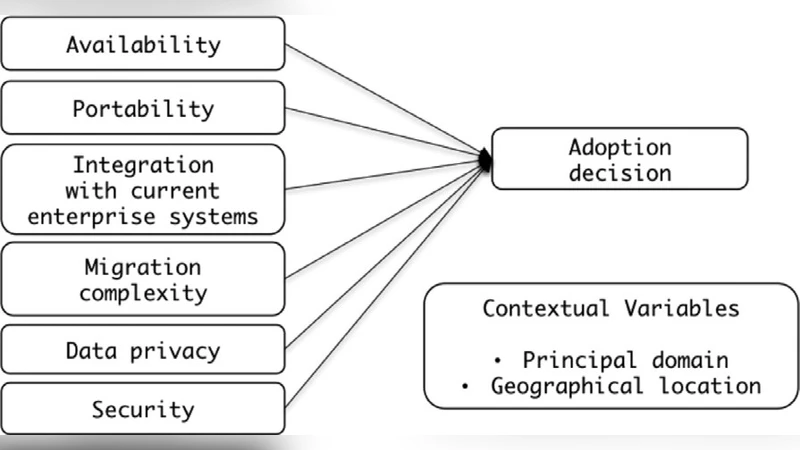
In the context of cloud computing, risks associated with underlying technologies, risks involving service models and outsourcing, and enterprise readiness have been recognized as potential barriers for the adoption. To accelerate cloud adoption, the concrete barriers negatively influencing the adoption decision need to be identified. Our study aims at understanding the impact of technical and security-related barriers on the organizational decision to adopt the cloud. We analyzed data collected through a web survey of 352 individuals working for enterprises consisting of decision makers as well as employees from other levels within an organization. The comparison of adopter and non-adopter sample reveals three potential adoption inhibitor, security, data privacy, and portability. The result from our logistic regression analysis confirms the criticality of the security concern, which results in an up to 26-fold increase in the non-adoption likelihood. Our study underlines the importance of the technical and security perspectives for research investigating the adoption of technology.
💡 Research Summary
The paper investigates how technical and security‑related barriers influence an organization’s decision to adopt cloud services. Drawing on prior literature that identifies technology‑based risks, service‑model risks, outsourcing risks, and enterprise readiness as potential inhibitors, the authors aim to pinpoint which of these concerns most strongly deter adoption.
Data were collected via an online questionnaire administered to 352 individuals employed by enterprises of varying sizes. The sample includes both decision‑makers (e.g., CIOs, CTOs) and non‑decision‑making staff, providing a broad view of organizational attitudes. Respondents were asked to rate, on a five‑point Likert scale, the extent to which they perceived several technical and security issues—specifically security, data privacy, and portability—as obstacles to cloud adoption. The respondents were then divided into two groups: adopters (those already using cloud services) and non‑adopters (those not using cloud services).
Initial descriptive statistics and independent‑samples t‑tests revealed that non‑adopters expressed significantly higher concern for security (mean = 4.2 vs. 3.1), data privacy (mean = 4.0 vs. 2.9), and portability (mean = 3.9 vs. 2.8) than adopters. To assess the predictive power of these concerns, the authors fitted a logistic regression model with “non‑adoption” as the binary dependent variable (1 = non‑adopter, 0 = adopter). Independent variables included the three barrier scores and control variables for firm size, industry sector, and whether the respondent held a decision‑making role.
The regression results were striking: security concerns produced an odds ratio of 26.3 (95 % CI = 12.5‑55.4, p < 0.001), indicating that a one‑unit increase in perceived security risk multiplies the likelihood of non‑adoption by more than twenty‑six times. Data privacy and portability also showed statistically significant effects, with odds ratios of 3.8 and 2.9 respectively, but their impact was modest compared with security. These findings confirm that, among the technical barriers examined, security is the dominant factor deterring cloud uptake.
In the discussion, the authors argue that cloud providers must prioritize robust security certifications (e.g., ISO 27001, SOC 2), transparent breach‑response policies, and demonstrable technical safeguards to alleviate organizational anxiety. They also note that concerns about data privacy—often linked to data‑sovereignty regulations—and portability—related to vendor lock‑in—remain relevant and can be mitigated through encryption standards, multi‑cloud management tools, and interoperable APIs.
The study acknowledges several limitations. First, the reliance on self‑reported survey data may introduce bias, as respondents’ perceptions might not perfectly reflect actual adoption behavior. Second, the sample is geographically and industry‑specific, limiting generalizability across different regulatory environments. Third, the cross‑sectional design precludes causal inference; longitudinal studies would be needed to track how barrier perceptions evolve over time.
Future research directions suggested include (1) multi‑country, multi‑industry investigations to test the robustness of the identified barriers, (2) integration of objective usage metrics (e.g., cloud consumption logs) with perception data to better capture the adoption process, and (3) development of comprehensive adoption models that incorporate non‑technical factors such as cost, performance, and organizational culture alongside technical concerns.
In conclusion, the paper provides empirical evidence that security, data privacy, and portability constitute the principal technical impediments to cloud service adoption, with security exerting an especially powerful effect—raising the odds of non‑adoption by up to 26 times. These results underscore the necessity for both cloud vendors and enterprise IT leaders to address security head‑on and to design policies and technologies that mitigate privacy and portability worries. By doing so, they can substantially lower the perceived risk landscape and accelerate the diffusion of cloud computing across enterprises.
Comments & Academic Discussion
Loading comments...
Leave a Comment