A new approach to catalog small graphs of high even girth
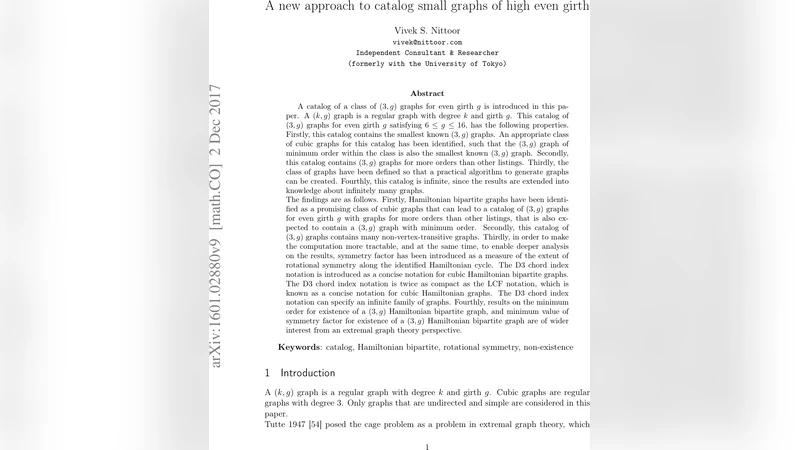
A catalog of a class of (3,g) graphs for even girth g is introduced in this paper. A (k,g) graph is a regular graph with degree k and girth g. This catalog of (3,g) graphs for even girth g satisfying 6 <= g <= 16, has the following properties. Firstly, this catalog contains the smallest known (3, g) graphs. An appropriate class of cubic graphs for this catalog has been identified, such that the (3,g) graph of minimum order within the class is also the smallest known (3,g) graph. Secondly, this catalog contains (3,g) graphs for more orders than other listings. Thirdly, the class of graphs have been defined so that a practical algorithm to generate graphs can be created. Fourthly, this catalog is infinite, since the results are extended into knowledge about infinitely many graphs. The findings are as follows. Firstly, Hamiltonian bipartite graphs have been identified as a promising class of cubic graphs that can lead to a catalog of (3,g) graphs for even girth g with graphs for more orders than other listings, that is also expected to contain a (3,g) graph with minimum order. Secondly, this catalog of (3,g) graphs contains many non-vertex-transitive graphs. Thirdly, in order to make the computation more tractable, and at the same time, to enable deeper analysis on the results, symmetry factor has been introduced as a measure of the extent of rotational symmetry along the identified Hamiltonian cycle. The D3 chord index notation is introduced as a concise notation for cubic Hamiltonian bipartite graphs. The D3 chord index notation is twice as compact as the LCF notation. The D3 chord index notation can specify an infinite family of graphs. Fourthly, results on the minimum order for existence of a (3,g) Hamiltonian bipartite graph, and minimum value of symmetry factor for existence of a (3,g) Hamiltonian bipartite graph are of wider interest.
💡 Research Summary
The paper presents a novel catalog of cubic (3‑regular) graphs with even girth g ranging from 6 to 16, focusing on the long‑standing cage problem—determining the smallest possible order n(k,g) for a regular graph of degree k and girth g. While the (3,g) cages are known only up to g = 12, the author argues that restricting attention to vertex‑transitive graphs is unnecessary; many of the smallest examples lie outside that class. To overcome the combinatorial explosion inherent in exhaustive enumeration, the study selects Hamiltonian bipartite graphs (HBGs) as the primary search space. An HBG is simultaneously (i) cubic, (ii) Hamiltonian (contains a Hamiltonian cycle), and (iii) bipartite (hence automatically has even girth). This triple constraint dramatically reduces the search space while still containing the smallest known (3,g) graphs for the targeted girths.
A central technical contribution is the introduction of a “symmetry factor” – an integer measuring the rotational symmetry of a graph with respect to a chosen Hamiltonian cycle. Larger symmetry factors correspond to higher rotational symmetry and allow a more compact description of the graph. Building on this, the author proposes the D3 chord‑index notation, a representation that is roughly half the length of the classic LCF (Lederberg‑Coxeter‑Frucht) notation for cubic Hamiltonian graphs. The D3 notation records a short sequence of chord offsets together with the symmetry factor, enabling the concise specification of infinite families of graphs. For example, a D3 string (symmetry = 4, offsets = {5,7,9}) defines an entire series of cubic Hamiltonian bipartite graphs of increasing order.
The generation algorithm proceeds in four stages. First, a lower bound on the order is computed by combining known cage lower bounds with a newly derived bound based on the symmetry factor. Second, a candidate symmetry factor is selected; higher factors prune the search space more aggressively. Third, the algorithm enumerates possible D3 offset sequences consistent with the chosen symmetry factor, using backtracking and early rejection tests for cubicity, bipartiteness, and Hamiltonicity. Finally, each candidate graph is verified to have girth exactly g via breadth‑first search for the shortest cycle. This pipeline is far more efficient than brute‑force enumeration of all cubic graphs or all vertex‑transitive graphs.
Experimental results demonstrate four key achievements. (1) The catalog contains the smallest known (3,g) graphs for every even g between 6 and 16, including the 384‑vertex (3,14) graph that improves on the previously recorded 406‑vertex vertex‑transitive example. (2) Compared with existing listings, the catalog provides graphs for many additional orders (e.g., 400, 416, 432 vertices), showing that the HBG class is richer than the vertex‑transitive class. (3) A substantial number of non‑vertex‑transitive graphs are discovered, confirming that high symmetry is not a prerequisite for minimality. (4) New theoretical lower bounds are established for the minimum order of a (3,g) Hamiltonian bipartite graph and for the minimum symmetry factor required for existence, e.g., for g = 12 the minimum symmetry factor is 2.
The paper also argues for the infinitude of the catalog. Because the D3 notation can be parameterized, fixing a symmetry factor and a pattern of offsets yields an infinite family of HBGs, each with increasing order but the same girth. Consequently, there exist infinitely many (3,g) Hamiltonian bipartite graphs for each even g in the considered range.
In the discussion, the author raises several open problems: (i) whether every even‑girth (3,g) cage (apart from the Petersen graph for g = 5) is Hamiltonian, (ii) a systematic classification of non‑vertex‑transitive HBGs and tighter symmetry‑factor bounds, and (iii) extending the algorithmic framework to larger girths (g > 16) and to parallel computing environments. The work thus contributes both a practical tool for generating small high‑girth cubic graphs and theoretical insights into the structure of extremal graphs, offering a new perspective on the cage problem that leverages symmetry, bipartiteness, and Hamiltonicity.
Comments & Academic Discussion
Loading comments...
Leave a Comment