On $r$-colorability of random hypergraphs
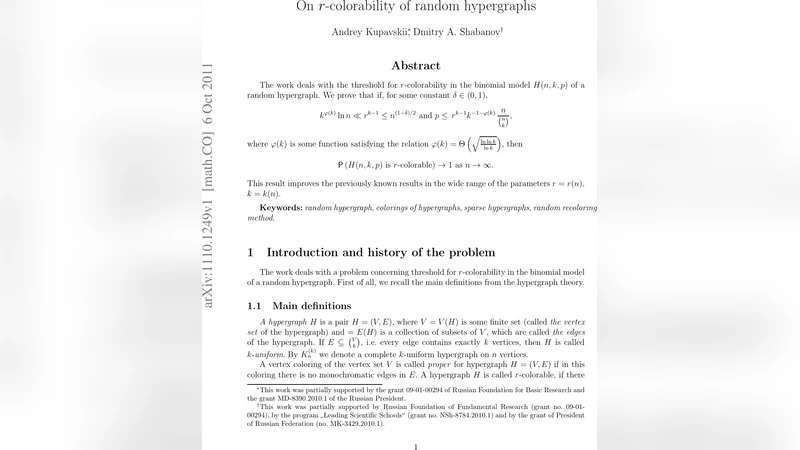
The work deals with the threshold probablity for r-colorability in the binomial model H(n,k,p) of a random k-uniform hypergraph. We prove a lower bound for this threshold which improves the previously known results in the wide range of the parameters r=r(n) and k=k(n).
💡 Research Summary
The paper investigates the threshold probability for r‑colorability of random k‑uniform hypergraphs in the binomial model H(n,k,p). While the sharp threshold for 2‑colorability is well understood (p*≈2^{-(k‑1)}·ln 2·n/ {n\choose k}), the situation for r>2, especially when both r and k grow with n, has remained largely unresolved. The authors improve the known lower bounds for this threshold by combining extremal hypergraph coloring results with probabilistic concentration techniques.
First, they review prior work: Friedgut’s general monotone property thresholds, Alon‑Spencer’s lower bound (Lemma 1), Achlioptas‑Kim‑Krivelevich‑Tetali’s upper bound (Theorem 1), and the more recent results of Krivelevich‑Sudakov (Theorem 2) and related corollaries. These give a lower bound of order p≈c·r^{k‑1}·k^{-2}·n/ {n\choose k} under fairly mild conditions, but the bound is far from optimal when r is large relative to k.
The key innovation is to relate r‑colorability to the minimal possible maximum degree Δ(k,r) of a non‑r‑colorable k‑uniform hypergraph. Classical results of Erdős‑Lovász, Kostochka‑Rödl, Shabanov, and the recent work of Kos‑Kumbhat‑Rödl provide upper and lower estimates for Δ(k,r), roughly Δ(k,r)=Θ(k·r^{k‑1}·ln r). Lemma 3 shows that if p≤½·Δ(k,r)·k/ {n\choose k}, then with high probability every vertex degree in H(n,k,p) is below Δ(k,r), forcing the hypergraph to be r‑colorable. The proof uses a Chernoff bound to control the tail of the binomial degree distribution and the condition 3·Δ(k,r)−ln n→−∞.
Applying the best known bounds for Δ(k,r) yields Corollary 2, which improves the previous Lemma 1 in two regimes: (i) for r≥3 and r^{k‑1}·√k≫ln n, the threshold is lowered to p≈(3/32)·r^{k‑1}·k^{3/2}·n/ {n\choose k}; (ii) for r=o(√ln ln k) a more delicate bound (18) is obtained, involving an exponential factor e^{-4r^{2}} and logarithmic terms.
The main result, Theorem 3, introduces a slowly varying function φ(k)=Θ(ln ln k/ln k) and a constant δ∈(0,1). Under the conditions (k‑1)·ln r<(1‑δ)·2·ln n and r·k^{‑1}≥6·ln n·k^{φ(k)}, the authors prove that for any p≤½·r^{k‑1}·k^{1+φ(k)}·n/ {n\choose k} the random hypergraph is r‑colorable with probability tending to 1. This bound is asymptotically stronger than the earlier Lemma 1 and Theorem 1 across a wide parameter range, notably when √ln k≪r≤k^{29}(ln k)^{28} and r·k^{‑1} is at least a polylogarithmic factor above ln n. For example, when k≈r≈ln n/(5 ln ln n), Theorem 3 yields a threshold essentially matching the upper bound from Lemma 2 up to a factor k^{φ(k)}·ln r, which is negligible compared with the leading term.
The proof of Theorem 3 relies on recent extremal results for 2‑simple hypergraphs with bounded degree, extending earlier work of Erdős‑Lovász, Szabó, Kostochka‑Kumbhat, and Shabanov. By constructing a 2‑simple hypergraph with few 3‑cycles and controlling its maximum degree, the authors ensure that any subgraph of H(n,k,p) violating r‑colorability would have to contain a forbidden configuration whose probability is vanishingly small under the stated p.
In conclusion, the paper delivers a substantially tighter lower bound for the r‑colorability threshold of random k‑uniform hypergraphs, especially in the regime where r grows moderately fast relative to k. The results close the gap between known lower and upper bounds for a broad class of parameters, and they open avenues for further refinement of φ(k) and for extending the techniques to l‑simple hypergraphs or to other monotone properties.
Comments & Academic Discussion
Loading comments...
Leave a Comment