Counterexamples to Borsuks conjecture on spheres of small radii
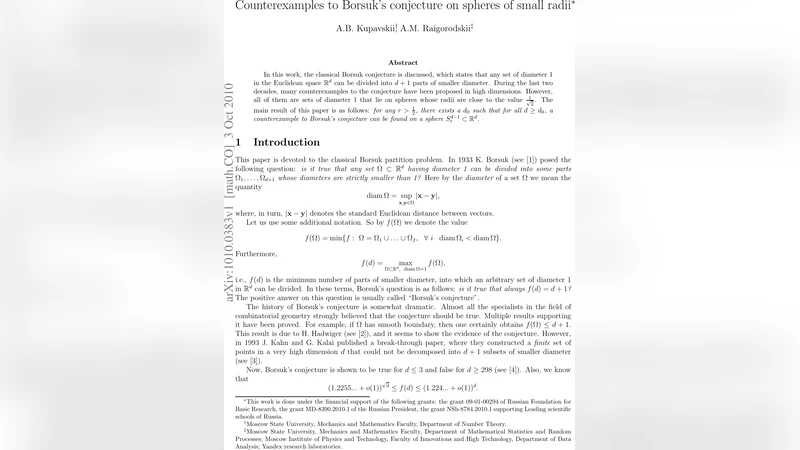
In this work, the classical Borsuk conjecture is discussed, which states that any set of diameter 1 in the Euclidean space $ {\mathbb R}^d $ can be divided into $ d+1 $ parts of smaller diameter. During the last two decades, many counterexamples to the conjecture have been proposed in high dimensions. However, all of them are sets of diameter 1 that lie on spheres whose radii are close to the value $ {1}{\sqrt{2}} $. The main result of this paper is as follows: {\it for any $ r > {1}{2} $, there exists a $ d_0 $ such that for all $ d \ge d_0 $, a counterexample to Borsuk’s conjecture can be found on a sphere $ S_r^{d-1} \subset {\mathbb R}^d $.
💡 Research Summary
The paper revisits the classical Borsuk conjecture, which asserts that any subset of Euclidean space ℝⁿ with diameter 1 can be partitioned into n + 1 subsets each of smaller diameter. While the conjecture was disproved in high dimensions by Kahn and Kalai and subsequent works, all known counterexamples have been constructed on spheres whose radii are very close to the critical value 1/√2. The authors ask whether this restriction on the sphere’s radius is essential, and they answer it in the negative. Their main theorem states that for every radius r > ½ there exists a dimension threshold d₀(r) such that for all d ≥ d₀(r) one can find a set X ⊂ S_r^{d‑1} (the (d‑1)-dimensional sphere of radius r) with diameter 1 that cannot be covered by d + 1 subsets of smaller diameter. In other words, Borsuk’s conjecture fails on spheres of any radius strictly larger than one half, provided the ambient dimension is large enough.
The proof proceeds in two stages. First, the authors use combinatorial constructions based on error‑correcting codes (e.g., Hadamard, BCH, or Latin‑cube type codes). Each codeword is mapped to a point on S_r^{d‑1} by a linear scaling that sends the binary vector to a vector whose coordinates are ±r/√n. This mapping preserves the Hamming distance in the sense that the Euclidean inner product between two mapped points is proportional to n − 2·dist_Hamming. Because the codes have a large minimum distance, the inner products become sufficiently small, guaranteeing that the Euclidean distance between any two distinct points is at least 1. The key geometric identity used is
Comments & Academic Discussion
Loading comments...
Leave a Comment