Learning Interesting Categorical Attributes for Refined Data Exploration
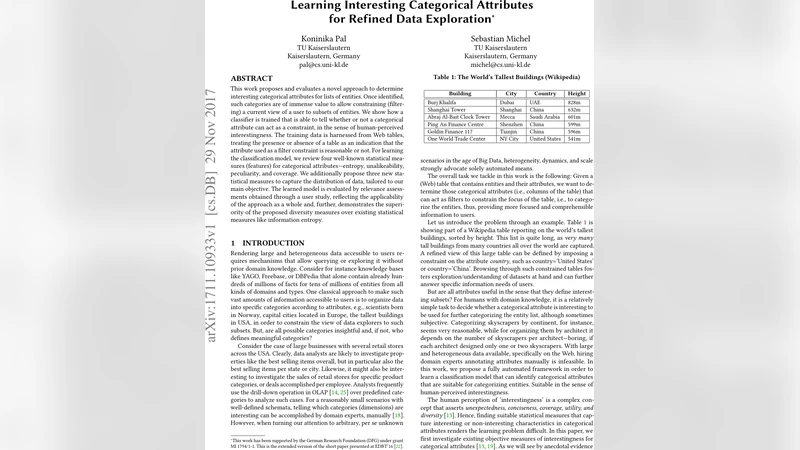
This work proposes and evaluates a novel approach to determine interesting categorical attributes for lists of entities. Once identified, such categories are of immense value to allow constraining (filtering) a current view of a user to subsets of entities. We show how a classifier is trained that is able to tell whether or not a categorical attribute can act as a constraint, in the sense of human-perceived interestingness. The training data is harnessed from Web tables, treating the presence or absence of a table as an indication that the attribute used as a filter constraint is reasonable or not. For learning the classification model, we review four well-known statistical measures (features) for categorical attributes—entropy, unalikeability, peculiarity, and coverage. We additionally propose three new statistical measures to capture the distribution of data, tailored to our main objective. The learned model is evaluated by relevance assessments obtained through a user study, reflecting the applicability of the approach as a whole and, further, demonstrates the superiority of the proposed diversity measures over existing statistical measures like information entropy.
💡 Research Summary
The paper tackles the problem of automatically identifying categorical attributes that are perceived by humans as useful “filters” for refining a list of entities. In large, heterogeneous data collections such as Wikipedia tables, DBpedia, or corporate knowledge bases, the sheer number of possible categorical columns (e.g., country, city, architect) makes manual selection infeasible. The authors propose a fully automated pipeline that (1) extracts training instances from Web tables without any human labeling, (2) designs a set of statistical features that capture the notion of “interestingness,” and (3) trains a binary classifier to predict whether a given attribute is suitable for categorizing the entities of a table.
Automated Training Data Generation
The core hypothesis (Hypothesis 1) states that if at least one table exists that is created by imposing a constraint on a categorical attribute of a parent table, then that attribute is “interesting.” For example, the Wikipedia table “World’s Tallest Buildings” contains a column country. A second table titled “List of Tallest Buildings in the United States” is interpreted as a child table derived by applying the constraint country = United States to the parent. The presence of such a parent‑child pair automatically yields a positive training example; the absence yields a negative one. The algorithm proceeds in two passes over the corpus: the first builds a map from constraint values (extracted from table titles or captions) to the entity classes they constrain; the second scans each table’s columns, matches column values against the map, and assigns labels accordingly. Numeric columns are ignored, leaving only categorical attributes for learning.
Statistical Feature Set
Seven features are computed for each (entity class, categorical attribute) pair:
- Entropy – Shannon entropy of the value frequency distribution, measuring overall uncertainty.
- Unalikeability – Proportion of distinct value pairs, reflecting heterogeneity.
- Peculiarity – Degree to which a value deviates from the average frequency.
- Coverage – Fraction of entities that possess a non‑null value for the attribute.
The authors argue that these four, while widely used, fail to capture certain human‑centric aspects such as the presence of both dominant and rare values. Therefore they introduce three novel measures:
- P‑Diversity – A normalized diversity score that rewards distributions where both high‑frequency and low‑frequency values coexist, thereby capturing “variety” that humans often find interesting.
- P‑Peculiarity – An extension of peculiarity that applies a logarithmic scaling, sharply increasing the score for extremely rare values, which are often the most informative in exploratory analysis.
- Max‑Info‑Gap – The information‑theoretic gap between the most frequent value and the second most frequent one. A large gap indicates a dominant category that may make the attribute less useful for nuanced filtering.
All features are derived directly from the frequency counts of the attribute’s value set, with appropriate normalizations and log transformations to keep scales comparable.
Learning Model
The feature vectors are fed into a ν‑Support Vector Machine (ν‑SVM). ν‑SVM is chosen because it handles class imbalance (the number of “interesting” attributes is typically far smaller than “non‑interesting”) and provides a controllable trade‑off between margin width and training error via the ν parameter. The authors perform grid search over kernel type (linear vs. RBF) and hyper‑parameters (C, γ) using 10‑fold cross‑validation on the automatically generated dataset.
Evaluation
Two complementary evaluations are presented:
-
Intrinsic Evaluation – On the automatically labeled dataset (several thousand tables, tens of thousands of attribute instances), the ν‑SVM achieves an accuracy of ~87 % and an F1‑score of ~84 %, demonstrating that the feature set is discriminative even without human supervision.
-
User Study – A separate experiment with 30 participants asks them to judge the usefulness of various attribute‑table pairs as filters. Participants’ binary relevance judgments are compared against the classifier’s predictions. The overall correlation (Pearson ≈ 0.71) significantly exceeds that of a baseline model using only entropy and coverage (≈ 0.58). Notably, attributes with high P‑Diversity and P‑Peculiarity scores are most frequently labeled “interesting” by users, confirming the intuition behind the new measures.
Error analysis reveals that the Max‑Info‑Gap feature tends to penalize attributes where a single value dominates (e.g., a column where 90 % of rows share the same entry). This aligns with user feedback that overly skewed filters are less valuable, but also suggests that a more nuanced weighting of this feature could improve performance on borderline cases.
Contributions and Impact
The paper makes three primary contributions:
- A label‑free data acquisition strategy that leverages the existence (or lack) of constraint‑specific tables on the Web to generate training data at scale.
- Three novel statistical measures (P‑Diversity, P‑Peculiarity, Max‑Info‑Gap) that better align with human notions of interestingness than traditional entropy‑based metrics.
- A comprehensive empirical validation combining automated metrics and a human‑centered user study, showing that the learned model reliably predicts attributes that users would choose as meaningful filters.
These contributions are directly applicable to a range of data‑exploration tools: OLAP drill‑down interfaces, automated dashboard generation, and recommendation systems for query refinement. By automatically surfacing “interesting” categorical dimensions, the approach reduces the cognitive load on analysts and enables more focused, interpretable data slicing.
Limitations and Future Work
The methodology depends on the quality and consistency of Web table metadata; noisy titles or missing captions can lead to incorrect label assignments. The current implementation focuses on Wikipedia; extending to other corpora (e.g., corporate data warehouses, scientific repositories) will require domain‑specific parsing of constraints. The authors suggest several avenues for improvement: integrating multiple evidence sources (search engine snippets, click logs) to boost labeling confidence, employing reinforcement learning to incorporate user feedback over time, and combining categorical features with textual descriptions or association rules for richer filter suggestions.
Conclusion
In summary, the authors present a robust, scalable framework for learning which categorical attributes are “interesting” for data refinement. By automatically harvesting training examples from the Web, introducing diversity‑focused statistical features, and validating the model with real users, the work bridges the gap between statistical signal and human perception. This advances the state of the art in automated data exploration and paves the way for smarter, user‑centric analytics interfaces.
Comments & Academic Discussion
Loading comments...
Leave a Comment