Deep Clustering and Conventional Networks for Music Separation: Stronger Together
Deep clustering is the first method to handle general audio separation scenarios with multiple sources of the same type and an arbitrary number of sources, performing impressively in speaker-independent speech separation tasks. However, little is kno…
Authors: Yi Luo, Zhuo Chen, John R. Hershey
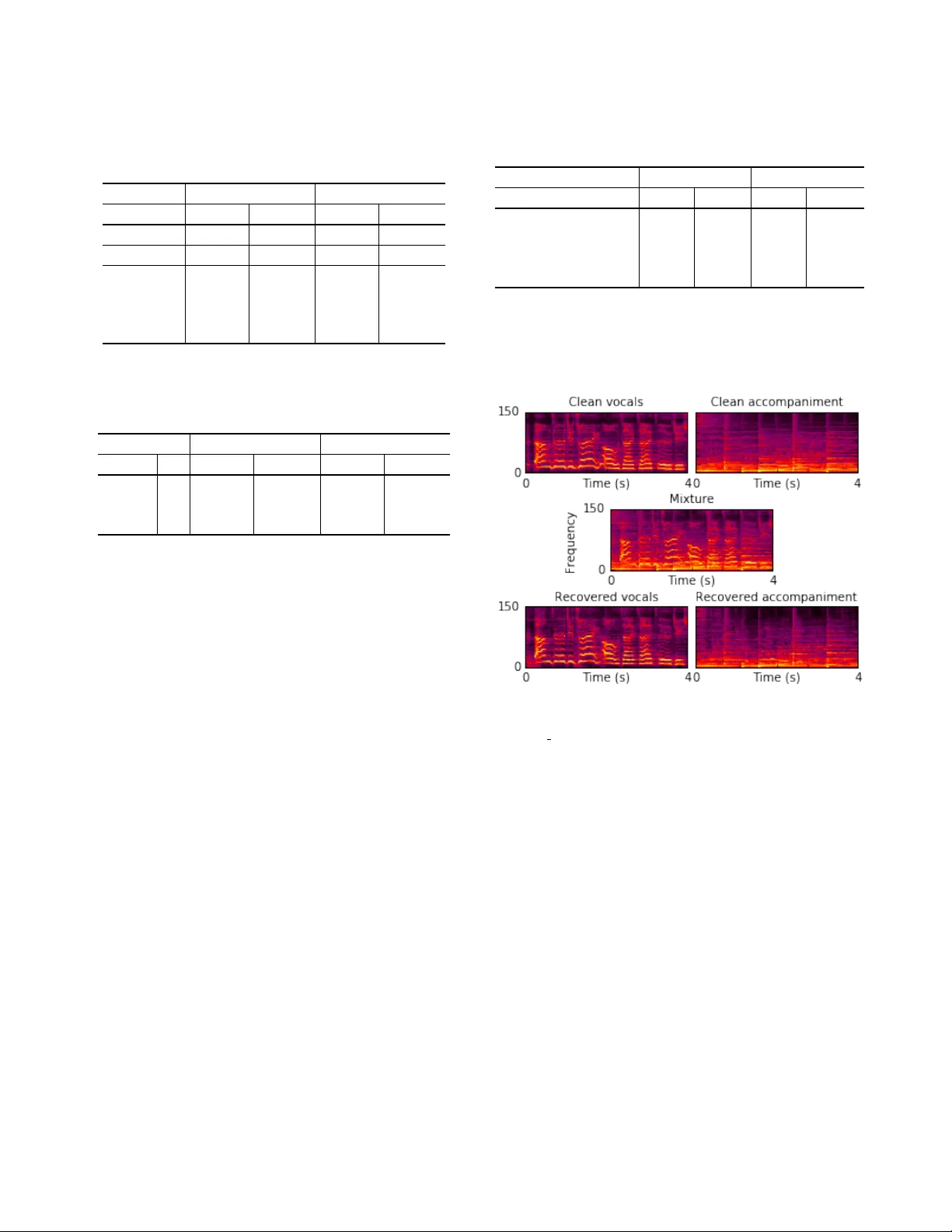
DEEP CLUSTERING AND CONVENTIONAL NETW ORKS FOR MUSIC SEP ARA TION: STR ONGER TOGETHER Y i Luo † Zhuo Chen † J ohn R. Hershe y ‡ J onathan Le Roux ‡ Nima Mesgarani † † Department of Electrical Engineering, Columbia Uni versity , New Y ork, NY ‡ Mitsubishi Electric Research Laboratories (MERL), Cambridge, MA ABSTRA CT Deep clustering is the first method to handle general audio separa- tion scenarios with multiple sources of the same type and an arbitrary number of sources, performing impressi vely in speaker-independent speech separation tasks. Howe ver , little is known about its effec- tiv eness in other challenging situations such as music source sep- aration. Contrary to con ventional networks that directly estimate the source signals, deep clustering generates an embedding for each time-frequency bin, and separates sources by clustering the bins in the embedding space. W e show that deep clustering outperforms con ventional networks on a singing voice separation task, in both matched and mismatched conditions, e ven though conv entional net- works ha ve the advantage of end-to-end training for best signal ap- proximation, presumably because its more flexible objective engen- ders better regularization. Since the strengths of deep clustering and con ventional network architectures appear complementary , we ex- plore combining them in a single hybrid network trained via an ap- proach akin to multi-task learning. Remarkably , the combination significantly outperforms either of its components. Index T erms — Deep clustering, Singing voice separation, Mu- sic separation, Deep learning 1. INTR ODUCTION Monaural music source separation has been the focus of many re- search efforts for over a decade. This task aims at separating a music recording into se veral tracks where each track corresponds to a single instrument. A related goal is to design algorithms that can separate vocals and accompaniment, where all the instruments are considered as one source. Music source separation algorithms have been suc- cessfully used for predominant pitch tracking [1], accompaniment generation for Karaoke systems [2], or singer identification [3]. Despite these advances, a system that can successfully general- ize to dif ferent music datasets has thus far remained unachiev able, due to the tremendous variability of music recordings, for e xample in terms of genre or types of instruments used. Unsupervised meth- ods, such as those based on computational auditory scene analysis (CASA) [4], source/filter modeling [5], or low-rank and sparse mod- eling [6], ha ve dif ficulty in capturing the dynamics of the vocals and instruments, while supervised methods, such as those based on non- negati ve matrix factorization (NMF) [7], F0-based estimation [8], or Bayesian modeling [9], suffer from generalization and processing speed issues. Recently , deep learning has found many successful applications in audio source separation. Con ventional re gression-based networks try to infer the source signals directly , often by inferring time- frequency (T -F) masks to be applied to the T -F representation of the mixture so as to recover the original sources. These mask-inference networks have been shown to produce superior results compared to the traditional approaches in singing voice separation [10]. These networks are a natural choice when the sources can be characterized as belonging to distinct classes. Another promising approach designed for more general situa- tions is the so-called deep clustering framew ork [11]. Deep cluster- ing has been applied very successfully to the task of single-channel speaker -independent speech separation [11]. Because it uses of pair- wise affinities as separation criterion, deep clustering can handle mixtures with multiple sources from the same type, and an arbitrary number of sources. Such difficult conditions are endemic to music separation. In this study , we explore the use of both deep clustering and con ventional mask-inference networks to separate the singing voice from the accompaniment, grouping all the instruments as one source and the vocals as another . The singing voice separation task that we consider here is amenable to class based separation, and would not seem to require the extra flexibility in terms of source types and number of sources that deep clustering would provide. Howe ver , in addition to opening up the potential to apply to more general settings, the additional flexibility of deep clustering may have some benefits in terms of re gularization. Whereas con ventional mask-inference ap- proaches only focus on increasing the separation between sources, the deep clustering objecti ve also reduces within-source variance in the internal representation, which could be beneficial for general- ization. In recent work it has been shown that forcing deep net- work acti vations to cluster well can improve the resulting test per- formance [12]. T o in vestig ate these potential benefits, we dev elop a two-headed “Chimera” network with both a deep clustering head and a mask-inference head attached to the same network body . Each head has its own objective, but the whole hybrid network is trained in a joint fashion akin to multi-task training. Our findings show that the addition of the deep clustering criterion greatly improv es upon the performance of the mask-inference network. 2. MODEL DESCRIPTION 2.1. Deep clustering Deep clustering operates according to the assumption that the T -F representation of the mixed signal can be partitioned into multiple sets, depending on which source is dominant (i.e., its power is the largest among all sources) in a giv en bin. A deep clustering net- work takes features of the acoustic signal as input, and assigns a D -dimensional embedding to each T -F bin. The network is trained to encourage the embeddings of T -F bins dominated by the same source to be similar to each other, and the embeddings of T -F bins dominated by different sources to be dif ferent. Note that the concept of “source” shall be defined according to the task at hand: for ex- ample, one speaker per source for speaker separation, all vocals in one source v ersus all other instruments in another source for singing voice separation, etc. A T -F mask for separating each source can then be estimated by clustering the T -F embeddings [13]. The training target is deriv ed from a label indicator matrix Y ∈ R T F × C , where T denotes the number of frames, F the feature di- mension, and C the number of sources in the input mixture x , such that Y i,j = 1 if T -F bin i = ( t, f ) is dominated by source j , and Y i,j = 0 otherwise. W e can construct a binary affinity matrix A = YY T , which represents the assignment of the sources in a per - mutation independent way: A i,j = 1 if i and j are dominated by the same source, and A i,j = 0 if they are not. The network estimates an embedding matrix V ∈ R T F × D , where D is the embedding dimen- sion. The corresponding estimated affinity matrix is then defined as ˆ A = VV T . The cost function for the network is L DC = || ˆ A − A || 2 F = || VV T − YY T || 2 F . (1) Although the matrices A and ˆ A are typically very large, their low- rank structure can be exploited to decrease the computational com- plexity [11]. At test time, a clustering algorithm such as K-means is applied to the embeddings V to generate a cluster assignment matrix, which is used as a binary T -F mask applied to the mixture to estimate the T -F representation of each source. 2.2. Multi-task learning and Chimera networks Whereas the deep clustering objectiv e function has been shown to enable the training of neural networks for challenging source separation problems, a disadvantage of deep clustering is that the post-clustering process needed to generate the mask and recover the sources is not part of the original objectiv e function. On the other hand, for mask-inference networks, the objectiv e function minimized during training is directly related to the signal recovery quality . W e seek to combine the benefits of both approaches in a strategy reminiscent of multi-task learning, except that here both approaches address the same separation task. In [11] and [13], the typical structure of a deep clustering net- work is to have multiple stacked recurrent layers (e.g., BLSTMs) yielding an N -dimensional vector at the top layer, followed by a fully-connected linear layer . For each frame t , this layer outputs a D -dimensional vector for each of the F frequencies, resulting in a F × D representation Z t . T o form the embeddings, Z then passes through a tanh non-linearity , and unit-length normalization inde- pendently for each T -F bin. Concatenating across time results in the T F × D embedding matrix V as used in Eq. 1. W e extend this architecture in order to create a two-headed net- work, which we refer as “Chimera” network, with one head out- putting embeddings as in a deep clustering network, and the other head outputting a soft mask, as in a mask-inference network. The new mask-inference head is obtained starting with Z , and passing it through F fully-connected D × C mask estimation layers (e.g., softmax), one for each frequency , resulting in C masks M ( c ) , one for each source. The structure of the Chimera network is illustrated in Figure 1. The body of the network, up to the layer outputting Z , can be trained with each head separately . For the deep clustering head, we use the objective L DC . For the mask-inference head, we can use a classical magnitude spectrum approximation (MSA) objectiv e [6, Fig. 1 . Structure of the Chimera network. 14, 15], defined as: L MSA = X c || R ( c ) − M ( c ) S || 2 2 , (2) where R ( c ) denotes the magnitude of the T -F representation for the c -th clean source and S that of the mixture. Although this objec- tiv e function makes sense intuitiv ely , one ca veat is that the mixture magnitude S may be smaller than that of a given source R ( c ) due to destructiv e interference. In this case, M ( c ) , which is between 0 and 1 , cannot bring the estimate close to R ( c ) . As a remedy , we consider an alternati ve objecti ve, denoted as masked magnitude spectrum ap- proximation (mMSA), which approximates R ( c ) as the output of a masking operation on the mixture using a reference mask O ( c ) , such that O ( c ) S ≈ R ( c ) , for source c : L mMSA = X c || ( O ( c ) − M ( c ) ) S || 2 2 . (3) Note that this is equi valent to a weighted mask approximation objec- tiv e, using the mixture magnitude as the weights. W e can also define a global objective for the whole netw ork as L CHI = α L DC T F + (1 − α ) L MI (4) where α ∈ [0 , 1] controls the importance between the two objec- tiv es, and the objecti ve L MI for the mask inference head is either L MSA or L mMSA . Note that here we divide L DC by T F because the objectiv e for deep clustering calculates the pair-wise loss for each of the ( T F ) 2 pairs of T -F bins, while the spectrum approximation objectiv e calculates end-to-end loss on the T F time-frequency bins. For α = 1 , only the deep clustering head gets trained together with the body , resulting in a deep clustering network. For α = 0 , only the mask-inference head gets trained together with the body , resulting in a mask-inference network. At test time, if both heads ha ve been trained, either can be used. The mask-inference head directly outputs the T -F masks, while the deep clustering head outputs embeddings on which we perform clus- tering using, e.g., K-means. 3. EV ALU A TION AND DISCUSSION 3.1. Datasets For training and ev aluation purposes, we built a remixed version of the DSD100 dataset for SiSEC [16], which we refer to as DSD100- remix. For evaluation only , we also report results on two other datasets: the hidden iKala dataset for the MIREX submission, and the public iKala dataset for our newly proposed models. The DSD100 dataset includes synthesized mixtures and the cor - responding original sources from 100 professionally produced and mixed songs. T o build the training and validation sets of DSD100- remix, we use the DSD100 de velopment set (50 songs). W e design a simple energy-le vel-based detector [17] to remove silent parts in both the vocal and accompaniment tracks, so that the vocals and ac- companiment fully o verlap in the generated mixtures. After that, we downsample the tracks from 44.1 kHz to 16 kHz to reduce compu- tational cost, and then randomly mix the v ocals and accompaniment together at 0 dB SNR, creating a 15 h training set and a 0.5 h val- idation set. W e build the evaluation set of DSD100-remix from the DSD100 test set using a similar procedure, generating 50 pieces (one for each song) of fully-overlapped recordings with 30 seconds length each. The input feature we use is calculated by the short-time Fourier transform (STFT) with 512-point window size and 128-point hop size. W e use a 150-dimension mel-filterbank to reduce the input fea- ture dimension. First-order delta of the mel-filterbank spectrogram is concatenated into the input feature. W e used the ideal binary mask calculated on the mel-filterbank spectrogram as the target Y matrix. 3.2. System architectur e The Chimera network’ s body is comprised of 4 bi-directional long- short term memory (BLSTM) layers with 500 hidden units in each layer , followed by a linear fully-connected layer with a D -dimension vector output for each of the frame’ s F = 150 T -F bins. Here, we use D = 20 because it produced the best performance in a speech separation task [11]. In the mask-inference head, we set C = 2 for the singing voice separation task, and use softmax as the non- linearity . W e use the rmsprop algorithm [18] as optimizer and select the network with the lo west loss on the validation set. At test time, we split the signal into fixed-length segments, on which we run the network independently . W e also tried running the network on the full input feature sequence, as in [11], but this lead to worse performance, probably due to the mismatch in context size between the training and test time. The mask-inference head of the network directly generates T -F masks. For deep clustering, the masks are obtained by applying K-means on the embeddings for the whole signal. W e apply the mask for each source to the mel- filterbank spectrogram of the input, and recov er the source using an in verse mel-filterbank transform and in verse-STFT with the mixture phase, followed by upsampling. 3.3. Results f or the MIREX submission W e first report on the system submitted to the Singing V oice Sepa- ration task of the Music Information Retrie val Ev aluation eXchange T able 1 . Evaluation metrics for different systems in MIREX 2014- 2016 on the hidden iKala dataset. V denotes vocals and M music. GNSDR GSIR GSAR V M V M V M DC 6.3 11.2 14.5 25.2 10.1 7.3 MC2 [19] 5.3 9.7 10.5 19.8 11.2 6.1 MC3 [19] 5.5 9.8 10.8 19.6 11.2 6.3 FJ1 [1] 6.8 10.1 13.3 11.2 11.5 10.0 FJ2 [1] 6.3 9.9 13.7 11.7 10.6 9.1 IIY1 [23] 4.2 7.8 15.5 12.4 7.7 5.4 IIY2 [23] 4.5 7.9 13.3 14.3 8.6 5.0 (MIREX 2016) [19]. That system only contains the deep cluster- ing part, which corresponds to α = 1 in the hybrid system. In the MIREX system, dropout layers with probability 0 . 2 were added be- tween each feed-forward connection, and sequence-wise batch nor- malization [20] w as applied in the input-to-hidden transformation in each BLSTM layer . Similarly to [13], we also applied a curriculum learning strategy [21], where we first train the network on segments of 100 frames, then train on se gments of 500 frames. As distinguish- ing between vocals and accompaniment w as part of the task, we used a crude rule-based approach: the mask whose total number of non- zero entries in the low frequency range ( < 200 Hz) is more than a half is used as the accompaniment mask, and the other as the vocals mask. The hidden iKala dataset has been used as the ev aluation dataset throughout MIREX 2014-2016, so we can report, as shown in T a- ble 1, the results from the past three years, comparing the best two systems in each year’ s competition to our submitted system for 2016. The official MIREX results are reported in terms of global normal- ized SDR (GNSDR), global SIR (GSIR), global SAR (GSAR) [22]. Due to time limitations at the time of the MIREX submission, we submitted a system that we had trained using the DSD100-remix dataset described in Section 3.1. Ho wev er , as mentioned in the MIREX description, the DSD100 dataset is different from both the hidden and public parts of the iKala dataset [22]. Nonetheless, our system not only won the 1st place in MIREX 2016 but also outper- formed the best systems from past years, ev en without training on the better-matched public iKala dataset, showing the efficacy of deep clustering for robust music separation. Note that the hidden iKala dataset is unavailable to the public, and it is thus unfortunately im- possible to e valuate here what the performance of our system would be when trained on the public iKala data. 3.4. Results f or the proposed hybrid system W e now turn to the results using the Chimera networks. During the training phase, we use 100 frames of input features to form fixed duration segments. W e train the Chimera network in three dif ferent regimes: a pure deep clustering regime (DC, α = 1 ), a pure mask- inference regime (MI, α = 0 ), and a hybrid regime (CHI α , 0 < α < 1 ). All networks are trained from random initialization, and no training tricks mentioned above for the MIREX system are added. W e report results on the DSD100-remix test set, which is matched to the training data, and the public iKala dataset, which is not. By design, deep clustering provides one output for each source, and the sequence of the separation result is random. Therefore, the scores are computed by using the best permutation between ref- T able 2 . SDRi (dB) on the DSD100-remix and the public iKala datasets. The suf fix after CHI α denotes which head of the Chimera network is used for generating the masks. DSD100-remix iKala V M V M DC 4.9 7.2 6.1 10.0 MI 4.8 6.7 5.2 8.9 CHI 0 . 1 -DC 4.8 7.2 6.0 9.7 CHI 0 . 1 -MI 5.5 7.8 6.4 10.5 CHI 0 . 5 -DC 4.7 7.1 5.9 9.9 CHI 0 . 5 -MI 5.5 7.8 6.3 10.5 T able 3 . SDRi (dB) on the DSD100-remix and the public iKala datasets with various objectives in the MI head and embedding di- mensions D . DSD100-remix iKala L MI D V M V M MSA 20 5.5 7.8 6.4 10.5 mMSA 20 5.4 7.8 6.5 10.7 mMSA 10 5.5 7.9 6.6 10.8 erences and estimates at the file level. T able 2 shows the results with the MSA objecti ve in the MI head. W e compute the source-to- distortion ratio (SDR), defined as scale-in variant SNR [13], for each test example, and report the length-weighted av erage ov er each test set of the impro vement of SDR in the estimate with respect to that in the mixture (SDRi). As can be seen in the results, MI performs competitiv ely with DC on DSD100-remix, howe ver DC performs significantly better on the public iKala data. This shows the better generalization and robustness of the deep clustering method in cases where the test and training set are not matched. The best performance is achiev ed by CHI α -MI, the MI head of the Chimera network. Interestingly , the performance of the DC head does not change significantly for the values of α tested. This suggests that joint training with the deep clustering objecti ve allows the body of the network to learn a more powerful representation than using the mask-inference objec- tiv e alone; this representation is then best exploited by the mask- inference head thanks to its signal approximation objectiv e. W e now look at the influence of the objective used in the MI head. For the mMSA objecti ve, we use the W iener like mask [15] since it is shown to hav e best performance among oracle masks com- puted from source magnitudes. As shown in T able 3, training a hybrid CHI 0 . 1 network using the mMSA objective leads to slightly better MI performance ov erall compared to MSA. W e also consider varying the embedding dimension D , and find that reducing it from D = 20 to D = 10 leads to further improvements. Because the output of the linear layer Z t has dimension F × D , decreasing D also leav es room to increase the number of frequency bins F . T able 4 shows the results for various input features. W e design various features by v arying the sampling rate, the window/hop size in the STFT , and the dimension of the mel-frequency filterbanks. All networks are trained in the same hybrid regime as abov e, with the mMSA objecti ve in the MI head and an embedding dimension D = 10 . For simplicity , we do not concatenate first-order deltas into T able 4 . SDRi (dB) on the DSD100-remix and the public iKala datasets with various input features. DSD100-remix iKala V M V M 16k-1024-256-mel150 5.5 7.9 6.6 10.6 16k-1024-256-mel200 5.5 7.9 6.9 10.9 22k-1024-256-mel200 5.9 7.9 7.2 10.7 22k-2048-512-mel300 6.1 8.1 7.4 11.0 the input feature. W e can learn from the results that higher sampling rate, larger STFT window size STFT , and more mel-frequency bins result in better performance. Fig. 2 . Example of separation results for a 4-second excerpt from file 45378 chorus in the public iKala dataset. 4. CONCLUSION In this paper, we inv estigated the ef fectiv eness of a deep clustering model on the task of singing voice separation. Although deep clus- tering was originally designed for separating speech mixtures, we showed that this framework is also suitable for separating sources in music signals. Moreover , by jointly optimizing deep clustering with a classical mask-inference network, the new hybrid network outperformed both the plain deep clustering network and the mask- inference netw ork. Experimental results confirmed the robustness of the hybrid approach in mismatched conditions. Audio examples are a vailable at [24]. 5. A CKNO WLEDGEMENT The work of Y i Luo, Zhuo Chen, and Nima Mesgarani was funded by a grant from the National Institute of Health, NIDCD, DC014279, National Science Foundation CAREER A ward, and the Pew Chari- table T rusts. 6. REFERENCES [1] Zhe-Cheng F an, Jyh-Shing Roger Jang, and Chung-Li Lu, “Singing voice separation and pitch extraction from monau- ral polyphonic audio music via DNN and adaptive pitch track- ing, ” in Proc. IEEE International Conference on Multimedia Big Data (BigMM) . IEEE, 2016, pp. 178–185. [2] Hideyuki T achibana, Y u Mizuno, Nobutaka Ono, and Shigeki Sagayama, “ A real-time audio-to-audio karaoke generation system for monaural recordings based on singing voice sup- pression and key conv ersion techniques, ” J ournal of Informa- tion Pr ocessing , vol. 24, no. 3, pp. 470–482, 2016. [3] Adam L. Berenzweig, Daniel P .W . Ellis, and Steve Lawrence, “Using voice segments to improve artist classification of mu- sic, ” in Pr oc. AES 22nd International Conference: V irtual, Synthetic, and Entertainment Audio . Audio Engineering Soci- ety , 2002. [4] Y ipeng Li and DeLiang W ang, “Separation of singing voice from music accompaniment for monaural recordings, ” IEEE T ransactions on Audio, Speech, and Language Processing , vol. 15, no. 4, pp. 1475–1487, 2007. [5] Jean-Louis Durrieu, Ga ¨ el Richard, Bertrand David, and C ´ edric F ´ evotte, “Source/filter model for unsupervised main melody extraction from polyphonic audio signals, ” IEEE T ransactions on Audio, Speech, and Language Pr ocessing , v ol. 18, no. 3, pp. 564–575, 2010. [6] Po-Sen Huang, Scott Deeann Chen, P aris Smaragdis, and Mark Hasega wa-Johnson, “Singing-voice separation from monau- ral recordings using robust principal component analysis, ” in Pr oc. ICASSP , 2012, pp. 57–60. [7] Pablo Sprechmann, Alexander M Bronstein, and Guillermo Sapiro, “Real-time online singing voice separation from monaural recordings using robust low-rank modeling, ” in IS- MIR , 2012, pp. 67–72. [8] Chao-Ling Hsu and Jyh-Shing Roger Jang, “On the improve- ment of singing voice separation for monaural recordings using the MIR-1K dataset, ” IEEE T ransactions on Audio, Speech, and Language Pr ocessing , vol. 18, no. 2, pp. 310–319, 2010. [9] Po-Kai Y ang, Chung-Chien Hsu, and Jen-Tzung Chien, “Bayesian singing-voice separation, ” in Pr oc. ISMIR , 2014, pp. 507–512. [10] Po-Sen Huang, Minje Kim, Mark Hasegawa-Johnson, and Paris Smaragdis, “Singing-voice separation from monaural recordings using deep recurrent neural networks, ” in Proc. IS- MIR , 2014, pp. 477–482. [11] John R. Hershey , Zhuo Chen, Jonathan Le Roux, and Shinji W atanabe, “Deep clustering: Discriminati ve embeddings for segmentation and separation, ” in Proc. ICASSP , 2016, pp. 31– 35. [12] Renjie Liao, Alex Schwing, Richard Zemel, and Raquel Ur- tasun, “Learning deep parsimonious representations, ” in Ad- vances in Neural Information Pr ocessing Systems , 2016, pp. 5076–5084. [13] Y usuf Isik, Jonathan Le Roux, Zhuo Chen, Shinji W atanabe, and John R. Hershey , “Single-channel multi-speaker separa- tion using deep clustering, ” in Proc. Interspeech , 2016. [14] Felix W eninger , Jonathan Le Roux, John R. Hershey , and Bj ¨ orn Schuller , “Discriminati vely trained recurrent neural networks for single-channel speech separation, ” in Pr oc. IEEE Glob- alSIP 2014 Symposium on Machine Learning Applications in Speech Pr ocessing , Dec. 2014. [15] Hakan Erdogan, John R. Hershey , Shinji W atanabe, and Jonathan Le Roux, “Phase-sensitive and recognition-boosted speech separation using deep recurrent neural networks, ” in Pr oc. ICASSP , 2015, pp. 708–712. [16] “SiSEC 2016 Professionally produced music record- ings task, ” https://sisec.inria.fr/home/ 2016- professionally- produced- music- recordings/ , accessed: 2016-09-11. [17] Ja vier Ramirez, Juan Manuel G ´ orriz, and Jos ´ e Carlos Segura, V oice activity detection. fundamentals and speech recognition system r obustness , INTECH Open Access Publisher, 2007. [18] T ijmen Tieleman and Geoffre y Hinton, “Lecture 6.5-rmsprop: Divide the gradient by a running a verage of its recent magni- tude, ” COURSERA: Neural Networks for Machine Learning , vol. 4, no. 2, 2012. [19] “MIREX 2016: Singing Voice Separation Results, ” http://www.music- ir.org/mirex/wiki/2016: Singing_Voice_Separation_Results , accessed: 2016-09-11. [20] C ´ esar Laurent, Gabriel Pereyra, Phil ´ emon Brakel, Y ing Zhang, and Y oshua Bengio, “Batch normalized recurrent neural net- works, ” arXiv pr eprint arXiv:1510.01378 , 2015. [21] Y oshua Bengio, J ´ er ˆ ome Louradour , Ronan Collobert, and Ja- son W eston, “Curriculum learning, ” in Proc. ICML , 2009, pp. 41–48. [22] “MIREX 2016: Singing Voice Separation Task, ” http://www.music- ir.org/mirex/wiki/2016: Singing_Voice_Separation , accessed: 2016-09-11. [23] Y ukara Ikemiya, Katsutoshi Itoyama, and Kazuyoshi Y oshii, “Singing voice separation and vocal f0 estimation based on mutual combination of robust principal component analysis and subharmonic summation, ” arXiv preprint arXiv:1604.00192 , 2016. [24] “ Audio examples for chimera network, ” http://naplab. ee.columbia.edu/ivs.html .
Original Paper
Loading high-quality paper...
Comments & Academic Discussion
Loading comments...
Leave a Comment