Social Media, Money, and Politics: Campaign Finance in the 2016 US Congressional Cycle
With social media penetration deepening among both citizens and political figures, there is a pressing need to understand whether and how political use of major platforms is electorally influential. Particularly, the literature focused on campaign usage is thin and often describe the engagement strategies of politicians or attempt to quantify the impact of social media engagement on political learning, participation, or voting. Few have considered implications for campaign fundraising despite its recognized importance in American politics. This paper is the first to quantify a financial payoff for social media campaigning. Drawing on candidate-level data from Facebook and Twitter, Google Trends, Wikipedia page views, and Federal Election Commission (FEC) donation records, we analyze the relationship between the topic and volume of social media content and campaign funds received by all 108 candidates in the 2016 US Senate general elections. By applying an unsupervised learning approach to identify themes in candidate content across the platforms, we find that more frequent posting overall and of issue-related content are associated with higher donation income when controlling for incumbency, state population, and information-seeking about a candidate, though campaigning-related content has a stronger effect than the latter when the number rather than value of donations is considered.
💡 Research Summary
This paper provides the first systematic quantification of how social‑media activity translates into campaign‑finance outcomes in a U.S. federal election. Using the complete set of candidates (N = 108) who ran in the 2016 Senate general elections, the authors merge four distinct data streams: (1) every public post made by each candidate on Facebook and Twitter, (2) Google Trends search volume for the candidate’s name, (3) Wikipedia page‑view counts for the candidate, and (4) Federal Election Commission (FEC) donation records that detail both the number of contributions and the total dollar amount received.
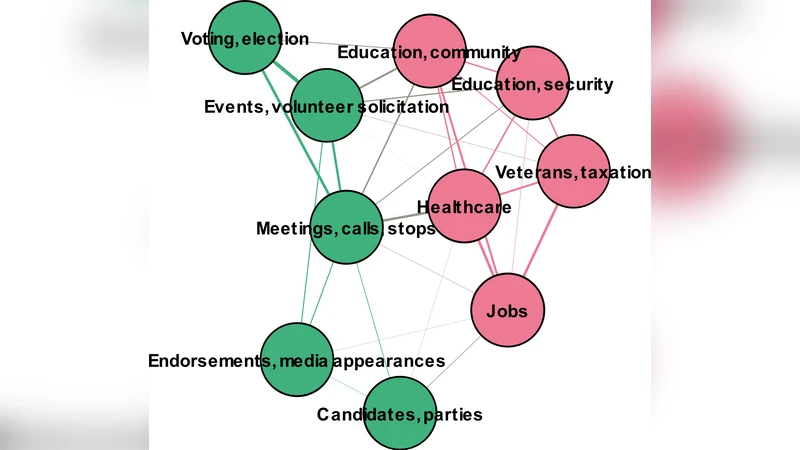
The methodological core consists of an unsupervised text‑analysis pipeline. After standard preprocessing (tokenization, stop‑word removal, lemmatization), the authors apply Latent Dirichlet Allocation (LDA) to the combined corpus of Facebook and Twitter posts. The resulting topics are manually labeled and collapsed into three interpretable categories: (a) issue‑related content (policy discussions, social‑justice topics, etc.), (b) campaign‑related content (calls for votes, fundraising appeals, event announcements), and (c) general engagement content (thank‑you notes, personal anecdotes). For each candidate the authors compute (i) total post volume, (ii) the proportion of posts in each category, and (iii) engagement metrics (likes, retweets, comments).
To assess the financial payoff, the study estimates two separate regression models. Model 1 predicts total donation dollars, while Model 2 predicts the count of individual contributions (using a negative‑binomial specification to accommodate over‑dispersion). Independent variables include the three social‑media measures described above, incumbency status, state population (as a proxy for potential donor pool size), and the two information‑seeking controls (Google Trends and Wikipedia views). All variables are logged where appropriate, and the authors introduce one‑month lags of the social‑media measures to mitigate reverse causality. Robustness checks include fixed‑effects for state, alternative topic‑model specifications, and exclusion of outlier candidates with exceptionally high fundraising totals.
Key findings are as follows:
-
Overall posting frequency matters. A 10 % increase in total posts is associated with roughly a 3 % rise in total donation dollars and a 5 % increase in the number of contributions, holding all else constant.
-
Issue‑related content drives monetary value. The share of issue‑related posts has a statistically significant positive coefficient in the donation‑amount model; candidates who devote a larger fraction of their messaging to policy topics raise more money per donor, suggesting that substantive discourse builds credibility and attracts higher‑value contributors.
-
Campaign‑related content fuels donor breadth. The proportion of campaign‑related posts is the strongest predictor of contribution count. This indicates that direct appeals, event promotion, and explicit fundraising calls are effective at mobilizing a larger base of small donors.
-
General engagement posts show no measurable financial impact. Posts that are primarily personal or gratitude‑focused do not significantly affect either outcome, implying that “soft” engagement may be valuable for other goals (e.g., voter turnout) but not for fundraising.
-
Incumbency remains a dominant factor. Incumbent senators raise substantially more money and attract more donors than challengers, even after controlling for social‑media activity, confirming the entrenched advantage of office‑holding.
-
Information‑seeking variables have limited financial relevance. While higher Google Trends and Wikipedia view counts modestly increase the number of donors, they do not translate into larger donation totals, suggesting that basic name recognition is insufficient for high‑value fundraising without strategic content.
The authors acknowledge several limitations. The analysis is confined to a single election cycle and to two major platforms; results may differ in other cycles, for House races, or on emerging platforms such as Instagram or TikTok. Causal inference, while strengthened by lagged variables, cannot fully rule out omitted‑variable bias (e.g., offline campaign events). Moreover, the study treats all donations equally, without distinguishing between individual, PAC, or corporate contributions, which could exhibit distinct media sensitivities.
Despite these caveats, the paper offers clear practical implications. Campaign managers should calibrate their social‑media strategy: allocate a substantial share of posts to substantive issue discussion to attract higher‑value donors, while maintaining a steady stream of direct campaign appeals to broaden the donor base. The findings also suggest that simply increasing posting volume without attention to content mix yields diminishing returns. Future research avenues include extending the framework to other election types, incorporating additional platforms, and linking social‑media metrics to donor demographics to uncover more granular mechanisms.
In sum, the study convincingly demonstrates that the content and frequency of a candidate’s social‑media output are not merely ancillary communication tools; they constitute a measurable source of campaign finance, complementing traditional fundraising channels and reshaping the financial dynamics of modern American elections.
Comments & Academic Discussion
Loading comments...
Leave a Comment