Strong-pinning regimes by spherical inclusions in anisotropic type-II superconductors
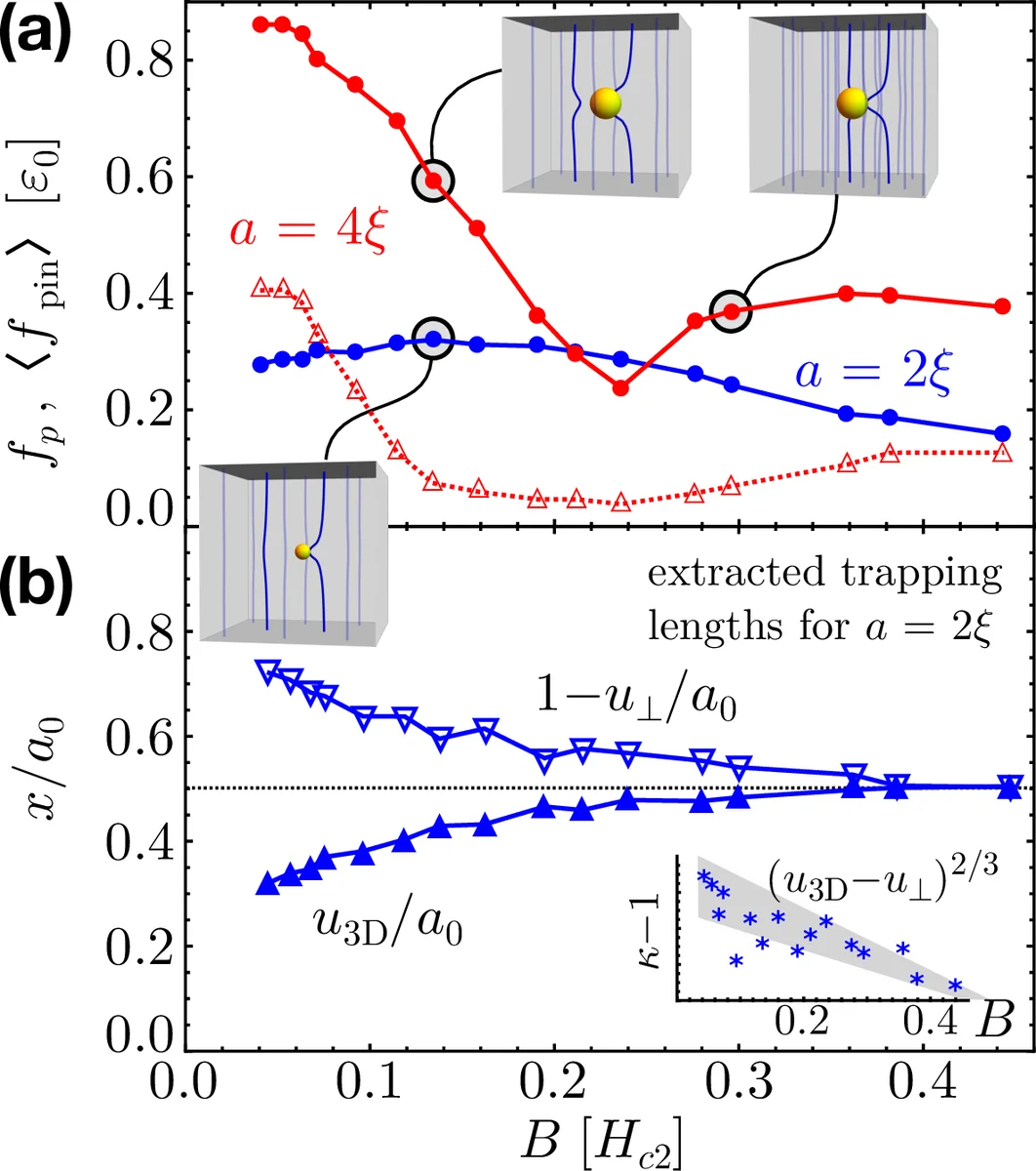
The current-carrying capacity of type-II superconductors is decisively determined by how well material defect structures can immobilize vortex lines. In order to gain deeper insights into the fundamental pinning mechanisms, we have explored the case of vortex trapping by randomly distributed spherical inclusions using large-scale simulations of the time-dependent Ginzburg-Landau equations. We find that for a small density of particles having diameters of two coherence lengths, the vortex lattice preserves its structure and the critical current $j_c$ decays with the magnetic field following a power-law $B^{-\alpha}$ with $\alpha \approx 0.66$, which is consistent with predictions of strong-pinning theory. For a higher density of particles and/or larger inclusions, the lattice becomes progressively more disordered and the exponent smoothly decreases down to $\alpha \approx 0.3$. At high magnetic fields, all inclusions capture a vortex and the critical current decays faster than $B^{-1}$ as would be expected by theory. In the case of larger inclusions with a diameter of four coherence length, the magnetic-field dependence of the critical current is strongly affected by the ability of inclusions to capture multiple vortex lines. We found that at small densities, the fraction of inclusions trapping two vortex lines rapidly grows within narrow field range leading to a peak in $j_c(B)$-dependence within this range. With increasing inclusion density, this peak transforms into a plateau, which then smooths out. Using the insights gained from simulations, we determine the limits of applicability of strong-pinning theory and provide different routes to describe vortex pinning beyond those bounds.
💡 Research Summary
This paper investigates how randomly distributed spherical inclusions pin vortex lines in anisotropic type‑II superconductors, using large‑scale time‑dependent Ginzburg‑Landau (TDGL) simulations. The authors focus on two inclusion sizes—diameters of 2 ξ and 4 ξ (where ξ is the coherence length)—and vary the inclusion volume fraction over several orders of magnitude. By measuring the critical current density j_c as a function of magnetic field B, they compare the numerical results with the predictions of strong‑pinning theory, which distinguishes a low‑field 1D regime (isolated vortices), a moderate‑field 3D regime (vortex lattice weakly deformed by pins), and a high‑field full‑occupation regime (every pin captures a vortex).
For small inclusions (2 ξ) at low density, the vortex lattice remains essentially ordered. The simulated j_c follows a power‑law decay j_c ∝ B^‑α with α ≈ 0.66, in excellent agreement with the 3D strong‑pinning prediction (α≈2/3). As the inclusion density or size increases, the lattice becomes progressively disordered, the exponent smoothly drops to α ≈ 0.3, and the system approaches the regime where pin‑pin interactions (“close‑pair” corrections) become important. At high fields, all pins are occupied and j_c decays faster than B⁻¹, confirming the theoretical expectation for the full‑occupation regime.
Large inclusions (4 ξ) exhibit qualitatively new behavior. At low densities, a narrow field interval triggers a rapid increase of the fraction of pins that trap two vortex lines. This “double‑occupancy” transition produces a pronounced peak in the j_c(B) curve. When the inclusion density is raised, the peak broadens into a plateau and eventually smooths out as multiple pins become doubly occupied over a wide field range. Consequently, the high‑field decay of j_c becomes steeper (exponent > 1), reflecting the breakdown of the standard strong‑pinning assumption that each pin captures at most one vortex.
The authors use the simulations to extract microscopic parameters such as the pin‑breaking force f_p, the transverse trapping length u_⊥, and the effective elastic constant \bar C. They show that in the low‑density, small‑inclusion limit these quantities satisfy the analytical relations of both 1D and 3D strong‑pinning theory. To account for deviations at higher densities and larger inclusions, they introduce corrections: (i) a “close‑pair” correction that modifies the effective trapping area when pins are closer than the intervortex spacing, and (ii) a “multiple‑occupancy” extension that rescales the trapping area by a factor (1 + β ⟨k⟩), where ⟨k⟩ is the average number of vortices per pin and β quantifies the additional capture efficiency. These extensions reproduce the observed evolution of the exponent α and the emergence of peaks/plateaus in j_c(B).
The paper delineates the boundaries of applicability of traditional strong‑pinning theory in a phase diagram spanned by magnetic field, pin density, and pin strength. It demonstrates that while the theory works quantitatively for dilute, small pins, it must be supplemented by pin‑pin interaction corrections and multiple‑occupancy models for realistic pin landscapes encountered in modern high‑temperature superconductors (e.g., RE‑BCO coated conductors with self‑assembled nanoparticles or irradiation‑induced clusters).
From an engineering perspective, the results provide concrete guidelines: to achieve a predictable, monotonic j_c(B) one should keep inclusion diameters ≤ 2 ξ and volume fractions ≤ 10⁻⁴. If a field‑specific enhancement of j_c is desired, larger inclusions at modest densities can be employed to generate a peak or plateau near the target field, exploiting the double‑occupancy effect. The study thus bridges the gap between microscopic vortex physics and the “critical‑current‑by‑design” paradigm, offering a pathway to optimize pinning landscapes for next‑generation superconducting wires and tapes.
Comments & Academic Discussion
Loading comments...
Leave a Comment