Symmetries and the fundamental forces of Nature
Lecture script of a one-semester course that aims to develop an understanding and appreciation of fundemental concepts in modern physics for students who are comfortable with calculus. This document contains the first six lessons that will walk you through the special theory of relativity.
💡 Research Summary
The manuscript “Symmetries and the Fundamental Forces of Nature” is a lecture script intended for a one‑semester undergraduate course that introduces modern physics concepts, beginning with classical symmetry principles and culminating in special relativity. The first six lessons, of which the first two and the opening of a third are presented in the excerpt, follow a pedagogical progression from Galilean invariance to the principle of least time for light.
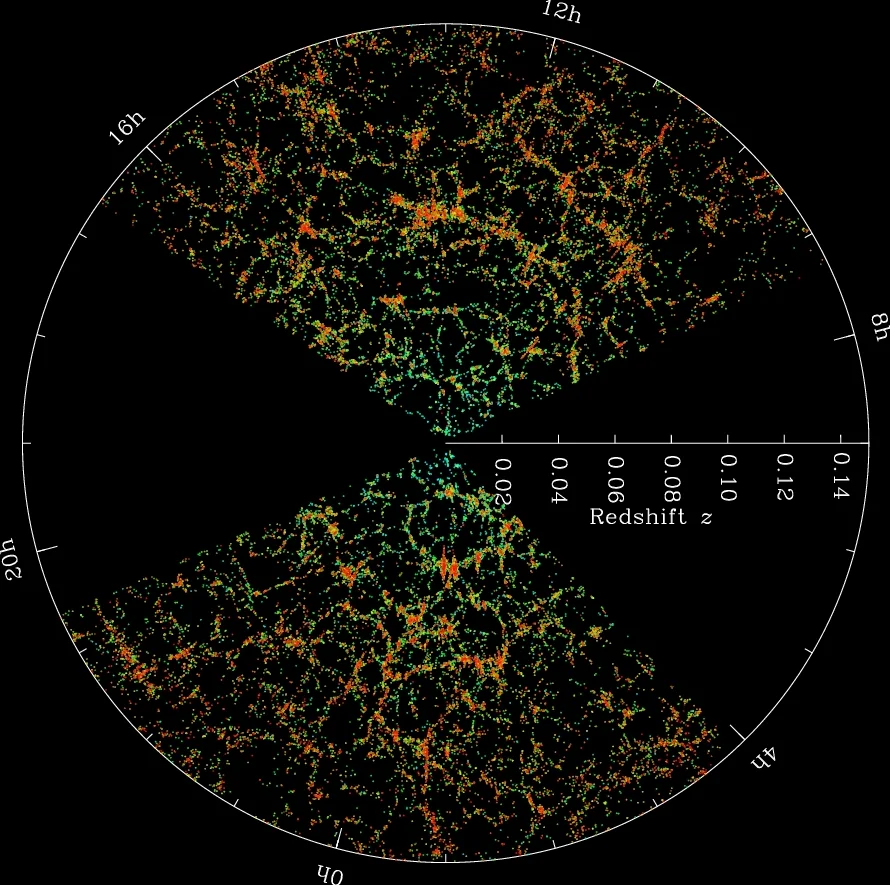
Lesson I focuses on Galilean invariance, emphasizing that no experiment can detect an absolute uniform velocity. The author uses everyday analogies—such as a boat leaving a pier—to illustrate the impossibility of measuring an absolute speed and to motivate the idea that all inertial observers must describe physics with the same laws. The discussion then expands to the homogeneity and isotropy of space, linking these abstract symmetries to observational evidence from the Cosmic Microwave Background (CMB) temperature map and large‑scale galaxy surveys. By presenting real astronomical data, the script reinforces that the universe appears uniform and direction‑independent on large scales, thereby grounding the symmetry concepts in empirical facts.
Lesson II introduces spacetime diagrams. Particle positions and times are recorded as (x, t) pairs, and the continuous set of events forms a worldline on an x‑t plane. The slope of the worldline corresponds to the particle’s velocity (dx/dt); stationary particles have vertical lines, while moving particles have lines whose slope is the reciprocal of the speed. The author then derives the Galilean transformation between two inertial frames:
t′ = t, x′ = x − vt, y′ = y, z′ = z
using a concrete scenario involving a tourist on the Ponte di Rialto (the “unprimed” observer) and a gondolier (the “primed” observer). By overlaying the primed coordinate grid on the unprimed spacetime diagram, the script visually demonstrates how the same physical event acquires different coordinates in each frame while the underlying physics remains unchanged. From the transformation, the familiar Galilean velocity‑addition law u′ = u − v is obtained, and several exercises ask students to apply these ideas to real‑world problems (e.g., reconciling magnetic‑north and true‑north surveys, or determining river current speed from a crossing angle).
Lesson III, titled “Principle of Least Time,” begins to shift focus toward optics. It briefly recounts Fermat’s principle that light follows the path of stationary optical time, foreshadowing the role of light in the development of quantum mechanics and relativity. Although the section is incomplete in the excerpt, it signals the upcoming transition from classical Galilean kinematics to the relativistic treatment of light, where the constancy of the speed of light in all inertial frames replaces the absolute time of Galilean physics.
The manuscript intersperses high‑resolution CMB maps and power‑spectrum figures from the Planck mission. While these images illustrate the homogeneity and isotropy arguments, they appear somewhat out of place in a first‑semester introductory text and risk overwhelming students who are still mastering basic coordinate transformations. A more effective approach would be to reserve such advanced cosmological data for a supplemental module or an appendix.
Overall, the script succeeds in building intuition through concrete examples, visual spacetime diagrams, and step‑by‑step derivations. It emphasizes the continuity of physical laws across inertial frames, prepares students for the conceptual leap required by special relativity, and connects abstract symmetry principles to observable cosmological phenomena. Minor issues include typographical errors, inconsistent formatting, and occasional over‑technical insertions that should be edited before publication. With these refinements, the material offers a solid foundation for students transitioning from Newtonian mechanics to the relativistic worldview.
Comments & Academic Discussion
Loading comments...
Leave a Comment