Effect of sodium chloride (NaCl) on the growth of six Acacia species
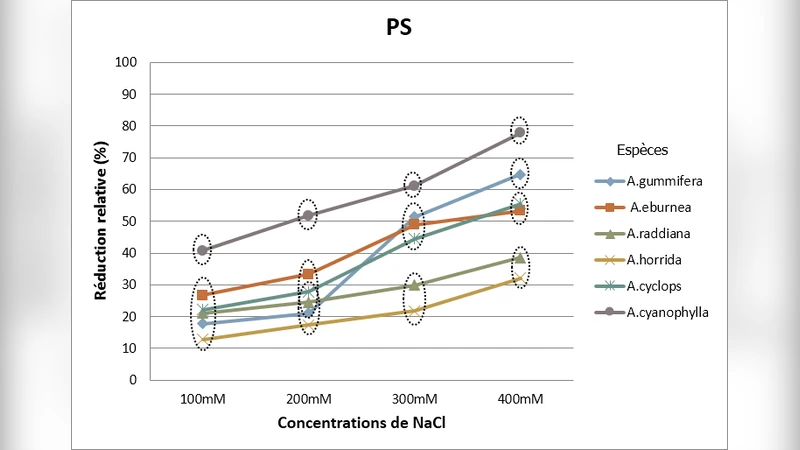
Background: Salinity is one of the major abiotic stresses affecting plant production in arid and semi-arid regions. It causes reduction of cultivable area and combined with other factors, presents a serious threat to food stability in these areas. Context: In front of this problem, the selection of salt tolerant species and varieties remains the best economic approach for exploitation and rehabilitation of salt-affected regions. Objective: The purpose of this study was to assess and compare the seed germination response of six Acacia species under different NaCl concentrations in order to explore opportunities for selection and breeding salt tolerant genotypes. Methods: The salinity effect was examined by measuring some agro-morphological parameters in controlled growth environment using five treatment levels: 0, 100, 200, 300 and 400 mM of NaCl. Results: The analyzed data revealed significant variability in salt response within and between species. All growth parameters were progressively reduced by increased NaCl concentrations. Growth in height, leaf number and total plant dry weight were considered as the most sensitive parameters. However, the growth reduction varied among species in accordance with their tolerance level. It is important to note that all species survived at the highest salinity (400 mM). Whereas A. horrida and A. raddiana were proved to be often the best tolerant, they recorded the lowest reduction percentage at this stage. Conclusion: The genetic variability found in the studied species at seedling stage may be used to select genotypes particularly suitable for rehabilitation and exploitation of lands affected by salinity.
💡 Research Summary
The study addresses the pressing issue of soil salinization in arid and semi‑arid regions by evaluating the salt‑tolerance of six Acacia species at the seedling stage. Seedlings of Acacia horrida, A. raddiana, A. sophora, A. cyanophylla, A. saligna, and A. melanoxylon were grown under controlled greenhouse conditions with five NaCl concentrations: 0, 100, 200, 300, and 400 mM. Four key agro‑morphological traits—shoot height, leaf number, total dry weight, and survival rate—were measured after 28 days. Statistical analysis employed one‑way ANOVA followed by Duncan’s multiple range test, with significance set at p < 0.05.
Results showed a clear, dose‑dependent decline in all measured traits as salinity increased. Height, leaf number, and total dry weight proved to be the most sensitive indicators, exhibiting average reductions of 55 %–70 % at the highest NaCl level. Nevertheless, all species survived even at 400 mM NaCl, indicating a baseline resilience inherent to the genus. Notably, A. horrida and A. raddiana displayed the smallest percentage losses (approximately 15 %–20 %) across all parameters and maintained a 100 % survival rate at 400 mM, marking them as the most tolerant. In contrast, A. sophora and A. cyanophylla suffered the greatest reductions, suggesting lower intrinsic tolerance.
The authors attribute inter‑specific differences to variations in ion‑homeostasis mechanisms, osmotic adjustment capacity, cell‑wall composition, and antioxidant enzyme activity—traits that are often genotype‑specific in Acacia. The observed seedling‑stage tolerance is likely to persist through later growth phases, making the identified tolerant genotypes valuable candidates for breeding programs aimed at salinity‑prone environments.
From an applied perspective, the study proposes that A. horrida and A. raddiana be prioritized for afforestation and land‑reclamation projects on salt‑affected soils, given their ability to maintain growth and survive under extreme salinity. Moreover, the documented genetic variability among the six species provides a rich resource for marker‑assisted selection or gene‑editing approaches to develop elite, salt‑tolerant cultivars.
Limitations include the short experimental duration (four weeks), confinement to greenhouse conditions, and focus solely on early vegetative traits. Consequently, the findings do not directly address long‑term wood production, interactions with soil microbiota, or performance under combined abiotic stresses such as drought and high temperature. Future work should involve field trials, multi‑season monitoring, and integrated stress assessments to validate the utility of these genotypes in real‑world reclamation scenarios.
In summary, this research quantifies species‑specific responses of Acacia seedlings to a wide range of NaCl concentrations, identifies A. horrida and A. raddiana as superior salt‑tolerant candidates, and underscores the potential of leveraging intra‑genus genetic diversity for the development of resilient planting material suited to the rehabilitation of saline lands.
Comments & Academic Discussion
Loading comments...
Leave a Comment