Computational polarimetric microwave imaging
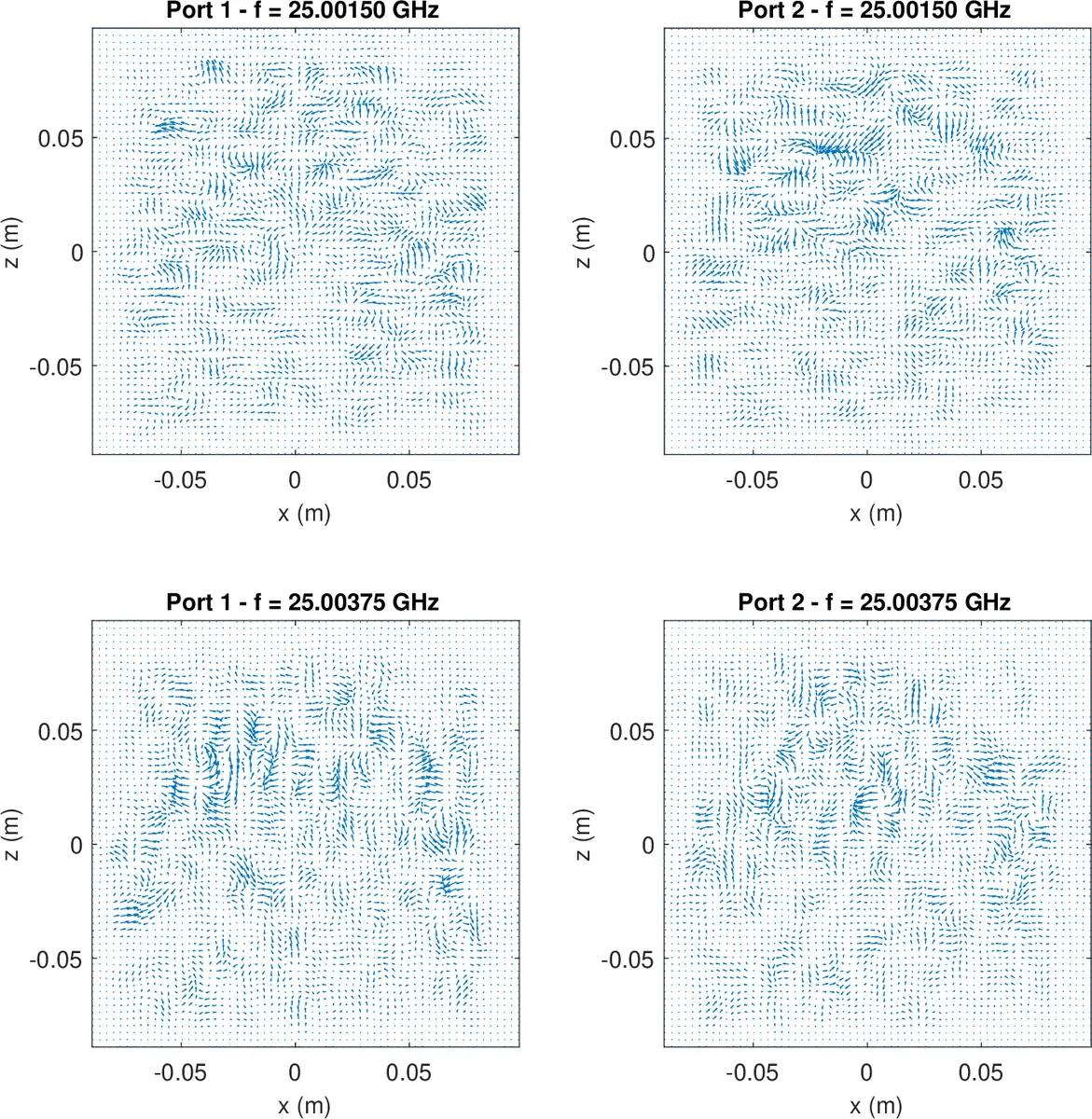
We propose a polarimetric microwave imaging technique that exploits recent advances in computational imaging. We utilize a frequency-diverse cavity-backed metasurface, allowing us to demonstrate high-resolution polarimetric imaging using a single transceiver and frequency sweep over the operational microwave bandwidth. The frequency-diverse metasurface imager greatly simplifies the system architecture compared with active arrays and other conventional microwave imaging approaches. We further develop the theoretical framework for computational polarimetric imaging and validate the approach experimentally using a multi-modal leaky cavity. The scalar approximation for the interaction between the radiated waves and the target—often applied in microwave computational imaging schemes—is thus extended to retrieve the susceptibility tensors, and hence providing additional information about the targets. Computational polarimetry has relevance for existing systems in the field that extract polarimetric imagery, and particular for ground observation. A growing number of short-range microwave imaging applications can also notably benefit from computational polarimetry, particularly for imaging objects that are difficult to reconstruct when assuming scalar estimations.
💡 Research Summary
The paper introduces a novel polarimetric microwave imaging method that leverages recent advances in computational imaging and frequency‑diverse metasurfaces. Traditional microwave computational imagers usually treat the interaction between the radiated field and the target as a scalar quantity, which limits the amount of information that can be extracted about the target’s electromagnetic properties. In contrast, the authors propose a system that encodes full vectorial (polarization) information using a single transceiver and a broadband frequency sweep, thereby simplifying hardware while dramatically increasing the richness of the recovered data.
The core of the approach is a cavity‑backed metasurface that exhibits strong frequency diversity: as the excitation frequency varies, many orthogonal modes are excited within the cavity, each radiating a distinct spatial field distribution. By designing the metasurface to be polarization‑sensitive, the transmitted field can be launched in one linear (or circular) polarization while the received field is measured in another. Consequently, each frequency point provides a measurement of a specific element of the target’s electric susceptibility tensor χ̄(r), which is a 2 × 2 dyadic quantity describing how the target responds to different polarization components.
Mathematically, under the first Born approximation, the measured S‑parameter for a transmit‑receive polarization pair (x, z) at frequency ν is expressed as
Sₓz(r_t, r_r, ν) = ∫ Eₓ(r_t, r, ν) · χ̄(r) · E_z(r_r, r, ν) d³r,
where Eₓ and E_z are the vector fields radiated by the transmit and receive antennas, respectively. This formulation generalizes the scalar model (where χ̄ reduces to a single complex number) and enables the simultaneous reconstruction of all tensor components.
To solve the inverse problem, the authors collect a dense set of frequency‑dependent measurements from a single physical port (the same antenna acts as both transmitter and receiver). The data are fed into a compressed‑sensing reconstruction algorithm that enforces sparsity and physical constraints, yielding three‑dimensional images of each tensor component.
Experimental validation is performed with a multi‑modal leaky cavity operating from 3 GHz to 7 GHz. The cavity is excited through a single feed, and the reflected/scattered fields are recorded for both co‑ and cross‑polarized configurations. Test objects consisting of metallic and dielectric inclusions are imaged. The reconstructed χ̄ maps clearly differentiate metal (high real part, strong anisotropy) from dielectric (lower loss, weaker polarization dependence), demonstrating that the method captures both shape and intrinsic electromagnetic contrast.
The paper’s contributions are threefold: (1) a hardware‑efficient single‑port architecture that still provides full polarimetric information; (2) a theoretical extension from scalar to tensorial susceptibility, allowing richer target characterization; (3) experimental proof‑of‑concept showing that the approach works in realistic microwave bands and can be applied to short‑range scenarios.
Potential applications include ground‑based radar remote sensing (soil, vegetation, snow classification), security screening (distinguishing metal weapons from plastic threats), and biomedical imaging (detecting anisotropic tissue properties). The authors suggest that scaling the concept to millimeter‑wave frequencies, integrating multiple ports, or combining with dynamic holographic metasurfaces could further improve resolution and acquisition speed. In summary, the work establishes computational polarimetric microwave imaging as a powerful, low‑complexity alternative to conventional multi‑antenna polarimetric radars, opening new avenues for high‑information, short‑range electromagnetic sensing.
Comments & Academic Discussion
Loading comments...
Leave a Comment