A new probabilistic shift away from seismic hazard reality in Italy?
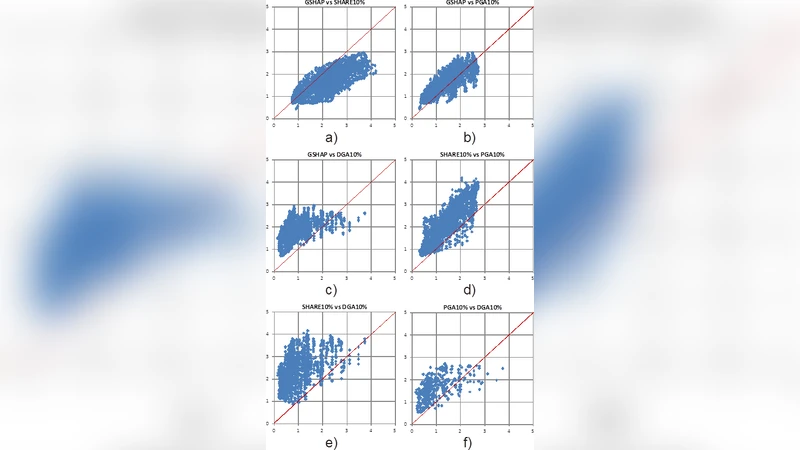
Objective testing is a key issue in the process of revision and improvement of seismic hazard assessments. Therefore we continue the rigorous comparative analysis of past and newly available hazard maps for the territory of Italy against the seismic activity observed in reality. The final Global Seismic Hazard Assessment Program (GSHAP) results and the most recent version of Seismic Hazard Harmonization in Europe (SHARE) project maps, along with the reference hazard maps for the Italian seismic code, all obtained by probabilistic seismic hazard assessment (PSHA), are cross-compared to the three ground shaking maps based on the duly physically and mathematically rooted neo-deterministic approach (NDSHA). These eight hazard maps for Italy are tested against the available data on ground shaking. The results of comparison between predicted macroseismic intensities and those reported for past earthquakes (in the time interval from 1000 to 2014 year) show that models provide rather conservative estimates, which tend to over-estimate seismic hazard at the ground shaking levels below the MCS intensity IX. Only exception is represented by the neo-deterministic maps associated with a fixed return period of 475 or 2475 years, which provide a better fit to observations, at the cost of model consistent 10% or 2% cases of exceedance respectively. In terms of the Kolmogorov-Smirnov goodness of fit criterion, although all of the eight hazard maps differ significantly from the distribution of the observed ground shaking reported in the available Italian databases, the NDSHA approach appears to outscore significantly the PSHA one.
💡 Research Summary
The paper conducts an objective, comparative validation of eight seismic hazard maps for Italy, contrasting three probabilistic seismic hazard assessment (PSHA) products—the final Global Seismic Hazard Assessment Program (GSHAP) results, the most recent Seismic Hazard Harmonization in Europe (SHARE) maps, and the national code‑based PSHA map—with four neo‑deterministic seismic hazard assessment (NDSHA) maps. The NDSHA suite includes maps generated for fixed return periods of 475 years and 2 475 years, as well as versions calibrated to 10 % and 2 % exceedance probabilities, respectively.
The validation dataset comprises macro‑seismic intensity observations (MCS intensities) recorded in Italy from the year 1000 through 2014, extracted from national earthquake catalogs. For each hazard map, the authors compare the predicted intensity distribution with the observed distribution and apply the Kolmogorov‑Smirnov (K‑S) goodness‑of‑fit test to quantify statistical agreement.
Key findings are as follows. First, all PSHA‑based maps tend to be overly conservative at intensity levels below MCS IX; they systematically over‑estimate shaking compared with historic records. This reflects the intrinsic nature of PSHA, which averages over long‑term seismicity rates and therefore inflates the probability of rare, high‑impact events when applied to design‑level return periods. Second, the NDSHA maps provide a markedly better fit to the observed intensities, especially those constructed for the conventional 475‑year return period and the longer 2 475‑year period. Nevertheless, these maps embed explicit exceedance probabilities of 10 % and 2 %, meaning that they predict shaking levels that will be exceeded in 10 % or 2 % of the cases, respectively—an unavoidable trade‑off between realism and design safety. Third, the K‑S test confirms that while none of the eight maps perfectly reproduces the empirical intensity distribution, the NDSHA products achieve significantly lower K‑S statistics than any PSHA counterpart, indicating superior statistical compatibility.
The authors also discuss the implications of return‑period selection. A 475‑year period aligns with many engineering codes but yields mixed results—sometimes under‑predicting, sometimes over‑predicting observed intensities. Extending the period to 2 475 years produces a more conservative hazard estimate but may be impractical for routine design due to the low 2 % exceedance level.
In conclusion, the study provides a rigorous, data‑driven critique of the prevailing PSHA paradigm for Italy, demonstrating that physically based NDSHA approaches can capture the spatial and intensity characteristics of historic shaking more faithfully. However, the authors caution that neither methodology offers a definitive solution; both require careful calibration of return periods and exceedance probabilities to balance safety, economic considerations, and realism. They advocate for future work that integrates probabilistic and deterministic concepts, possibly through hybrid models that retain the physical realism of NDSHA while incorporating the uncertainty quantification inherent in PSHA, thereby advancing toward a more robust seismic hazard assessment framework for Italy and comparable tectonic settings.
Comments & Academic Discussion
Loading comments...
Leave a Comment