Catching the k-NAESAT Threshold
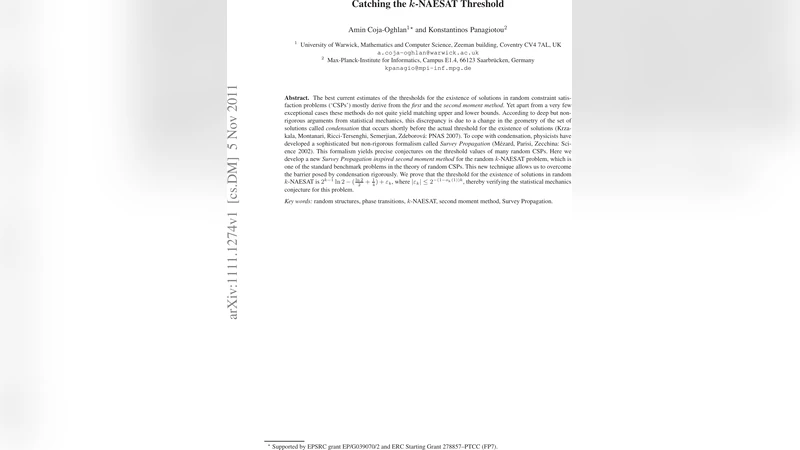
The best current estimates of the thresholds for the existence of solutions in random constraint satisfaction problems (‘CSPs’) mostly derive from the first and the second moment method. Yet apart from a very few exceptional cases these methods do not quite yield matching upper and lower bounds. According to deep but non-rigorous arguments from statistical mechanics, this discrepancy is due to a change in the geometry of the set of solutions called condensation that occurs shortly before the actual threshold for the existence of solutions (Krzakala, Montanari, Ricci-Tersenghi, Semerjian, Zdeborova: PNAS 2007). To cope with condensation, physicists have developed a sophisticated but non-rigorous formalism called Survey Propagation (Mezard, Parisi, Zecchina: Science 2002). This formalism yields precise conjectures on the threshold values of many random CSPs. Here we develop a new Survey Propagation inspired second moment method for the random k-NAESAT problem, which is one of the standard benchmark problems in the theory of random CSPs. This new technique allows us to overcome the barrier posed by condensation rigorously. We prove that the threshold for the existence of solutions in random $k$-NAESAT is $2^{k-1}\ln2-(\frac{\ln2}2+\frac14)+\eps_k$, where $|\eps_k| \le 2^{-(1-o_k(1))k}$, thereby verifying the statistical mechanics conjecture for this problem.
💡 Research Summary
The paper determines the exact satisfiability threshold for random k‑NAE‑SAT, a canonical constraint‑satisfaction problem where each clause must contain at least one true and one false literal. Prior work using the first and second moment methods yielded a gap of about 0.347 between the best known upper bound (≈ 2^{k‑1} ln 2 – ½ ln 2) and lower bound (≈ 2^{k‑1} ln 2 – ln 2). Statistical‑physics insights suggested that this gap is caused by a “condensation” phase: as clause density increases, the solution space fragments into many small clusters and a few giant clusters, breaking the decorrelation assumption required for the classic second‑moment analysis.
To overcome this obstacle, the authors introduce a Survey‑Propagation (SP) inspired second‑moment technique. They first decompose the set of all NAE‑solutions S(Φ) into clusters S₁,…,S_N. Instead of sampling uniformly from S(Φ), they define the SP distribution: pick a cluster uniformly at random, then pick a solution uniformly within that cluster. Under this distribution, two independently drawn solutions belong to different clusters with probability 1 – o(1), restoring the required Hamming distance ≈ n/2 even inside the condensation regime.
The core technical device is a parameter β∈(0,1] that selects clusters of size roughly 2^{βn}. Setting β = ½ reproduces the SP distribution exactly. They define a non‑negative random variable Y_β(Φ) that counts (or is proportional to) the number of β‑clusters. The key is to show that for densities r up to a certain value, E
Comments & Academic Discussion
Loading comments...
Leave a Comment