The maximum theoretical performance of unconcentrated solar photovoltaic and thermoelectric generator systems
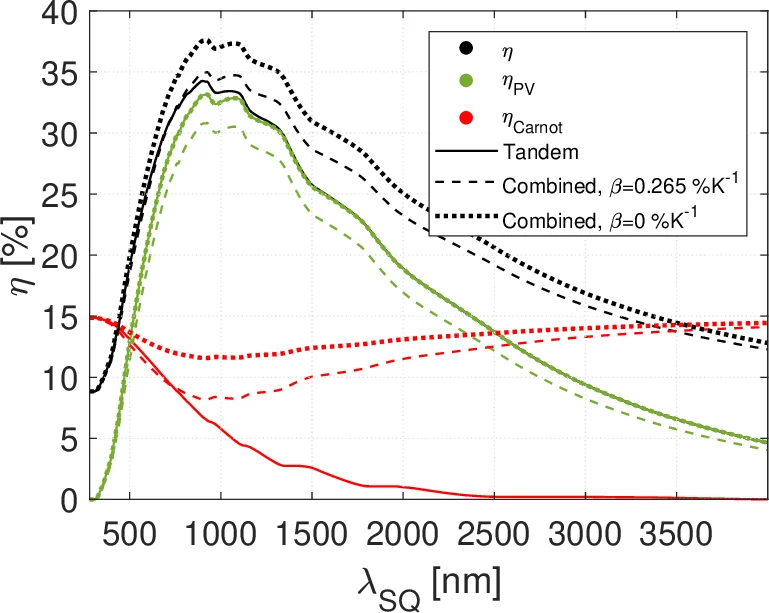
The maximum efficiency for photovoltaic (PV) and thermoelectric generator (TEG) systems without concentration is investigated. Both a combined system where the TEG is mounted directly on the back of the PV and a tandem system where the incoming sunlight is split, and the short wavelength radiation is sent to the PV and the long wavelength to the TEG, are considered. An analytical model based on the Shockley-Queisser efficiency limit for PVs and the TEG figure of merit parameter $zT$ is presented. It is shown that for non-concentrated sunlight, even if the TEG operates at the Carnot efficiency and the PV performance is assumed independent of temperature, the maximum increase in efficiency is 4.5 percentage points (pp.) for the combined case and 1.8 pp. for the tandem case compared to a stand alone PV. For a more realistic case with a temperature dependent PV and a realistic TEG, the gain in performance is much lower. For the combined PV and TEG system it is shown that a minimum $zT$ value is needed in order for the system to be more efficient than a stand alone PV system.
💡 Research Summary
The paper investigates the theoretical upper limits of converting unconcentrated solar radiation into electricity using hybrid systems that combine photovoltaic (PV) cells with thermoelectric generators (TEGs). Two configurations are examined: (i) a “combined” system where the TEG is mounted directly on the rear of the PV, so that the heat generated in the PV is transferred to the TEG; and (ii) a “tandem” system where a wavelength‑selective beam splitter sends short‑wavelength light to the PV and long‑wavelength light to the TEG.
The analysis is built on two well‑established performance models. The PV efficiency is taken from the Shockley‑Queisser (SQ) limit, which provides the maximum conversion efficiency for a single‑junction cell as a function of its band‑gap (expressed as a cutoff wavelength λ_SQ). Temperature dependence of the PV is introduced through a linear coefficient β (typical values 0–0.4 % K⁻¹). The TEG performance is described by the dimensionless figure of merit zT = σS²T/κ, and the corresponding efficiency is given by the standard thermoelectric expression η_TEG = (T_H−T_C)/T_H ·
Comments & Academic Discussion
Loading comments...
Leave a Comment