Location-Aided Coordinated Analog Precoding for Uplink Multi-User Millimeter Wave Systems
Millimeter wave (mmWave) communication is expected to play an important role in next generation cellular networks, aiming to cope with the bandwidth shortage affecting conventional wireless carriers. Using side-information has been proposed as a pote…
Authors: Flavio Maschietti, David Gesbert, Paul de Kerret
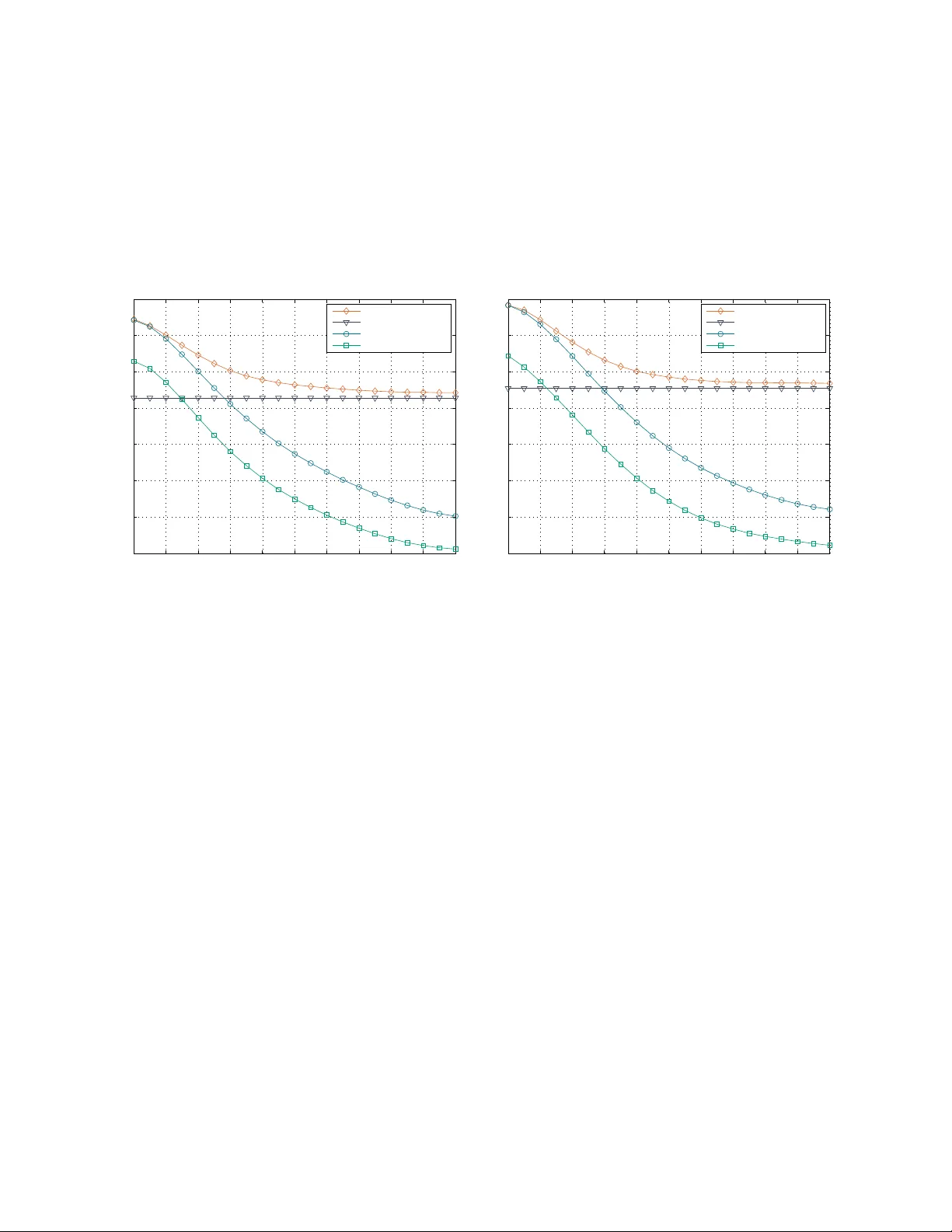
1 Location-Aided Coordinated Analog Precoding for Uplink Multi-User Millimeter W a v e Systems Fla vio Maschietti ‡ , Da vid Gesbert ‡ , P aul de K erret ‡ ‡ Communication Systems Department, EURECOM, Sophia-Antipolis, France Email: { flavio.maschietti, da vid.gesbert, paul.dekerret } @eurecom.fr Abstract Millimeter wav e (mmW av e) communication is expected to hav e an important role in next generation cellular networks, aiming to cope with the bandwidth shortage af fecting con ventional wireless carriers. Using side-information has been proposed as a potential approach to accelerate beam selection in mmW av e massiv e MIMO (m-MIMO) communications. Howe ver , in practice, such information is not error-free, leading to performance degradation. In the multi-user case, a wrong beam choice might result in irreducible inter-user interference at the base station (BS) side. In this paper, we consider location- aided precoder design in a mmW a ve uplink scenario with multiple users (UEs). Assuming the existence of direct de vice-to-device (D2D) links, we propose a decentralized coordination mechanism for robust fast beam selection. The algorithm allows for improved treatment of interference at the BS side and in turn leads to greater spectral efficiencies. I . I N T RO D U C T I O N The large bandwidths av ailable at mmW a ve carrier frequencies are expected to help meet the throughput requirements for future mobile networks [1]. Since smaller wav elength signals are more prone to absorption, mmW a ve communications require beamforming in order to guarantee appropriate link margins and cov erage [2], [3]. T o this end, m-MIMO techniques [4] are en vi- sioned as high-gain directional antennas with small form factor can be designed for mmW av e usage [5]. Ho we ver , configuring those massi ve antennas to operate with lar ge bandwidths entails an additional effort. The high cost and power consumption of the radio components impact on the UEs and small BSs, thus limiting the practical implementation of a fully-digital beamforming architecture [1]. Moreov er , the large number of antennas at both ends of the radio links would require unfeasible CSI-training overhead to design the precoders. 2 One step to wards simplification consists in replacing the fully-digital architecture with a hybrid analog-digital one [6]–[11]. In mixed analog-digital architectures, a lo w-dimensional digital processor is concatenated with an RF analog beamformer , implemented through phase shifters. Note that while the latter is suf ficient to achiev e a good part of the overall beamforming gain – through beam steering to wards desired spatial directions – the digital stage is essential when processing multiple streams and users. Interestingly , existing works on hybrid architectures typically ignore multi-user interference issues in the analog domain and cope with them in the digital part. For instance, in [12], a procedure is proposed for the downlink transmission, where the analog stage is intended to find the best beam directions for each UE (regardless of multi-user interference), while the digital one applies the con ventional Zero-Forcing (ZF) beamformer on the resulting effecti ve channel. The strength of this approach lies in the fact that it is possible to use the existing beam training algorithms for single-user links – such as [13]–[15] – in the analog stage. Such algorithms hav e been de veloped bearing in mind the need for fast link establishment in lo w-latency applications. Ne vertheless, the reduced number of digital chains might not always allow to resolve the residual multi-user interference which remains after the analog beamforming stage. In particular , in a mmW a ve propagation scenario [2], [3], multiple closely located UEs will likely share some common reflectors, causing an alignment of the main path’ s angles of arriv al at the BS receiv er and prev enting it from resolving the interference, ev en at the digital decoding stage. T o solve this problem, a principal idea consists in treating interference before it takes place, i.e. the UE side, as is done for e xample in [16], [17]. Although sho wing significant performance adv antages over the existing solutions, these works assume perfect CSIR for analog beamforming and single-antenna UEs, which might not be realistic in all mmW a ve contexts [12]. Rather , we are interested in statistically-dri ven analog beamforming at the UE TX side. In this paper , we point out that simple analog UE beam selection can be designed so as to enable the analog receiv e beam on the BS side to discriminate for interference. W e propose to do this through the help of low-rate side-information at the UEs. Se veral works can be found in the mmW av e literature, where side-information is exploited to improv e performance without burdening ov erhead. Side-information can be obtained from various sources, such as automotiv e sensors [18], UHF band [19], GNSS [20], or also past multipath fingerprints measurements [21]. W e bring forward the idea that position-based side-information can be exploited in order to de velop a coordination mechanism between the UEs, so that the interference at the BS side can 3 be treated ef ficiently through both the analog and digital parts of the receiv er , as opposed to relying on the digital part alone. The main intuition is to use coordination to make sure the selected analog beams at the BS con ve y the full rank of multi-user channels towards the digital part to preserve in vertibility . As in some previous work [22], we are interested in establishing a r obust form of coordination which accounts for possible noise in the positioning information made av ailable to the UEs. Ho wev er , [22] targets a single-user scenario only . In the multi-user scenario, the lack of a real- time communication channel prev ents the UEs from exchanging instantaneous CSI. W e consider , instead, the existence of a low-rate unidirectional D2D channel, allowing communication of GPS-type data. In particular , we consider a hierarchical set-up where higher ranked UEs receiv e position information from lo wer ranked ones. The unidirectional aspect and the limitation to position information exchange help keep the D2D ov erhead much lo wer than real-time D2D. Our main contributions read as follows: • W e formulate the problem of per-user analog precoding with side position information and recast it as a decentralized beam selection problem. • Our algorithm exploits the hierarchical structure of the information, in order to perform robust (with respect to position data noise) interference mitigation at both analog and digital stages. • Under the proposed method, the UEs coordinate to select beams which, while being sub- optimal in terms of av erage po wer , help attain the full rank condition needed at the BS for interference suppression. I I . S Y S T E M M O D E L Consider the single-cell uplink multi-user mmW av e scenario in Fig. 1. The BS is equipped with N BS 1 antennas to support K UEs with N UE 1 antennas each. The UEs are assumed to reside in a disk of a gi ven radius r cl , which will be used to control inter -UE a verage distance. Each UE sends one data stream to the BS. W e assume that the BS has N RF = K RF chains a vailable, each one connected to all the N BS antennas, assuming a fully-connected hybrid architecture [1]. The u -th UE precodes the data s u ∈ C through the analog precoding vector v u ∈ C N UE × 1 . W e assume that the UEs hav e one RF chain each, i.e. UEs are limited to analog beamforming via phase shifters (constant-magnitude elements) [7]. In addition, E [ k v u s u k 2 ] ≤ 1 , assuming normalized power constraints. 4 The reconstructed signal after mixed analog/digital combining at the BS can be expressed as follo ws – assuming no timing and carrier mismatches: ˆ x = K X u =1 W D W H RF H u v u s u + W D W H RF n (1) where H u ∈ C N BS × N UE is the channel matrix from the u -th UE to the BS and n ∈ C N BS × 1 is the thermal noise vector , with zero mean and cov ariance matrix σ 2 n I N BS . W RF ∈ C N BS × N RF is, instead, the analog combining matrix, containing the vectors relativ e to each of the K RF chains (subject to the same hardware constraints as described abov e), while W D ∈ C K × N RF denotes the digital combining matrix. The receiv ed SINR for the u -th UE at the BS is expressed as follo ws: γ u = | w u D W H RF H u v u | 2 P w 6 = u | w u D W H RF H w v w | 2 + σ 2 ˜ n (2) where w u D ∈ C 1 × N RF denotes the ro w of W D related to the u -th UE (one RF chain for each UE), and where we used the short-hand notation ˜ n = W D W H RF n for the filtered thermal noise. r cl UE 1 UE 2 BS Fig. 1: Scenario example with L = 3 propagation paths, two reflectors, and K = 2 UEs. The UEs are assumed to reside in a disk of radius r cl , which is relati vely common in realistic scenarios, e.g. dense UE distrib ution in a coffee house. In this illustration, two closely located UEs are sharing some reflectors, and paths reflecting on the top reflector arri ve quasi-aligned at the BS while originating from distinct UEs. 5 A. Channel Model Unlike the con ventional UHF band propag ation en vironment, the mmW a ve one does not e xhibit rich-scattering [2] and is in fact modeled as a geometric channel with a limited number of dominant propagation paths which survi ve high attenuation. The UE u is thus subject to the channel matrix H u ∈ C N BS × N UE , expressed as the sum of L components or contributions [7]: H u = N BS N UE 1 / 2 L X ` =1 α u ` a BS ( ϑ u ` ) a H UE ( φ u ` ) (3) where α u ` ∼ C N (0 , ( σ u ` ) 2 ) denotes the comple x gain for the ` -th path of the u -th UE. Furthermore, we assume that the v ariances ( σ u ` ) 2 , ` ∈ { 1 , . . . , L } ; u ∈ { 1 , . . . , K } of the paths are such as P ` ( σ u ` ) 2 = 1 , ∀ u ∈ { 1 , . . . , K } . The v ariables φ u ` ∈ [0 , 2 π ) and ϑ u ` ∈ [0 , 2 π ) are the angles of departure (AoDs) and arri val (AoAs) for each contribution, for a giv en UE u , where one angle pair corresponds to the LoS direction while other might account for the presence of strong reflectors (e.g. buildings, hills) in the en vironment. The positions of those points of reflection depend on the position of the considered UE (see Fig. 1). W e will denote the reflecting points for the u -th UE with R u i , i ∈ { 1 , . . . , L − 1 } in the rest of the paper . The vectors a UE ( φ u ` ) ∈ C N UE × 1 and a BS ( ϑ u ` ) ∈ C N BS × 1 denote the antenna steering vectors at the u -th UE and the BS for the corresponding AoDs φ u ` and AoAs ϑ u ` , respectiv ely . W e assume to use ULAs at both sides, so that [23]: a UE ( φ ) = 1 ( N UE ) 1 / 2 h 1 , e − iπ cos( φ ) , . . . , e − iπ ( N UE − 1) cos( φ ) i T (4) a BS ( ϑ ) = 1 ( N BS ) 1 / 2 h 1 , e − iπ cos( ϑ ) , . . . , e − iπ ( N BS − 1) cos( ϑ ) i T (5) B. Codebooks for Analog Beams The most recognized method to implement the analog beamformer is through a network of digitally-contr olled phase shifters [24] (refer to [1] for alternativ e architectures). Thus, the phase of each element of the analog beamformer is limited to fixed quantized values, and therefore, the beamforming vectors need to be selected from a finite set (or codebook). W e denote the codebooks used for analog beamforming as: V UE = { v 1 , . . . , v M UE } , V BS = { w 1 , . . . , w M BS } (6) where V UE is assumed to be shared between all the UEs, to ease the notation. 6 For ULAs, a suitable design for the fixed beamforming vectors in the codebook consists in selecting steering vectors ov er a discrete grid of angles [12], [14]: v p = a UE ( ¯ φ p ) , p ∈ { 1 , . . . , M UE } (7) w q = a BS ( ¯ ϑ q ) , q ∈ { 1 , . . . , M BS } (8) where the angles ¯ φ p , ∀ p ∈ { 1 , . . . , M UE } and ¯ ϑ q , ∀ q ∈ { 1 , . . . , M BS } can be chosen according to different strategies, including regular and non-regular sampling of the [0 , π ] range [22]. Remark 1 . Giv en the one-to-one correspondence between the beamforming vectors in V BS (resp. V UE ), and the grid angles ¯ ϑ q , ∀ q ∈ { 1 , . . . , M BS } (resp. ¯ φ p , ∀ p ∈ { 1 , . . . , M UE } ), we will make the ab use of notation q ∈ V BS (resp. p ∈ V UE ) to denote the vector w q ∈ V BS (resp. v p ∈ V UE ). I I I . I N F O R M A T I O N M O D E L In this section, we describe the structure of the channel state- and side-information av ailable at both UEs and BS sides. W e start with defining the nature of information in an ideal setting before turning to a realistic (noisy) case. Definition 1. The averag e beam gain matrix G u ∈ R M BS × M UE contains the power level associated with each combined choice of analog beam pair between the BS and the u -th UE after avera ging over small scale fading. It is defined as: G u q ,p = E α u h w H q H u v p 2 i (9) wher e the e xpectation is carried out over the channel coef ficients α u = [ α u 1 , α u 2 , . . . , α u L ] and with G u q ,p denoting the ( q , p ) -element of G u . Definition 2. The position matrix P u ∈ R 2 × ( L +1) contains the two-dimensional location coor- dinates p u n = [ p u n x p u n y ] T for node n , wher e n indif ferently r efers to either the BS, the u -th UE or one of the reflector s R u i , i ∈ { 1 , . . . , L − 1 } . It is defined as follows: P u = h p u BS p u R 1 . . . p u R L − 1 p u UE i (10) W e will denote as P the set containing all the position matrices P u , ∀ u ∈ { 1 , . . . , K } . As shown in [22], the matrix G u can be expressed as a function of the matrix P u . W e recall here the deterministic relationship that is found between those two matrices. 7 Lemma 1. W e can write the averag e beam gain matrix r elative to the u -th UE as follows: G u q ,p ( P u ) = L X ` =1 ( σ u ` ) 2 | L BS (∆ u `,q ) | 2 | L UE (∆ u `,p ) | 2 (11) wher e we r emind the r eader that ( σ u ` ) 2 denotes the variance of the channel coefficients α u ` and we have defined: L UE (∆ u `,p ) = 1 ( N UE ) 1 / 2 e i ( π / 2)∆ u `,p e i ( π / 2) N UE ∆ u `,p sin(( π / 2) N UE ∆ u `,p ) sin(( π / 2)∆ u `,p ) (12) L BS (∆ u `,q ) = 1 ( N BS ) 1 / 2 e i ( π / 2)∆ u `,q e i ( π / 2) N BS ∆ u `,q sin(( π / 2) N BS ∆ u `,q ) sin(( π / 2)∆ u `,q ) (13) and ∆ u `,p = (cos( ¯ φ p ) − cos( φ u ` )) (14) ∆ u `,q = (cos( ϑ u ` ) − cos( ¯ ϑ q )) (15) with the angles φ u ` , ` ∈ { 1 , . . . , L } and ϑ u ` , ` ∈ { 1 , . . . , L } obtained fr om the position matrix P u thr ough simple algebra (r efer to [22] for mor e details). A. Distrib uted Noisy Information Model In the distrib uted model, each UE u recei ves its o wn estimates of the position matrices P w , ∀ w ∈ { 1 , . . . , K } . W e will use the superscript with parenthesis ( u ) to denote any information kno wn at the u -th UE. In particular , we denote as ˆ P w, ( u ) ∈ R 2 × ( L +1) , ∀ w ∈ { 1 , . . . , K } the local information a vailable at the u -th UE about the position matrix P w . This information is modeled as follows: ˆ P w, ( u ) = P w + E w, ( u ) ∀ w ∈ { 1 , . . . , K } (16) where E w, ( u ) denotes the following matrix: E w, ( u ) = h e w, ( u ) BS e w, ( u ) R 1 . . . e w, ( u ) R L − 1 e w, ( u ) UE i (17) containing the random position errors which the u -th UE made in estimating p w n . Such error comes with an arbitrary , yet kno wn, probability density function f e w, ( u ) n . Definition 3. W e will denote as ˆ P ( u ) , wher e: ˆ P ( u ) = { ˆ P 1 , ( u ) , . . . , ˆ P K, ( u ) } (18) the overall local information available at the u -th UE containing all the estimated position matrices ˆ P w, ( u ) , ∀ w ∈ { 1 , . . . , K } . 8 B. Hier ar chical Location-Information Exchange The hierarchical (or nested) model is a sub-case of the distributed model in which the u -th UE has access to the estimates of the UEs u + 1 , . . . , K . As we will see in the next section, this information structure enables some coordination for just half of the overhead needed in a con ventional two-way exchange mechanism. One consequence in particular is that the u -th UE is able to retriev e the beam decisions carried out at (the less informed) UEs u + 1 , . . . , K . C. Additional Information In what follo ws the number of dominant paths, and their a verage po wers ( σ u ` ) 2 , ` ∈ { 1 , . . . , L } ; u ∈ { 1 , . . . , K } are assumed to be known at each UE, based on prior a veraged measurements. Like wise, statistical distributions f e w, ( u ) n , ∀ u, w are supposed to be quasi-static and as such are supposed to be av ailable to each UE. In other words, the u -th UE is aware of the amount of error in the position estimates which it and other UEs hav e to cope with. I V . M U LT I - U S E R L O C A T I O N - A I D E D H Y B R I D P R E C O D I N G In order to maximize the recei ved SNR γ u defined in (2) for each UE, the mutual optimization of both analog and digital components must be taken into account. A common approach consists in decoupling the design, as the analog beamformer can be optimized in terms of long-term chan- nel statistics, whereas the digital one can be made dependent on instantaneous information [25]. A. Uncoor dinated Beam Selection W e first revie w here the approach gi ven in [12], where the authors proposed to design the analog beamformers to maximize the receiv ed power for each UE, neglecting multi-user interference. Once the analog beamformers are fixed at both UE and BS sides, the design of the digital beamformer at the BS follows the con ventional MU-MIMO approach. In this respect, a common choice is to consider ZF combining. Therefore, the digital beamforming matrix W D is the pseudo-in verse of the effecti ve channel matrix ˜ H ∈ C N RF × K , which is defined as follows [23]: W D = ˜ H H ˜ H − 1 ˜ H H (19) where ˜ H = h W H RF H 1 v 1 W H RF H 2 v 2 . . . W H RF H K v K i , and with W RF = h w 1 w 2 . . . w K i . 9 When position and path av erage power information is a vailable, the beam selection ( q un u ∈ V BS , p un u ∈ V UE ) at the analog stage of the algorithm proposed in [12] – which we will denote as uncoor dinated (un) – can be expressed as follows: ( q un u , p un u ) = argmax q u ∈V BS p u ∈V UE R u ˆ P ( u ) , q u , p u , ∀ u (20) where we hav e defined the single-user rate R u as [22]: R u ( P , q u , p u ) = log 2 1 + G u q u ,p u ( P u ) σ 2 n (21) Equation (20) can be solved through direct search of the maximum in the matrix G u , deri ved from ˆ P ( u ) through (11). While being simple to implement, the information at each UE in this method is treated as perfect, although some Bayesian robustization can be introduced [22]. Another limitation of this approach is that each UE solv es its own beam selection problem in a way which is independent of other UEs, thus ignoring the possible impairments in terms of interference. W e illustrate this ef fect in Fig. 2, where we plot the mean rate per UE obtained when the analog precoders are chosen through (20), in case of K = 2 UEs, perfect position information, as a function of r cl . As the inter -UE av erage distance decreases, the performance of this procedure degrades, since the UEs hav e much more chance to share common best propagation paths (which results in se vere interference at the analog stage at the BS). The action of the ZF is noticeable but not sufficient for small cluster radii. In what follows, we consider different flav ors of coordination. B. Naive-Coor dinated Beam Selection In order to improve performance, we design the analog precoders according to the following figure of merit, which takes into account the a verage multi-user interference at the analog stage: R ( P , q 1: K , p 1: K ) = K X u =1 log 2 1 + G u q u ,p u ( P u ) P w G w q u ,p w ( P w ) + σ 2 n (22) Remark 2 . W e used here the short-hand q 1: K , p 1: K to denote the indexes q 1 , . . . , q K and p 1 , . . . , p K , respecti vely . The hierarchical model allo ws the u -th UE to predict the beam selected at UEs u + 1 , . . . , K . Ho wev er , for a full coordination, the u -th UE would also need to know the precoding strate gies of the mor e informed UEs, i.e. UE 1 , . . . , u − 1 , which in volves some guessing [26]. 10 1 3 5 7 9 11 13 15 17 19 21 0 2 4 6 8 10 12 14 Cluster radius [m] Mean rate per user [b/s/Hz] Single−User Hybrid Analog Fig. 2: Mean rate per UE vs Cluster radius. The performance degrades sharply as the inter-UE av erage distance decreases. As a first approximation, the u -th UE can assume that its estimates are perfect (error -free) and global (shared between all the UEs). Since UEs 1 , . . . , u − 1 ha ve in f act dif ferent estimates, and since such information is not error-free, we call this approach naive-coor dinated (nc). The beam index es ( q nc u ∈ V BS , p nc u ∈ V UE ) associated to the u -th UE are then found as follo ws: ( ˜ q 1: u − 1 , q nc u , ˜ p 1: u − 1 , p nc u ) = argmax q 1 ,...,q u ∈V BS p 1 ,...,p u ∈V UE R q o u +1: K ,p o u +1: K ˆ P ( u ) , q 1: u , p 1: u (23) Remark 3 . W e make here an abuse of notation. The subscripts q o u +1: K , p o u +1: K ackno wledge for the kno wn strategies at the u -th UE. Those strategies are fixed parameters of the function R . The same notation will be used in the rest of the paper . Remark 4 . The u -th UE will use the precoding vector associated to the index p nc u ∈ V UE to reach the BS and will discard the remaining beam index es ˜ q 1: u − 1 , ˜ p 1: u − 1 found for the other UEs. Indeed, those indexes only correspond to guesses realized at the u -th UE which do not necessarily correspond to the true beams used for transmission at UEs 1 , . . . , u − 1 . W e hav e introduced the notation ˜ q u to denote such beams. 11 C. Statistically-Coor dinated Beam Selection The naiv e-coordinated approach relies on the correctness of the position estimates a vailable at each UE. As a consequence, its performance is expected to de grade in case of GPS inaccuracies or lost location awareness. As the precision of position estimates decreases, the beam selection is expected to hav e more confidence in long-term statistics alone, to predict the behavior of the UE which are higher ranked in the information chain. In this case, the position estimates are not exploited, and each UE relies on prior statistics to figure out other UEs’ information. W e denote the resulting statistically-coordinated (sc) beam indexes relativ e to the u -th UE as ( q sc u ∈ V BS , p sc u ∈ V UE ) , which read as follows: ( ˜ q 1: u − 1 , q sc u , ˜ p 1: u − 1 , p sc u ) = argmax q 1 ,...,q u ∈V BS p 1 ,...,p u ∈V UE E P | r cl h R q o u +1: K ,p o u +1: K P , q 1: u , p 1: u i (24) This is a long-term optimization which is updated only if prior statistics change. Thus, (24) represents a simple stochastic optimization problem [27] which can be solved through e.g. approximation of the expectation operator (carried out ov er prior statistics) with Monte-Carlo iterations. D. Rob ust-Coor dinated Beam Selection The UEs ha ve also access to the statistics of their local position estimates. In the previous approach, each UE used prior statistics to guess the precoding strategies of the more informed UEs. This helps in case the local information av ailable at the u -th UE is not accurate enough to gain more kno wledge about the UEs 1 , . . . , u − 1 . In the opposite case, local statistical information can be exploited to supplement prior information. In this approach, the UEs look for beam selection strategies which pr ogr essively pass from exploiting local information only – in case of perfect local information – to exploiting statistical information only – in case of poor local information. W e denote this approach as r obust-coor dinated (rc). The beams ( q rc u ∈ V BS , p rc u ∈ V UE ) for the u -th UE are obtained through: ( ˜ q 1: u − 1 , q rc u , ˜ p 1: u − 1 , p rc u ) = argmax q 1 ,...,q u ∈V BS p 1 ,...,p u ∈V UE E P | ˆ P ( u ) ,r cl h R q o u +1: K ,p o u +1: K P , q 1: u , p 1: u i (25) Remark 5 . Here, the u -th UE considers its locally-av ailable position estimates as imperfect and globally -shared. Also in this case, an approximate solution can be obtained through Monte-Carlo methods, generating possible matrices P according to the (known) distrib ution P | ˆ P ( u ) , r cl . 12 W e summarize the proposed robust-coordinated beam selection used at the u -th UE in Al- gorithm 1. In Step 1, the u -th UE retriev es the processing carried out at less informed UEs u + 1 , . . . , K . The K -th UE skips this step. In Step 2, beam selection is performed through (22) (an approximation) and (25). Algorithm 1 f rc : Robust-Coordinated Beam Selection ( u -th UE) INPUT : ˆ P ( w ) , ∀ w ∈ { u, . . . , K } , pdf of ( P | ˆ P ( w ) , r cl ) , ∀ w ∈ { u, . . . , K } Step 1 1: f or w = K : u + 1 do The K -th UE skips this decreasing for loop 2: ( q o w , p o w ) = f rc ( ˆ P ( w ) , q o w +1: K , p o w +1: K ) 3: end for Step 2 4: r eturn ( q rc u , p rc u ) ← Ev aluate (25) Refer to Algorithm 2 for implementation details Algorithm 2 Implementation details for Step 2 in Algorithm 1 ( u -th UE) INPUT : ˆ P ( u ) , pdf of ( P | ˆ P ( u ) , r cl ) , q o u +1 , . . . , q o K , p o u +1 , . . . , p o K 1: f or i = 1 : M do Approximate expectation over ( P | ˆ P ( w ) , r cl ) , ∀ w with M Monte-Carlo iterations 2: Generate possible position matrices P through sampling ov er the distribution ( P | ˆ P ( w ) , r cl ) 3: Compute possible gain matrices ˆ G w , ∀ w ∈ { 1 , . . . , K } through (11) using the generated P 4: S U M R A T E E V A L ( ˆ G 1 , . . . , ˆ G K , q o u +1 , . . . , q o K , p o u +1 , . . . , p o K ) Described in Algorithm 3 5: end for 6: Compute the a verage sum-rate o ver the Monte-Carlo iterations for all possible beam pairs 7: ( q rc u , p rc u ) ← Inde xes relative to the beams achieving maximum av erage sum-rate 8: The pair of vectors with indexes ( q rc u , p rc u ) is assigned to the u -th UE V . S I M U L A T I O N R E S U LT S W e e valuate here the performance of the proposed algorithms. W e consider L = 3 multipath components. A distance of 100 m is assumed from the UEs’ cluster center and the BS. The radius of the UEs’ cluster is set to r cl = 7 m. Both the BS and UEs are equipped with N UE = N BS = 64 antennas (ULA). The number of elements in the beam codebooks is M UE = M BS = 64 , with grid angles spaced according to the in verse cosine function so as to guarantee equal gain losses among adjacent angles [22]. All the plotted rates are the av eraged – ov er 10000 Monte-Carlo runs – rates per UE. 13 Algorithm 3 Function ev aluating an approximated average sum-rate (22) ( u -th UE) 1: function S U M R A T E E V A L ( ˆ G 1 , . . . , ˆ G K , q o u +1 , . . . , q o K , p o u +1 , . . . , p o K ) 2: KnownInds = { q o u +1 , . . . , q o K , p o u +1 , . . . , p o K } 3: f or w = 1 : u − 1 do The most informed UE 1 skips this loop 4: ( q w , . . . , q u , p w , . . . , p u ) = max ˆ G w q w ,p w / ( P v 6 = w ˆ G v q w ,p v + N 0 ) with given Kno wnInds 5: KnownInds = { q w , p w } ∪ KnownInds Updated set of index es to be used in the next iteration 6: Discard all the other index es q w +1 , . . . , q u , p w +1 , . . . , p u 7: end for 8: retur n ˆ G u q u ,p u / ( P w 6 = u ˆ G w q u ,p w + N 0 ) for all possible q u , p u with given Kno wnInds 9: end function A. Location Information Model In the simulations, we adopt a uniform bounded error model for location information [20], [22]. In particular , we assume that all the position estimates lie some where inside disks centered in the actual positions p u n , n ∈ { UE , BS , R u i } ; i ∈ { 1 , . . . , L − 1 } ; u ∈ { 1 , . . . , K } . Let S ( r ) be the two-dimensional closed ball centered at the origin and of radius r , which is S ( r ) = { υ ∈ R 2 : k υ k ≤ r } . W e model the estimation errors e w, ( u ) n as a random v ariable uniformly distributed in S ( r w, ( u ) n ) , where r w, ( u ) n is the maximum positioning error for the node n of the w -th UE as seen from the u -th UE. B. Results and Discussion T o ev aluate the performance, we start with a simple configuration with K = 2 UEs. 1) Str ong LoS: In what follows, we consider a stronger (on av erage) LoS path with respect to the reflected paths, being indeed the prominent propagation dri ver in mmW av e bands [2], [3]. The reflected paths are assumed to ha ve the same a verage po wer . The av erage power of such paths is assumed to be shared across the UEs, i.e. ( σ (1) ` ) 2 , = ( σ (2) ` ) 2 , ∀ ` ∈ { 1 , . . . , L } . In Fig. 3, we consider the performance of the proposed algorithm as a function of the precision of the information av ailable at the less informed UE. In particular , an error radius of 5 m means r w, (2) n = 5 m, ∀ w , n . As for the most informed UE, we consider perfect information in Fig. 3a, i.e. r w, (1) n = 0 m, ∀ w , n , and 3 m of precision in Fig. 3b, i.e. r w, (1) n = 3 m, ∀ w , n . Fig. 3a and Fig. 3b sho w that both the uncoordinated and the naiv e approaches de grade fast as the error radius for the less informed UE increases. This is due to the fact that the UEs build their 14 strategies according to their av ailable position estimates, which become unreliable to perform beam selection. In particular , when the precision is less than 6 m, the statistically-coordinated approach – based on statistical information only – behav es better . The robust-coordinated ap- proach outperforms all the other algorithms, being able to discriminate for interference at the BS side, while taking into account the noise present in position information. 0 2 4 6 8 10 12 14 16 18 20 6 6.5 7 7.5 8 8.5 9 9.5 Pos. information precision for less informed UE [m] Mean rate per UE [b/s/Hz] Robust−Coordinated Stat.−Coordinated Naive−Coordinated Uncoordinated (a) Most informed UE with perfect information 0 2 4 6 8 10 12 14 16 18 20 4.5 5 5.5 6 6.5 7 7.5 8 Pos. information precision for less informed UE [m] Mean rate per UE [b/s/Hz] Robust−Coordinated Stat.−Coordinated Naive−Coordinated Uncoordinated (b) Most informed UE with 3 m precision Fig. 3: Mean rate per UE vs Position information precision. Strong LoS. 2) LoS Bloc kage: It is also interesting to observe ho w the proposed algorithms behav e in case of total line-of-sight blockage, while having one stronger reflected path. Fig. 4 compares the proposed algorithms as a function of the error radius for the less in- formed UE. The most informed UE is assumed to ha ve access to perfect information. The same considerations outlined for the strong LoS case remain valid. It is possible to observe that the uncoordinated approach performs worse than before (with strong LoS), since the UEs choose to use the beams pointing to wards the same stronger reflected path. As a consequence, there is much more chance to arriv e at the BS with non-distinguishable AoAs. In such cases, coordination between the UEs is essential to combat multi-user interference. V I . C O N C L U S I O N S In mmW a ve communications, multi-user interference has to be handled in the analog stage as well. In this respect, suitable strategies for multi-user interference minimization can be applied in the beam domain through e.g. exploitation of location-dependent information. 15 0 2 4 6 8 10 12 14 16 18 20 6 6.5 7 7.5 8 8.5 9 9.5 Pos. information precision for less informed UE [m] Mean rate per UE [b/s/Hz] Robust−Coordinated Stat.−Coordinated Naive−Coordinated Uncoordinated Fig. 4: Mean rate per UE vs Position information precision. LoS blockage. Dealing with the imperfections in location information is not trivial, due to the decentralized nature of the information, which leads to disagreements between the UEs affecting performance. In this w ork, we introduced a decentralized rob ust algorithm which aim to select the best precoder for each UE taking both the noise present in location information and multi-user interference in the analog stage into account. Numerical experiments hav e sho wn that good performance can be achiev ed with the proposed algorithm and have confirmed that coordination is essential to counteract inter-UE interference in mmW av e multi-user en vironments. Exploiting Machine Learning tools [28] for solving the proposed algorithms in a more efficient manner is an interesting and challenging problem which we aim to tackle in future studies. A C K N O W L E D G M E N T S F . Maschietti, D. Gesbert and P . de K erret are supported by the ERC under the European Union’ s Horizon 2020 research and innov ation program (Agreement no. 670896). 16 R E F E R E N C E S [1] R. W . Heath, N. Gonz ´ alez-Prelcic, S. Rangan, W . Roh, and A. M. Sayeed, “ An overvie w of signal processing techniques for millimeter wav e MIMO systems, ” IEEE J. Sel. T opics Signal Pr ocess. , Apr . 2016. [2] M. R. Akdeniz, Y . Liu, M. K. Samimi, S. Sun, S. Rangan, T . S. Rappaport, and E. Erkip, “Millimeter wav e channel modeling and cellular capacity ev aluation, ” IEEE J. Sel. Areas Commun. , June 2014. [3] T . S. Rappaport, G. R. MacCartne y , M. K. Samimi, and S. Sun, “Wideband millimeter-wav e propagation measurements and channel models for future wireless communication system design, ” IEEE T rans. Commun. , Sept. 2015. [4] L. Lu, G. Y . Li, A. L. Swindlehurst, A. Ashikhmin, and R. Zhang, “ An overvie w of massive MIMO: Benefits and challenges, ” IEEE J. Sel. T opics Signal Pr ocess. , Oct. 2014. [5] B. Biglarbegian, M. Fakharzadeh, D. Busuioc, M. R. Nezhad-Ahmadi, and S. Safa vi-Naeini, “Optimized microstrip antenna arrays for emerging millimeter-wa ve wireless applications, ” IEEE T rans. Antennas Pr opag. , May 2011. [6] O. E. A yach, S. Rajagopal, S. Abu-Surra, Z. Pi, and R. W . Heath, “Spatially sparse precoding in millimeter wav e MIMO systems, ” IEEE T rans. W ireless Commun. , Mar . 2014. [7] A. Alkhateeb, O. E. A yach, G. Leus, and R. W . Heath, “Channel estimation and hybrid precoding for millimeter wa ve cellular systems, ” IEEE J. Sel. T opics Signal Pr ocess. , Oct. 2014. [8] F . Sohrabi and W . Y u, “Hybrid digital and analog beamforming design for large-scale antenna arrays, ” IEEE J. Sel. T opics Signal Pr ocess. , Apr . 2016. [9] C. Rusu, R. M ` endez-Rial, N. Gonz ´ alez-Prelcic, and R. W . Heath, “Low complexity hybrid precoding strategies for millimeter wav e communication systems, ” IEEE T rans. W ireless Commun. , Dec. 2016. [10] K. V enugopal, A. Alkhateeb, N. Gonz ´ alez-Prelcic, and R. W . Heath, “Channel estimation for hybrid architecture-based wideband millimeter wav e systems, ” IEEE J. Sel. Areas Commun. , Sept. 2017. [11] F . Sohrabi and W . Y u, “Hybrid analog and digital beamforming for mmW av e OFDM large-scale antenna arrays, ” IEEE J. Sel. Ar eas Commun. , Jul. 2017. [12] A. Alkhateeb, G. Leus, and R. W . Heath, “Limited feedback hybrid precoding for multi-user millimeter wave systems, ” IEEE T rans. Wir eless Commun. , Nov . 2015. [13] J. W ang, “Beam codebook based beamforming protocol for multi-Gbps millimeter-wa ve WP AN systems, ” IEEE J. Sel. Ar eas Commun. , Oct. 2009. [14] S. Hur , T . Kim, D. J. Love, J. V . Krogmeier , T . A. Thomas, and A. Ghosh, “Millimeter wa ve beamforming for wireless backhaul and access in small cell networks, ” IEEE T rans. Commun. , Oct. 2013. [15] D. Ogbe, D. J. Love, and V . Raghavan, “Noisy beam alignment techniques for reciprocal MIMO channels, ” IEEE T rans. Signal Pr ocess. , Oct. 2017. [16] J. Li, L. Xiao, X. Xu, and S. Zhou, “Robust and low complexity hybrid beamforming for uplink multiuser mmW ave MIMO systems, ” IEEE Commun. Lett. , June 2016. [17] Y . Zhu and T . Y ang, “Low complexity hybrid beamforming for uplink multiuser mmW ave MIMO systems, ” in Proc. IEEE W ir eless Commun. and Netw . Conf. (WCNC) , Mar. 2017. [18] J. Choi, V . V a, N. Gonz ´ alez-Prelcic, R. Daniels, C. R. Bhat, and R. W . Heath, “Millimeter-wa ve vehicular communication to support massive automotive sensing, ” IEEE Commun. Mag. , Dec. 2016. [19] A. Ali, N. Gonz ´ alez-Prelcic, and R. W . Heath, “Millimeter wave beam-selection using out-of-band spatial information, ” CoRR , Feb . 2017. [Online]. A vailable: http://arxiv .org/abs/1702.08574 [20] N. Garcia, H. W ymeersch, E. G. Str ¨ om, and D. Slock, “Location-aided mm-wav e channel estimation for vehicular communication, ” in Pr oc. IEEE Int. W orkshop on Signal Pr ocess. Advances in W ireless Commun. (SP A WC) , Jul. 2016. 17 [21] V . V a, J. Choi, T . Shimizu, G. Bansal, and R. W . H. Jr ., “In verse multipath fingerprinting for millimeter wav e V2I beam alignment, ” CoRR , 2017. [Online]. A v ailable: http://arxiv .org/abs/1705.05942 [22] F . Maschietti, D. Gesbert, P . de Kerret, and H. W ymeersch, “Robust location-aided beam alignment in millimeter wave massiv e MIMO, ” Pr oc. IEEE Global T elecommun. Conf. (GLOBECOM) , Dec. 2017. [23] D. Tse and P . V iswanath, Fundamentals of W ireless Communication . Cambridge Univ ersity Press, 2005. [24] Y . Y u, et al. , “ A 60 GHz phase shifter integrated with LNA and P A in 65 nm CMOS for phased array systems, ” IEEE J. Solid-State Cir cuits , Sept. 2010. [25] Z. Li, S. Han, and A. F . Molisch, “Optimizing channel-statistics-based analog beamforming for millimeter-wa ve multi-user massiv e MIMO do wnlink, ” IEEE T rans. W ireless Commun. , Jul. 2017. [26] Y .-C. Ho and K.-C. Chu, “T eam decision theory and information structures in optimal control problems, ” IEEE T rans. Autom. Contr ol , Feb . 1972. [27] A. Shapiro, D. Dentchev a, and A. Ruszczy ´ nski, Lectures on stochastic progr amming: modeling and theory . Philadelphia, P A, USA: Society for Industrial and Applied Mathematics, 2014. [28] C. Rasmussen and C. W illiams, Gaussian Processes for Machine Learning , ser . Adaptiv e Computation and Machine Learning. Cambridge, MA, USA: The MIT Press, 2006.
Original Paper
Loading high-quality paper...
Comments & Academic Discussion
Loading comments...
Leave a Comment