Performance Analysis of NOMA in Training Based Multiuser MIMO Systems
This paper considers the use of NOMA in multiuser MIMO systems in practical scenarios where CSI is acquired through pilot signaling. A new NOMA scheme that uses shared pilots is proposed. Achievable rate analysis is carried out for different pilot si…
Authors: Hei Victor Cheng, Emil Bj"ornson, Erik G. Larsson
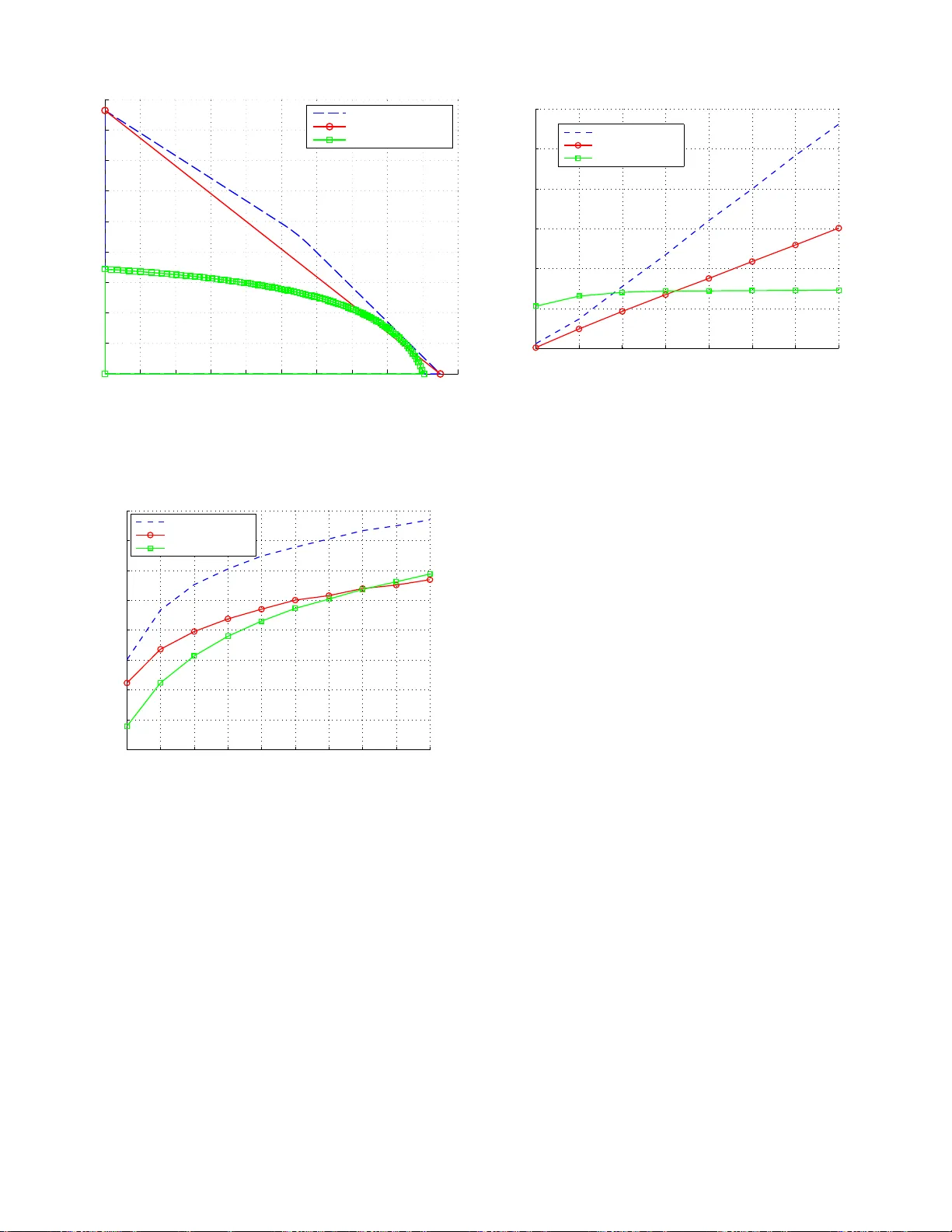
1 Performance Analysis of NOMA in T raining Based Multiuser MIMO Systems Hei V ictor Cheng, Emil Bj ¨ ornson, and Erik G. Larsson Department of Electrical Engineering (ISY), Link ¨ oping Uni versity , Sweden Email: { hei.cheng, emil.bjornson, erik.g.larsson } @liu.se Abstract —This paper considers the use of NOMA in multiu ser MIMO systems in practical scenario s where CSI is a cquired through pilot signaling. A new NOMA scheme th at uses shared pilots is proposed. Achieva ble rate analysis is carried out for different pilot signaling schemes includin g both uplink and downlink pilots. The achiev abl e rate perf ormance of the proposed NOMA scheme with shared p ilot within each group is compared with the t raditional orthogonal access scheme with orthogonal pilots. Our proposed scheme is a generalization of the orthogonal scheme, and can be reduced t o th e orthogonal scheme wh en appropriate power allocation parameters are chosen. Numerical results sho w that when downlink CSI is a vailable at th e users, our p roposed NOMA scheme outperforms orthogonal schemes. Howe ver with more gr oups of users present i n the cell, it is preferable to u se multi-user beamfo rming in stead of NOMA. I . I N T RO D U C T I O N Non-or thogon a l-multiple-access (NOMA) is a new multiple-acce ss concept proposed for next gene r ation wireless networks [2]. Th e key idea beh ind NOMA is th e use of superp osition cod ing [3], and associated interfere n ce cancellation technique s, to serve multiple terminals in the same time-fre q uency slot. Th is is classified as NOMA in the p ower domain . NOM A provides the ability to increase capacity , e sp ecially when the n umber of user s exceeds the dimension of the channel co herence interval, or the number of spatial dimension s (anten nas) av ailab le for multiplexing is limited. The techno logy is curr ently attracting much attention [4]–[7]. In the standardizatio n of 3GPP-L TE-Ad vanced networks, a NOM A tec h nique fo r the downlink (DL), called multiuser superposition transmission (MUST), was recently propo sed [8]. Concurren tly , multiuser MI MO is be coming a co r nerstone technolog y in emerging stand a r ds for wir eless access. T he idea is to use multiple, phase- coherently operating antennas at the base station to simultaneously serve many termin als and separate them in th e spatial d omain. The basic mu ltiuser MIMO concepts an d the associated inform a tion theor y go back a long time [9]–[ 11]. The mo st usefu l f orm o f multiuser MIMO is massive MIMO, wh ic h emerged mo re recen tly [12], [13]. In massi ve MIM O, the base stations use hu ndreds of antennas to serve ten s of termin als – harn essing a large spatial This w ork was supported by the Swedish Resea rch Council (VR), the Link ¨ oping Uni versi ty Center for Industri al Information T echnology (CENIIT), and the ELLIIT . Part of thi s work has been presented at IEEE Interna- tional W orkshop on Signal Processing Adv ances in Wire less Communicat ions (SP A WC) 2017 [1], howe ver there is an error in the Fig. 2 which is correc ted in this paper . multiplexing gain fo r high area thr oughp uts, as well a s a large array gain for imp roved coverage. The question add ressed in this pa p er is und e r wha t cir- cumstances the use of NOMA can provid e gains in multiuser MIMO systems. While this question p er se is no t new , no exist- ing study to the author s’ knowledge addressed it und er realistic assumptions on the av ailability of cha n nel state information (CSI). Specifically , previous work either assum ed perf ect CSI [5], [14] o r only statistical CSI [15]. In con trast, we con sider the use o f training (p ilot transmission ) to acquire estimated CSI, and we derive rigorou s c a pacity bound s for NOMA-based access un der these p ractical cond itions. T r aining-b ased NOMA schemes h ave been considere d in [1 6], but on ly for single- antenna systems and he nce o nly downlink pilots ar e sent to the users f o r estimatin g th eir effective chann el gains. Moreo e ver , in m u lti-user MIMO the effecti ve ch a nnels depen d on the beamfor ming, which complicates the analysis. Beamforming with imp erfect CSI also creates extra interf erence to the users, which has n ot b een in vestigated in the literature. I n contrast, in th is work pilots are transmitted on the uplink (UL), facilitating the base statio n to estimate all chan nels. By virtue of recipr ocity and tim e-division-duplex (T DD) op eration, the so-obtaine d estimate s con stitute legitimate estimates of the downlink chann e l as well and can be used for co herent beamfor ming. Howe ver, since th e terminals d o not know their effecti ve channels, we con sider also the possibility o f sending (beamfo rmed) pilots in the DL. The assump tions made o n av ailability of CSI are critical in the ana lysis of wireless access perf ormance: Per fect CSI ( or ev en h igh-qu ality CSI) is u nobtainab le in environments with mobility , and p erforma nce analyses cond ucted under perf ect- CSI assumptions often y ield significantly overoptimistic r e - sults. Con versely , the reliance o n only statistical CSI pre cludes the full exploitation of spatial m ultiplexing g ains, render ing any perf ormance r esults overpessimistic. The quality of the channel estimates that can ultimately b e o btained is d ictated by the length of the channel coh erence interval (CI) (prod u ct o f the c o herence time and the cohe r ence bandwid th): the high e r mobility , the less room for pilots, the lower-quality CSI – and vice versa. Since the coheren ce time is propo rtional to the wa velength, the use o f hig her carrier-frequ encies accentu ates this p roblem. I n high mob ility and at high frequenc ies, the channel coherence may b ecome very short and ev entually o ne is forced to use n on-coh e rent commun ication techniqu es [17]. The specific technica l con tributions of this p a p er are: ‚ W e pr opose a train ing scheme to obta in CSI and utilize 2 the NOMA concep t in a DL m u ltiuser M IMO system . ‚ The deriv ation of new , rig orous, semi-clo sed fo rm lower bound s on the DL capacity in mu ltiuser MIM O with NOMA, with and with out DL pilots. ‚ A num erical demonstration that NOMA can give gain s in mu ltiuser MIMO with estimated CSI u nder appro pri- ate con ditions, and a discussion o f relev a n t application scenarios, most importantly th at of r ate-splitting and multicasting. I I . S Y S T E M M O D E L W e consider a s ingle-ce ll m assi ve MIMO sy stem with M antennas at the base station ( BS) and K (even num ber) single- antenna u ser s. Among these users, K { 2 of them are located in the cell cen ter , while the other K { 2 users are at the cell edge. TDD operation is assumed and therefore the BS acquire s downlink ch annel estimates throug h uplink pilot signaling, by exploiting channel recipro city . These e stimates are u sed to perfor m downlink multiuser beamform ing. These operations have to be done within th e sam e CI, wher e the channe ls ar e approx imately constant. T herefore the mo re symbo ls spent on uplin k training, the fe wer symbols are a vailable for data. W e co nsider n on-line-o f-sight co mmunicatio n an d mo del the small-scale fading for each user as inde pendent Rayleigh fading. W e de note the small-scale fading realizatio ns f or the users at the ce ll center as g k „ C N p 0 , I M q , k “ 1 , . . . , K { 2 . (1) The correspo nding large-scale fadin g p arameters are β k g ą 0 , k “ 1 , . . . , K { 2 for the u sers in the cell c e n ter; th e actua l channel realizatio n is th e n b β k g g k . Similarly , the small-scale fading realizations for th e users at the cell ed ge are denote d as h k „ C N p 0 , I M q , k “ 1 , . . . , K { 2 . (2) The correspo nding large-scale fadin g p arameters are β k h ą 0 , k “ 1 , . . . , K { 2 fo r the u sers at th e cell edge . Th e actual channel is then b β k g g k . T h e large- scale fading is wid ely different betwee n the two sets o f users: β k g " β k h . Note that this is the scenario of interest to us, but the f ormulas will actually be valid for any values of β k g and β k h . The names ”cell edg e” and ” cell center” are just de scr iptiv e, but should not be interp reted literally . The BS is assumed to know the deterministic parameter s β k g and β k h . Howe ver the small-scale fading r ealizations are unknown a priori and chan ging independ ently fro m one CI to another CI. T o estima te the small-scale fading realization s a t the BS, in tradition a l T DD multiu ser MIMO, or th ogonal up- link pilots are transmitted from the user s in the cell. Howev er, the n umber of av ailab le orthog onal pilot sequence s is limited by the size o f the CI an d this effecti vely limits the numb er o f users that can be sched uled simultan eously . In this stud y , we are interested in the case wh en K is greater than the numb e r of av ailab le pilot sequen ces. T o facilitate discussion and analysis, we assume that there are only K { 2 ortho gonal pilo t sequences av ailab le. W ith this assump tion, we co mpare two schem e s that make use of the K { 2 pilot seq uences differently . A. Orthogonal A ccess Scheme The first scheme is the tradition al orth ogonal ac c ess scheme [18] th at schedules K { 2 u sers in a fraction η of time- frequen cy resources, and th e n ser ve the o thers in th e remainin g fractio n 1 ´ η of the resour c es. T o minimize near-far effects, we schedule the K { 2 u ser s at the cell center in the first fr a ction η , fo llowed by the o ther K { 2 users at th e cell ed ge in the remaining 1 ´ η of the resour ces. From now on we call this Scheme-O . B. Pr opo sed NOMA Scheme The second sch e m e is a g eneralization of an existing scheme in the NOMA liter a ture [19], which creates K { 2 grou ps, each with one user a t the c e ll edg e and o ne at the cell center . In [1 9], the b e a mformer s are selecte d based on th e chann el of the cell center u ser, but NOMA with sup e r position codin g is applied within eac h group so that the c e ll edge user can get a separ ate d ata signal. The b e amformer s c a n be selected to mitigate the in ter-group interfer ence. For example, in [19], zero-fo rcing beamf orming is applied to can cel inter-group interferen ce. However , this existing schem e can only provide the user at the cell edge w ith a small data rate. T his is so because the beams are directed to the stronger user in the group , thus the weaker user will not have any be amformin g gain and this results in low received p ower and no interferen ce suppression. Moreover, the existing work is based on the impractical assum ption of perfect CSI. In [20] a two-stage beamfor mer is p r oposed wher e the outer stage aims to cancel the in ter-group interferen ce and the inn er stage beamfo rmer is optimized to enhan ce the r ate perform a n ce for the u sers with in the gro up. Howe ver this approac h needs perf ect CSI at the BS which is hard to obtain in practice an d ther efore we do not consider it here. W e pr opose a gen eralization of the NOMA scheme fro m [19] and devise a way to estimate the channels in practice. T o resolve the pilot-shortag e p roblem, we propo se to reuse th e same pilot fo r mu ltiple term inals in the same cell. In pa r ticular , the BS allocates the same pilot to the two termina ls in a gr oup, where one is in th e cell center and o ne is at the cell edg e. 1 Since the two users are usin g th e same pilot and h av e the same small-scale fading statis tics, we will later see that the BS can n ot disting uish their channel respo n ses. However , th e BS can estimate a linear com bination of the cha n nels to both terminals fro m the pilot transmission. T his estimate pr ovid es a useful description o f the co mbined c hannel, p articularly , if power co ntrol is used to even out the pilot sign a l streng ths of the two terminals. In our propo sed schem e, the BS b eamform s a combin a tio n of the d ata symbols intended fo r the two terminals u sing the estimated channels. W e make use of the NOMA co ncept fo r which the sym bols in tended for different users are super-imposed using sup er-position cod ing. The cell ed g e user perfo rms the decod ing b y treating inter-user interferen ce as noise, wh ile the cell center user decodes the other user’ s d ata fir st and performs in te r ference can cellation before decodin g its own da ta . Since th e beamfo rmers are based 1 This s cheme can be extended to m ore than two users, and we will briefly discuss about this in Secti on V. 3 P S f r a g r e p l a c e m e n t s One CI Another CI Cell Edge Users DL Data: DL Data: DL Data: DL Data: Cell Center Users Pilots Pilots Pilots Pilots Pilots Pilots Pilots Pilots UL UL UL UL DL DL DL DL All Users All Users Fig. 1. Frame structure in the considered traini ng based multiuser MIMO systems. Upper figure: frame structu re for the proposed Scheme-N, where all users are scheduled by sharing pilots. Bottom figure: common frame structure for Scheme-O, where users are schedul ed in diffe rent CIs. P S f r a g r e p l a c e m e n t s user (1,g) user (1,g) user (1,h) user (1,h) user (2,g) user (2,g) user (2,h) user (2,h) (a) (b) Fig. 2. The training and the beamforming stages for Scheme-N. (a) the transmissions during the uplink training stage where two users with the same inde x share the same orthogonal pilot. (b) the beamforming transmission for the data where the same beam is formed for e very two users. on the chann e ls of all u sers, the p r oposed schem e can d eli ver good data rates to everyone. From now on we ca ll this g eneralized NOMA schem e Scheme-N . Fig. 1 shows the frame structure for the two schem es, Scheme-O and Scheme- N, and Fig. 2 shows the trainin g and beamfor ming oper ations f or Schem e -N. I I I . U P L I N K C H A N N E L E S T I M AT I O N In th is section we con sider the uplink channel estimation fo r the two schemes th at we are comp aring. The chann e l estima- tion is d ifferent f rom in conventional systems sinc e the nu mber of users sche duled in one slot and the p ilot or thogon ality are different. W e den o te the pilot matrix by Φ P C K { 2 ˆ K { 2 that contains the K { 2 orthog onal pilot sequ ences in its rows, i.e. ΦΦ H “ I K { 2 . For Schem e - O, the K { 2 users at the cell cen ter ar e sched - uled first, and th e received uplin k pilot signal Y O uc P C M ˆ K { 2 is Y O uc “ ? p u GD g Φ ` N uc , (3) where D g is a dia g onal m a tr ix with b β 1 g , . . . , b β K { 2 g on its diagona l. Then the K { 2 user s at the cell e d ge ar e schedu led in a subsequen t CI an d the received uplin k pilot signal Y O ue P C M ˆ K { 2 is Y O ue “ ? p u H D h Φ ` N ue , (4) where D h is a diagonal matrix with a β 1 h , . . . , b β K { 2 h on its diagonal. For Scheme-N, th e r eceiv ed u p link p ilot signal Y N u P C M ˆ K { 2 is Y N u “ ? p u GD g A g Φ ` ? p u H D h A h Φ ` N u , (5) where A g and A h are diagonal matrices with b α 1 g , . . . , b α K { 2 g and a α 1 h , . . . , b α K { 2 h on the diagona l respectively . N uc , N ue and N u represent the a d ditiv e noise during p ilot tra n smission with ind ependen t and identically distributed (i.i.d. ) C N p 0 , 1 q entries. α k h ď 1 and α k g ď 1 are the positive power control param e ters ap plied to the pilot to (potentially ) even out the chan n el estimation quality between the users in the same grou p . W itho ut loss of genera lity , the k th user at th e cell center is paired with the k th user at the cell e dge to f orm the k th group in Sch eme-N, an d they are using the same pilot sequence. From now on we call the cell edge user in the k th group “user p k , h q ” and the cell center user in the k th group “user p k , g q ”. A. MMSE Chann el Estimation fo r Scheme-O In th is subsection, we con sider the ch annel estimation f or Scheme-O. The estimates will be used in the next section for perfo rmance analysis. The BS first processes the received pilots signals b y multiplying with Φ H from the right. The processed pilot signal in (3) b ecomes ¯ y O uc,k “ r Y O uc Φ H s k “ b p u β k g g k ` ¯ n uc,k , k “ 1 , . . . , K { 2 , (6) where ¯ n uc,k “ r N uc Φ H s k „ C N p 0 , I M q , for th e u sers at th e cell center , and where r¨s k denotes th e k th co lumn of a matrix . Th e proce ssed pilo t signal in (4) becomes ¯ y O ue,k “ r Y O ue Φ H s k “ b p u β k h h k ` ¯ n ue,k , k “ 1 , . . . , K { 2 , (7) where ¯ n ue,k “ r N ue Φ H s k „ C N p 0 , I M q , for the users at the cell edge. Based on th e processed rece ived pilots, the BS then per- forms channel e stimation. W e consider M M SE ch annel esti- mation here. Using classical results from [21], we obtain the MMSE chan n el estimate of g k is ˆ g k “ b p u β k g p u β k g ` 1 ¯ y uc,k , k “ 1 , . . . , K { 2 (8) for u ser s a t the cell center and the MMSE estimate o f h k is ˆ h k “ b p u β k h p u β k h ` 1 ¯ y ue,k , k “ 1 , . . . , K { 2 (9) for u ser s a t the cell edge. B. MMSE Chann el Estimation fo r Scheme-N Similar to the case o f Scheme-O, the BS first pr ocesses the received pilot sign al b y multiplyin g with Φ H from the righ t in (5) and o b tains the processed received sign als ¯ y N u,k “ r Y N u Φ H s k “ b p u α k g β k g g k ` b p u α k h β k h h k ` ¯ n u,k , k “ 1 , . . . , K { 2 , (10) 4 where ¯ n u,k “ r N u Φ H s k „ C N p 0 , I M q . T h en the MMSE channel estimate of g k for a user in the cell center is ˆ g k “ b p u α k g β k g p u α k g β k g ` p u α k h β k h ` 1 ¯ y N u,k , k “ 1 , . . . , K { 2 . (11) The MMSE chann el estimate of h k for a user at the cell edg e is ˆ h k “ b p u α k h β k h p u α k g β k g ` p u α k h β k h ` 1 ¯ y N u,k , k “ 1 , . . . , K { 2 . (12) W e observe th at ˆ g k and ˆ h k are p a rallel, thus th e BS cannot disting uish between th e channel “dir ection” of u sers that share th e same p ilot. This effect is a co nsequence of pilot contam ination. Pilot contamin ation is a major issue in massi ve MIMO system, since it makes it hard for the BS from perfo rming coher e nt beamfo rming only towards one of the users that share a pilot [12]. In con tr ast, if the same data is multicasted to multiple users, it is desirable to jointly beamfor m towards all of them. Pilot contamin a tion is then useful to red uce the pilot overhead [22]. In this paper, we will show how to exploit NOMA to send different data to the user s that sha re a pilot. One alter nativ e way to utilize the uplink p ilots is to estimate the lin ear comb ination w k “ b α k g β k g g k ` b α k h β k h h k of the chan n els. Th e MMSE estimate o f w k for g r oup k is ˆ w k “ ? p u α k g β k g ` ? p u α k h β k h p u α k g β k g ` p u α k h β k h ` 1 ¯ y N u,k , k “ 1 , . . . , K { 2 . (13 ) Note th at ˆ w k is a lso parallel with ˆ g k and ˆ h k . Th e cho ice of chann el estimate doe s no t m atter because in either case the channel estimates are linearly scaled versions o f the pr ocessed pilot sign al. Henc e the beamfo rming d irections sugg ested by the estima te s are the same by u sing any one of the estimato rs. Since we nee d to normalize th e bea m former to satisfy the power con straint, the scaling disappears after no rmalization and ther efore does n ot affect the rate. C. Interfer ence-Limited Scen arios W e can ob tain a special case by assum ing there is no no ise during th e up link training , or equ i valently th at the uplink power p u goes to infinity . This yields as an upper bound on the perf o rmance of all the schem e s. It is also a g ood approx imation of th e in terference- limited scena r io with high SNR, but large inter-user interf erence. For Scheme-O, noise-free channe l estimation implies that the channels ar e perfectly k n own at the BS , due to th e fact that all users use o rthogon al pilo ts in th e uplink training , i.e., ˆ g k “ g k , k “ 1 , . . . , K { 2 , (14) and ˆ h k “ h k , k “ 1 , . . . , K { 2 . (15) In con trast, for Sch eme-N, th e channel estima te at the BS will still be a lin e ar c ombination of th e channels because of the use of the same pilot in each grou p. T he no ise-free estimate of w k becomes ˆ w k “ b α k h β k h h k ` b α k g β k g g k “ w k , k “ 1 , . . . , K { 2 . (16) I V . P E R F O R M A N C E A N A LY S I S In th is section , we analy ze the ergodic achievable rates of Scheme-O and Schem e-N un der imperfect chann el estimation . In wireless systems with fast fading chan nels, ch annel cod es span many realizations of the fading pro cess. Therefo r e th e ergodic achievable rate is an app ropriate metric to charac terize the perfor mance of co ded systems in fast fading environment. It is commonly adopted in th e multiuser MIMO literature, especially when the n umber of ante n nas is large. W e make use of the UL ch a n nel estimates from Section III for downlink beamfor ming, by assuming perfe ct recip rocity betwe e n UL and DL. Th e chann el estimation errors a re taken into accoun t in the ergodic achiev able ra te expressions. W e separate the analysis into three parts, namely the cases with an d withou t instantaneou s DL CSI, and the case with estimated DL cha n nel gains. The case with instantaneo us downlink CSI is uno btain- able in practice, and used only as a b enchmark . Note that th e ef fectiv e ergod ic rate have a prelog penalty ` 1 ´ K 2 T ˘ for the case withou t DL pilots, where T is the size of the CI. This pe n alty accounts for the loss from spending K 2 T of every CI to estimate the chan nels. For the case with DL pilots, the pre-lo g p enalty is ` 1 ´ K T ˘ . A. Downlink Sig nal Model Denote by p d the DL tran smission power no rmalized by the noise variance. For Scheme-O, the received signal for user k in the cell c e n ter is y c,k “ b p d β k g g T k x g ` n c,k , k “ 1 , . . . , K { 2 , (17) and the received signal for user k at th e cell ed ge is y e,k “ b p d β k h h T k x h ` n e,k , k “ 1 , . . . , K { 2 , (18) where x g ( x h ) is th e signal vector containing data f or th e cell center users ( c ell e d ge users), an d n c,k ( n e,k ) is the n ormalized i.i.d. zero mean un it variance c o mplex Gaussian noise at th e k th user at the ce ll cen ter (edg e). Befo re tran sm ission, each data symb ol is mu ltiplied with a beam forming vector as x g “ K { 2 ÿ k “ 1 b k b γ O k,g s k,g (19) for the users in the cell cen ter and x h “ K { 2 ÿ k “ 1 a k b γ O k,h s k,h (20) for the users at cell edg e . In the above eq u ations γ k,h ( γ k,g ) represents th e non-n egati ve power co ntrol coefficients for user 5 k at the cell edg e (cell cen ter), an d s k,h ( s k,g ) is the data symbol intend ed for user k at the cell edg e (cell center ) which is zero mean and un it variance. Th e combined sign al vectors x h and x g need to satisfy the power constrain t E r x H h x h s ď 1 and E r x H g x g s ď 1 . In this work we focu s on maximu m ra tio tran smission (MR T) wh ic h is simp le to implement an d per forms close to optimality in low SNR scenar ios, b k “ ˆ g ˚ k a E r|| ˆ g k || 2 s for the cell cen ter users and a k “ ˆ h ˚ k b E r|| ˆ h k || 2 s for the cell edge users. With the norm alized b eamform ing vectors, the power constraint be comes ř K { 2 k “ 1 γ O k,g ď 1 an d ř K { 2 k “ 1 γ O k,h ď 1 . For Scheme- N, the received downlink signal for users in the cell cen ter is y k,g “ b p d β k g K { 2 ÿ i “ 1 g T k a i ? γ i,h s i,h ` b p d β k g K { 2 ÿ i “ 1 g T k b i ? γ i,g s i,g ` n k , k “ 1 , . . . , K { 2 . (21) Similarly , th e rec ei ved downlink signal for u sers at the cell edge can be written as y k,h “ b p d β k h K { 2 ÿ i “ 1 h T k a i ? γ i,h s i,h ` b p d β k h K { 2 ÿ i “ 1 h T k b i ? γ i,g s i,g ` n k , k “ 1 , . . . , K { 2 . (22) In Sch eme-N, where th e BS knows only the linear com- bination of the chan nels for the users in the same NOMA group , it regards the estimate as the tru e cha n nel for both users p k , g q an d p k , h q since that is the best estimate av ailable. The com bined symb ols from both termin als in the same gr oup are weighted with the p ower contro l co efficients ? γ k,h and ? γ k,g . The tr ansmitted symbo l in the k th NOMA gr o up is hence ? γ k,h s k,h ` ? γ k,g s k,g . Ther e f ore the power constraint is ř k γ k,h ` ř k γ k,g ď 1 . In this case we have the MR T beamfor ming vector with normaliza tio n a k “ b k “ ˆ w ˚ k a E r} ˆ w k } 2 s . (23) B. P erformanc e W ith P erfect CSI at the Users In this subsection , we comp ute the ergod ic achiev able rate for the two sche mes un der the assumptio n that the DL pilots make pe rfect DL CSI av ailable a t th e user s. This assumes that DL pilo ts a re sent in each CI and users p erform chan nel estimation to o btain their own cha n nel gain coefficients and the cross-chann el gains between different users. The achiev a b le rate is ob tained by av eraging over all sources of rand omness in the chann el and noise. For Schem e-O, every user decod es its own d ata sym b ol by treating interferen ce as noise. Since per fect CSI is av a ilab le, an ergod ic achievable rate of user k with beamfor ming vec- tor a 1 , . . . , a K and b 1 , . . . , b K can be computed using [13, Section 2.3 .5] R O c,k “ ˆ 1 ´ K T ˙ η E « log 2 ˜ 1 ` p d β k g γ O k,g | g T k b k | 2 p d β k g ř j γ O j,g | g T k b j | 2 ` 1 ¸ff (24) for the users in the cell cen ter and R O e,k “ ˆ 1 ´ K T ˙ p 1 ´ η q E « log 2 ˜ 1 ` p d β k h γ O k,h | h T k a k | 2 p d β k h ř j γ O j,h | h T k a j | 2 ` 1 ¸ff (25) for the users a t the c e ll edge . The ergodic achievable rates are measured in b/s/Hz, and they can be achieved by using Gaussian signaling and code- words that span over all chan nel r ealizations. The p re-log factors acco unt for the loss in achiev able rate d ue to the fact that each user is on ly sched uled for a fra ction of the CIs, in time or frequ ency . For Scheme-N, recall that we name the k th user at th e cell edge as p k , h q and the k th user at the cell center as p k , g q . T he instantaneou s SINR of s k,h of user p k , g q is SINR k,g “ p d β k g γ k,h | g T k a k | 2 p d β k g ř j ‰ k γ j,h | g T k a j | 2 ` p d β k g ř j γ j,g | g T k b j | 2 ` 1 (26) and similarly the instantaneo us SINR of s k,h at user p k , h q can be written a s SINR k,h “ p d β k h γ k,h | h T k a k | 2 p d β k h ř j ‰ k γ j,h | h T k a j | 2 ` p d β k h ř j γ j,g | h T k b j | 2 ` 1 . (27) The cond itio n tha t user p k , g q can deco d e the data in te n ded for user p k, h q is that the ergodic achie vable rate of s k,h at user p k , g q is no less than the ergodic achiev able rate of s k,h at user p k , h q , which is explicitly E r log 2 p 1 ` SINR k,g qs ě E r log 2 p 1 ` SINR k,h qs . (28) When this cond itio n does not hold, we need to lower the data rate to user p k , h q such that it can be d ecoded at user p k , g q . This c an be done by choosin g R N P k,h “ min p E r log 2 p 1 ` SINR k,g qs , E r log 2 p 1 ` SINR k,h qsq . (29) Since E r lo g 2 p 1 ` SINR k,h qs is an achiev ab le ra te for user p k , h q , from an info rmation-th eoretic perspective any rate that is lower th an that is also achiev ab le. Th e refore b y transmitting with the ch osen R N P k,h both u sers are able to d ecode the da ta . In practice, for (2 8) to hold we just ne ed to properly contro l the p ilot powers such that (28) ho lds. Th en user p k , g q gathers all r eceiv ed signals over all ch annel r ealizations (c o herence intervals) and decod es the data fo r user p k , h q . Notice that the 6 SIC is done after the whole codeword is decod ed, and not perfor med in every CI. Th erefore it is not a problem if the instantaneou s SINR is lower at user p k , g q , as lon g as (28) is satisfied in the lo n g term. In the ty p ical scenarios of β k h ! β k g , there is a wide range of possible cho ices of power contro l par ameters on the pilots av ailab le to satisfy (28 ). W ith any cho ice of p ower control satisfy ing (28 ) we tr ansmit with the super-position coding sch eme such th at user p k, h q decod es th e signal s k,h from y k,h by treatin g the sign al fro m user p k , g q as noise. Then u ser p k, g q perfor ms successiv e in terference can c ellation such th a t it first decodes s k,h from y k,g and th en sub tr acts b p d β k g g T k a k ? γ k,h s k,h from y k,g and decodes s k,g after- wards. W ith th e sup erposition cod ing scheme, the achievable ra te of user p k , g q is g i ven in (3 0) and the achiev a ble r ate of user p k , h q is giv en in (31) on top of next page. It is worth noticing that wh en α k g “ γ k,g “ 0 @ k and α k h “ 1 , o ne can ob tain R N k,h “ R O e,k with η “ 1 . Similar ly when α k h “ γ k,h “ 0 , @ k and α k g “ 1 , one can obtain R N k,g “ R O c,k with η “ 0 . By using time- sharing b etween these two extremes, we obtain all the ergodic achiev able rates that Sch eme-O can attain. This shows that Scheme-N is mor e general than the traditional scheme with o rthogon al access. C. P erforman ce W ithout Do wnlink CSI In th is section we in vestigate the c ase wh en instan ta n eous DL CSI is not av ailable, howe ver we assume the channel statistics are known by all parties. Th is co rrespond s to the case when no DL pilo ts are sent and serves as a lo wer bound o n the perfor mance of all the schemes with estimated DL ch annels. In this case users utilize th e lon g term statistics as th e chann el gain an d decode the signals, that is, they take th e statistical av erage of the effective gain as an estima te o f that gain. Th en the achiev ab le rate is obtained b y gatherin g all the symbols over different chann el rea liza tions and decoding the signal. Assume the BS uses the estimated CSI f or be amformin g to all terminals. Since we a re co nsidering M R T b eamform ing, a k and b k are scaled version s o f th e channe l estimate ˆ w k which is a scaled version of the processed pilots ¯ y N u,k . Then the beamfor ming vector is a k “ b k “ c k ¯ y N ˚ u,k where the normalizin g con stant c k that meets the power constraint can be calculated as c k “ 1 b E r} ¯ y N u,k } 2 s “ 1 b p p u α k h β k h ` p u α k g β k g ` 1 q M . (32) Therefo re the received signal at user p k , g q is y k,g “ c k b β k g g T k ¯ y N ˚ u,k ? p d γ k,h s k,h ` c k b β k g g T k ¯ y N ˚ u,k ? p d γ k,g s k,g ` I k,g ` n k,g , (33) where I k,g “ b β k g ÿ j ‰ k c j g T k ¯ y N ˚ u,j ? p d γ j,h s j,h ` b β k h ÿ j ‰ k c j g T k ¯ y N ˚ u,j ? p d γ j,g s j,g (34) is the interf e r ence fro m oth er group s o f users. Similarly , th e received signal at user p k , g q is y k,h “ c k b β k h h T k ¯ y N ˚ u,k ? p d γ k,h s k,h ` c k b β k h h T k ¯ y N ˚ u,k ? p d γ k,g s k,g ` I k,h ` n k,h , (35) where I k,h “ b β k h ÿ j ‰ k c j h T k ¯ y N ˚ u,j ? p d γ j,h s j,h ` b β k h ÿ j ‰ k c j h T k ¯ y N ˚ u,j ? p d γ j,g s j,g (36) is the interfer ence fro m other g r oups of users. Now we make u se of the channe l statistics to write th e received signal at terminal p k , h q as y k,h “ E „ c k b β k h h T k ¯ y N ˚ u,k ? p d γ k,h s k,h ` z k,h (37) where we have introd uced the fo llowing effecti ve no ise term z k,h “ ˆ c k b β k h h T k ¯ y N ˚ u,k ? p d γ k,h ´ E „ c k b β k h h T k ¯ y N ˚ u,k ? p d γ k,h ˙ s k,h ` c k b β k h h T k ¯ y N ˚ u,k ? p d γ k,g s k,g ` I k,h ` n k,h . (38) It can be easily verified th at z k,h is u ncorrelated with the signal term in (37). Theref o re (37) can be regard ed as an equivalent scalar channel with deterministic kn own gain and add iti ve uncorr elated noise. Usin g the fact that additive Gaussian n oise is the worst case un correlated noise [13, Sectio n 2.3.2], the following ra te is achiev able for user p k , h q : Proposition 1. The following ergodic rate is achievable for user p k , h q with Scheme-N: R N ip k,h “ ˆ 1 ´ K 2 T ˙ log 2 ˆ 1 ` p d λ k,h β k h γ k,h M p d λ k,h β k h γ k,g M ` p d β k h ` 1 ˙ , (39) wher e λ k,h is defi n ed as λ k,h “ p u α k h β k h p u α k h β k h ` p u α k g β k g ` 1 . (40) Pr oof. The proo f is given in Append ix A. W e define λ k,g “ p u α k g β k g p u α k h β k h ` p u α k g β k g ` 1 (41) to quantif y the ch annel estimation qua lity for the following discussion. Under the c o ndition α k h β k h ď α k g β k g , the effective SINR of the signal s k,h at user p k , g q is greater than the effecti ve SINR of the signal s k,h at user p k , h q , i.e., p d λ k,h β k h γ k,h M p d λ k,h β k h γ k,g M ` p d β k h ` 1 ď p d λ k,g β k g γ k,h M p d λ k,g β k g γ k,g M ` p d β k g ` 1 . (42) Therefo re we can use NOMA wher e user p k , g q de c odes data from user p k, h q and then sub tracts it f rom the rece i ved sign al y k,g . Fro m the sufficient co ndition α k h β k h ď α k g β k g we see tha t it is b etter to let the u ser with larger large-scale fadin g co efficient 7 R N P k,g “ ˆ 1 ´ K T ˙ E « log 2 ˜ 1 ` p d β k g γ k,h | g T k a k | 2 p d β k g ř j ‰ k γ j,h | g T k a j | 2 ` p d β k g ř j ‰ k γ j,g | g T k b j | 2 ` 1 ¸ff (30) R N P k,h “ ˆ 1 ´ K T ˙ E « log 2 ˜ 1 ` p d β k h γ k,h | h T k a k | 2 p d β k h ř j ‰ k γ j,h | h T k a j | 2 ` p d β k h ř j γ j,g | h T k b j | 2 ` 1 ¸ff (31) perfor m successiv e interferen ce cancellation as the condition is easier to satisfy . W e have the new rec e ived sign al ¯ y k,g “ y k,g ´ E ” c k b β k g g T k ¯ y N ˚ u,k ı ? p d γ k,h s k,h “ E ” c k b β k g g T k ¯ y N ˚ u,k ı ? p d γ k,g s k,g ` ´ c k b β k g g T k ¯ y N ˚ u,k ´ E ” c k b β k g g T k ¯ y N ˚ u,k ı¯ ? p d γ k,h s k,h ` ´ c b β k g g T k ¯ y N ˚ u,k ´ E ” c k b β k g g T k ¯ y N ˚ u,k ı¯ ? p d γ k,g s k,g ` I k,g ` n k,g . (43) W e can similar ly write the effectiv e noise as z k,g “ ´ c k b β k g g T k ¯ y N ˚ u,k ´ E ” c k b β k g g T k ¯ y N ˚ u,k ı¯ ? p d γ k,h s k,h ` ´ c b β k g g T k ¯ y N ˚ u,k ´ E ” c k b β k g g T k ¯ y N ˚ u,k ı¯ ? p d γ k,g s k,g ` I k,g ` n k,g . (44) Proposition 2. The following ergodic rate is achievable for user p k , g q with Scheme- N: R N ip k,g “ ´ 1 ´ τ 2 T ¯ log 2 ˜ 1 ` λ k,g β k g γ k,g M p d β k g ` 1 ¸ . (45) Pr oof. Th e proof is given in Append ix B. From the ergod ic rate expressions, we can ob serve that the signal terms a r e p roportio nal to M , which is th e array gain from coher e n t b eamform ing. Mo reover , we o bserve that the total interfer ence from other grou ps of user s is a con stant that only depen ds the user’ s own large-scale fading , but n o t on the number of antenna s or channel estimation quality . Therefo re the only parameters that affect the rate a r e the power con trol parameters and the u plink ch annel estimation quality . Ad ding m ore gro ups of users in Scheme- N will on ly change th e a mount of power th at is alloca te d to eac h gr oup, but not the total inter f erence. Each user at the cell ed ge is affected by co herent interferen c e from the sign a l in tended for the cell center user in its group . Howe ver , for the users in the cell center, coh erent interferen ce d isappears in the successiv e in terference can cellation and the only effect of the pilot co ntamination is the degrad ed ch annel estimation quality . Using similar calculations, we obtain the ergodic achievable rate expressions fo r Schem e-O. For users in the cell center, we have R Oip c,k “ ˆ 1 ´ K 2 T ˙ η lo g 2 ˜ 1 ` λ O k,g β k g γ O k,g M p d β k g ` 1 ¸ , k “ 1 , . . . , K { 2 (46) where λ O k,g “ p u β k g p u β k g ` 1 . (47) For users at the c e ll edg e , we have R Oip e,k “ ˆ 1 ´ K 2 T ˙ p 1 ´ η q log 2 ˜ 1 ` λ O k,h γ O k,h M p d β k h ` 1 ¸ , k “ 1 , . . . , K { 2 (48) where λ O k,h “ p u β k h p u β k h ` 1 . (49) As in the case with p erfect CSI at th e users, when we set α k h “ γ k,h “ 0 , @ k and α k g “ 1 in Sch eme-N we get the achiev able rate of th e u sers in the cell center in Sch eme-O with η “ 1 . Setting α k h “ γ k,h “ 0 , @ k and α k h “ 1 we get the achiev able rate of the users at the cell edge in Scheme-O with η “ 0 . By u sing time-sharin g between these two extremes, we obtain all the ergod ic achiev able rates that Scheme- O can attain. D. P erformance W ith Estimated Downlink CSI DL CSI doe s n ot com e for free. In pra c tice some f orm of estimation of the beamfo rmed chann el gain is usually neede d . In this subsectio n, we in vestigate th e per formanc e of th e two schemes when we send DL (b eamforme d ) pilots [2 3] for the channel estimation . For Schem e-O every user receives its own orthog onal pilot. For Sch eme-N, sinc e we are u sing the sam e beamfor mer for the p air of users in every g roup k , only o n e downlink pilot is needed for ev ery pair of users. I n this case the u ser s estimate their effecti ve cha n nel g ain and p erform a form of “eq ualization” using th e estimated ch annel gain (see below fo r the d etails). W e denote the chan nel gain at user p k , h q a s f k,h fi h T k a k . Then the received pilot a t each of these users is y dpk,h “ f k,h b p d β k h ` n dpk,h , k “ 1 , . . . , K { 2 . (50) Assuming LMMSE estimation [2 1] at the user, we obtain the estimate ˆ f k,h “ E r f k,h s ` b β k h p d V ar r f k,h s β k h p d V ar r f k,h s ` 1 ˆ y dpk,h ´ b β k h p d E r f k,h s ˙ , (51) of the chan n el g ain wh ere E r f k,h s “ a M λ k,h , V ar r f k,h s “ 1 . (52) 8 The estimation quality will imp rove with M a s the mean of the cha nnel gain is increasing with M while the v ariance is constant. Similarly , denote the channe l gain at user p k , g q as f k,g fi g T k b k . Th e received pilot a t each of these user is y dpk,g “ f k,g b p d β k g ` n dpk,g , k “ 1 , . . . , K { 2 . (53) Applying LM MSE estimation y ields the estimate ˆ f k,g “ E r f k,g s ` b β k g p d V ar r f k,g s β k g p d V ar r f k,g s ` 1 ´ y dpk,g ´ b β k g p d E r f k,g s ¯ , (54) where E r f k,g s “ a M λ k,g , V ar r f k,g s “ 1 . (55) W ith these estimates o f the channel gains, we first d i vide th e received sign al at u ser p k , h q by the channe l estimate. This can be s een as a form of equ alization, a n d ideally the ratio f k,g ˆ f k,g is on e. Then we use the same metho d as above to o btain the achiev able rate of user p k , h q in (56) on top of next page. Similarly for user p k, g q , an achievable rate is giv en in (57) on top of n ext p age. For Scheme-O, similar techn iques can be applied to o b tain the achiev able ra te fo r the users in the cell center given in (58) on top of next page. The correspon ding ach ievable rate fo r the users at the ce ll edge is given in (59) on top of next page. As in the case with p erfect CSI at th e users, when we set α k h “ γ k,h “ 0 , @ k and α k g “ 1 we get th e achiev able rate of the u ser s at the cell center in Scheme-O with η “ 1 . Settin g α k h “ γ k,h “ 0 , @ k and α k h “ 1 we g et the ach iev ab le rate of the u sers at the cell edge in Schem e-O with η “ 0 . By using time sharing between these tw o extremes, we o btain all the ergodic achiev able ra tes that Scheme-O can attain. T able I summarizes all the ergod ic rate expression s we have obtained, the y are all listed in T able I with reference to the equation nu mbers. Comparing the achiev ab le rates of the different schem es under different CSI assump tions, we observe that the main difference amo ng th em is that imperfect CSI at the users is causing self-interferen ce. W ithout any downlink p ilots, this self-interfer e nce is proportional to the received p ower ( p d β ), which fu ndamentally limits the ac hiev ab le r a te of the user . Therefo re we can conclude that neither incr e asing the DL power nor putting the user closer to the BS would help much . This would not create a large SINR difference at the user , and thus we expect that Schem e-N would not p rovide much ga in . Howe ver with DL pilots, the self-in terference can be red uced substantially if we increase th e DL SNR. Th is creates a larger SINR difference at the u sers and th us we expect that Scheme- N would provide h igher gains. V . P R A C T I C A L I S S U E S A N D E X T E N S I O N S In this section we discuss various issues when implementing the p roposed Schem e-N in pr actical systems and so m e po ssible extensions. Du e to space limitatio ns, these issues are d iscu ssed briefly an d in-dep th investigations are left for future work. A. User P a iring In th is paper we are inv estigating the ef f ects of imperfect CSI o btained throug h uplink trainin g. The chan nels are n o t known a prio ri; the on ly in formation available at the BS regarding the channel strength is the large scale fading co- efficients o f the u sers. As a r e su lt th e user pa iring has to be done based on the large-scale fading coefficients t β k u . This can also be o bserved fr o m the ach iev ab le ra te expressions. This is th e same con d ition that has been discu ssed in [24]. Howe ver th e differences are that first, in o ur case ther e is a b eamform ing g ain of order M which ef fectiv ely increases the SNR and seco nd, the existence of self - interferen ce caused by chann e l estimation er rors. A detailed analysis would be interesting, but has to b e left f or futu re work . B. Mor e than T wo U sers P er Gr ou p The p roposed Schem e-N can be extend ed to inclu d e more than two u ser s p er grou p. Su ppose there are L users in e ach group k and each u ser is labeled as u ser p k , 1 q to user p k , L q . In the channel estimation phase they are assigned the same pilot. The BS estimates a linea r combina tion of th e channels from all L users in the gro up. Th en th e BS u ses th is for MR T beamfor ming. W ithou t loss of gen e r ality , assume they have large-scale fading coefficients ordere d as β k 1 ď β k 2 ď . . . ď β k L . The r equired c o ndition such that NOMA can b e applied is that u ser p k , i q c a n decode all m e ssag e s intended f o r user p k , j q for all j ď i . The co ndition can be wr itten as E r log 2 p 1 ` SINR k,i qs ě E r log 2 p 1 ` SINR k,j qs @ i ě j, (60) where SINR k,i is the effecti ve SINR o f u ser p k , i q which has different for m s accor ding to the av ailability o f CSI. This condition can be met by contro lling the pilot power of the users. Detailed an a ly sis o f this extension is out o f scop e and has to be left for future work d ue to the limit of space. C. User s with Multip le Anten nas In the case when users are e quipped with more than one antenna, adding more antennas can be viewed as addin g users at the same distance. Thus the same analysis an d results can be a pplied by putting the different antenn as of the same user in different group s in Scheme-N. This argument d o es not consider the possibility of receiv e b eamform in g at the u sers as it req uires ac curate channe l estimation at th e users. Since the scenario we considered is wh en th e p ilot resou rces ar e scarce, the con sideration of receive be amformin g at the user side is out of scope. D. P ower Contr ol Power c o ntrol in any co mmunicatio n systems is crucial. W e have considere d both power contr ol in the UL for the p ilots and in the DL for the d ata. Th ey are optimized accord ing to the requirem ent of the user s. In Section VII we will loo k at the rate region a n d a particular operating p o int on the Pareto bo u ndary of the rate r egion which is obta in ed by perfor ming power control on bo th UL pilo ts and DL d a ta. Howe ver these ar e 9 R N d p k,h “ ˆ 1 ´ K T ˙ log 2 ¨ ˚ ˚ ˝ 1 ` p d β k h γ k,h ˇ ˇ ˇ E ” f k,h ˆ f k,h ı ˇ ˇ ˇ 2 p d β k h γ k,h V ar ” f k,h ˆ f k,h ı ` p d β k h γ k,g ˇ ˇ ˇ E ” f k,h ˆ f k,h ı ˇ ˇ ˇ 2 ` E „ ˇ ˇ ˇ I k,h ˆ f k,h ˇ ˇ ˇ 2 ` E „ ˇ ˇ ˇ 1 ˆ f k,h ˇ ˇ ˇ 2 ˛ ‹ ‹ ‚ (56) R N d p k,g “ ˆ 1 ´ K T ˙ log 2 ¨ ˚ ˚ ˝ 1 ` p d β k g γ k,g ˇ ˇ ˇ E ” f k,g ˆ f k,g ı ˇ ˇ ˇ 2 p d β k g V ar ” f k,g ˆ f k,g ı ` E „ ˇ ˇ ˇ I k,g ˆ f k,g ˇ ˇ ˇ 2 ` E „ ˇ ˇ ˇ 1 ˆ f k,g ˇ ˇ ˇ 2 ˛ ‹ ‹ ‚ (57) R Odp c,k “ ˆ 1 ´ K T ˙ η lo g 2 ¨ ˚ ˚ ˚ ˚ ˝ 1 ` p d β k g γ O k,g ˇ ˇ ˇ ˇ E „ f O k,g ˆ f O k,g ˇ ˇ ˇ ˇ 2 p d β k g V ar „ f O k,g ˆ f O k,g ` E « ˇ ˇ ˇ ˇ I O k,g ˆ f O k,g ˇ ˇ ˇ ˇ 2 ff ` E « ˇ ˇ ˇ ˇ 1 ˆ f O k,g ˇ ˇ ˇ ˇ 2 ff ˛ ‹ ‹ ‹ ‹ ‚ (58) R O e,k “ ˆ 1 ´ K T ˙ p 1 ´ η q log 2 ¨ ˚ ˚ ˚ ˚ ˝ 1 ` p d β k h γ O k,h ˇ ˇ ˇ ˇ E „ f O k,h ˆ f O k,h ˇ ˇ ˇ ˇ 2 p d β k h V ar „ f O k,h ˆ f O k,h ` E « ˇ ˇ ˇ ˇ I O k,h ˆ f O k,h ˇ ˇ ˇ ˇ 2 ff ` E « ˇ ˇ ˇ ˇ 1 ˆ f O k,h ˇ ˇ ˇ ˇ 2 ff ˛ ‹ ‹ ‹ ‹ ‚ (59) done b y a grid search over different power con trol coefficients. More efficient algor ithms for this pu rpose would be useful but have to be left for future work. V I . O T H E R A P P L I C A T I O N S A. Application in Multicasting A specific ap plication of the techniqu es in Sch eme-N is to multiresolution m u lticasting [20]. In multiresoultion mu lticast- ing, sign a ls o f d ifferent resolution s are multicasted to multiple users r e questing the same data. Users with low SI NR deco d e only the low resolutio n signal treating the high resolu tion signal as n o ise, while users with hig h received SI N R decod e both the low an d high resolution signals. It is n atural to apply NOMA her e since the low resolutio n sign al is wanted b y all users in th e cell. In th is setup we only need to use o n e uplink pilot for ch annel training an d th e same beam forming vector is applied to all users in th e cell. T his can be viewed as a special case of Scheme-N where the data intended for all user s p k , h q are the same an d data intend ed fo r a ll users p k , g q are the same. B. Rate-Splitting for Impr oving Sum Degr ee o f F r ee dom Recently a rate-splitting approach was pro posed to imp rove the sum degree of freedom in bro adcast chann els [25] which is an appro ach that was first used for in terference chann els and then ca lled the the Han-Kobayashi scheme [26]. In the rate-splitting scheme, on e selected user’ s message is split into a comm on part an d a priv ate p a rt where the commo n part can be d ecoded b y all users. Th e com mon part is super-imposed on the p riv ate par t and sent with a different beamfo r mer . All NOMA schemes can be v iewed as a spec ial case of the rate-splitting ap proach where th e re is no p r i vate par t for the user p k , h q an d a ll m essage to u ser p k , h q is contained in the common p art. Our p roposed Scheme-N can b e adapted for the rate-splitting sche me to h andle the prob lem o f pilo t shortag e by decompo sing the message of user p k , h q into two parts an d the analy sis can b e carr ied o ut using similar tech niques. V I I . N U M E R I C A L R E S U LT S In this section we compare the p erforma n ce o f the two schemes in d ifferent setting s. Th e comp a rison is done by comparin g the complete a c h iev ab le rate region s. The achiev- able rate region is obtain ed by con sidering a grid of pilot power control and data power control coefficients to o btain the rate p airs f or each set of po wer co ntrol p arameters, and then take the co n vex h ull of all the r ate pairs. Th is assume s the u se of time-sharin g be tween different sets of power co ntrol parameters. Th is gives an appr oximate r ate region wh ich is a lower bo und on the actual r ate region . A. Small-Sca le Antenn a S ystems The fir st setup that we a r e looking into is the case with a small number of anten n as at the BS. In the simulation s we choose M “ 1 0 , K “ 2 , β h “ 1 , β g “ 100 , p u “ p d “ 1 . Since we co mpare sch emes that u se th e same n u mber of pilo ts, we omit th e pre- log penalty caused by th e use of pilots for acquiring CSI. For the case witho ut downlink CSI it ha s fewer pilots than the o ther cases. Fig. 3 shows the per formanc e with noise free uplink estima- tion and perfect CSI at the users. This case represents an upp er bound o n th e per formanc e fo r practically realizable schemes. From this fig ure we observe that with perfect CSI available, 10 T ABLE I S U M M A R Y O F A C H I E VAB L E R ATE R E S U LT S Schemes (users) Estimated CSIT , Perfect CSIR Estimated CSIT , no CSIR Es timate d CSIT , CSIR Scheme-O (cell center) (24) (46) (58) Scheme-O (cell edge) (25) (48) (59) Scheme-N (cell center) (30) (45) (57) Scheme-N (cell edge) (31) (39) (56) 0 0.5 1 1.5 2 2.5 3 3.5 4 0 2 4 6 8 10 12 Rate of User (k,h) (b/s/Hz) Rate of User (k,g) (b/s/Hz) Scheme−N Scheme−O Fig. 3. Achie vable rate regio n with noise free uplink channe l estimation and perfect CSI at the users. M “ 10 , K “ 2 β h “ 1 , β g “ 100 , p u “ p d “ 1 . 0 0.5 1 1.5 2 2.5 3 0 1 2 3 4 5 6 7 8 9 10 Rate of User (k,h) (b/s/Hz) Rate of User (k,g) (b/s/Hz) Scheme−N Scheme−O Fig. 4. Ac hie vable rate region with noisy uplink ch annel estimation and perfect CSI at the users. M “ 10 , K “ 2 , β h “ 1 , β g “ 100 , p u “ p d “ 1 . the perfo rmance gaine d b y using NOMA is quite significant. For example, when the r ate of user p k , h q is 2.5 b /s/Hz, the rate o f user p k , g q can b e incr e ased b y almost 2 b/s/Hz. Fig. 4 shows th e pe r forman c e with no isy u p link estimation and per fect CSI at th e users. Comparing with Fig. 3 we obser ve that the uplink chann el estimation errors do not lower th e perfor mance much for the user in the cell center . Howe ver the rate of the user at the cell ed ge loses m ore than 2 0% , due to the poo r quality of the uplink chann e l estimate. Never the less, the gain fro m using NOMA is still large. 0 0.5 1 1.5 2 0 0.5 1 1.5 2 2.5 3 3.5 Rate of User 1 (b/s/Hz) Rate of User 2 (b/s/Hz) Scheme−N Scheme−O Orthogonal UL pilots Fig. 5. Achie va ble rate region with noisy uplink channel estimatio n and no CSI at the users. M “ 10 , K “ 2 , β h “ 1 , β g “ 100 , p u “ p d “ 1 . Fig. 5 sho ws the achiev able rate re gion with noisy uplin k estimation and no CSI at the users. Com p aring to Fig. 4 we see that CSI at the users is critical as Sche m e-N and Scheme- O are overlapping. W ithout CSI, Scheme-N is pe rformin g the same as Schem e -O which means th ere is no gain f rom using NOMA. W e also p lot the pe r forman c e with orth ogonal UL pilots for all K users a s reference. In Sch eme-N we send K { 2 u plink pilots, w h ile with the ‘Orthogo n al UL Pilots’ scheme we sen d K u plink pilots. In this com parison all schemes do no t require downlink pilots. Th is shows that without taking the penalty of using m ore pilots, it is be tter to use orthogo n al pilots when DL CSI is not av ailable. When the number of pilot symbo ls is lim ited and sending K orth ogonal pilots is not possible, we can only co mpare Scheme-O an d Scheme-N. There are still some gains f rom using NOMA w ith other sets of par a m eters (when M is of th e ord er of thou san ds) th a n the on e considered in th is figure, but they are marginal and applying NOMA may not be worth it since it increases the comp lexity and delays at the user . Fig. 6 sho ws the achiev able rate re gion with noisy uplin k estimation an d estimated chann e l gain s at the u sers, which is the most pra c tical scenario. Comparin g to Fig. 5 we see that with the estimated channel gains, we see some gain s from using NOMA. W e also plot the perfo rmance with o rthogon al UL p ilots fo r all K users as refer e nce. In Sch eme-N we sen d K { 2 uplink pilots and K { 2 downlink pilots, while with the ‘Orthog o nal UL Pilots’ scheme we send K uplink pilots and no downlink pilots. Comp aring the r ate regions w e see that our propo sed Scheme- N outper f orms bo th tr aditional schem es. 11 0 0.2 0.4 0.6 0.8 1 1.2 1.4 1.6 1.8 2 0 1 2 3 4 5 6 7 8 9 Rate of User (k,h) (b/s/Hz) Rate of User (k,g) (b/s/Hz) Scheme−N Scheme−O Orthogonal UL Pilots Fig. 6. Ac hie vable rate region with noisy uplink ch annel estimation and estimate d CSI at the users. M “ 10 , K “ 2 , β h “ 1 , β g “ 100 , p u “ p d “ 1 . 10 20 30 40 50 60 70 80 90 100 3 4 5 6 7 8 9 10 11 Number of Antennas at the BS (M) Sum Ergodic Achievable Rate (b/s/Hz) Scheme−N Scheme−O Orthogonal UL Pilots Fig. 7. Sum rate with noisy uplink channel estimati on and estimated chann el gains at the users for differe nt number of antennas at the BS (M). K “ 2 , β 1 h “ 1 , β 1 g “ 100 , p u “ p d “ 1 . The rate of the user p k , h q is constrained to be the rate it would get when using Scheme-O with η “ 0 . 5 . B. Constrained S um Rate Comparison In this subsection we compare a specific operating po int on the achiev able rate r egion . W e ch o ose the poin t such th at users at th e cell edge get th e same rate as in Sch eme-O with η “ 0 . 5 . Th is m e a ns th at users at the cell ed ge do not lose any rate by usin g NOMA. W e com p are the sum rate of the wh ole cell und er this con straint and vary the num ber of antenn as, large-scale fading parameter s. In all plo ts we ch oose K “ 2 with 1 user at the cell edge and 1 u ser in the cell cente r . For Scheme-O, 1 user is sch eduled in one slo t, thus fu ll power is used with γ O 1 ,g “ 1 an d γ O 1 ,h “ 1 . For Schem e-N, we vary th e power b etween the two users to find the o ptimal constrain ed sum rate. In Fig. 7 we co mpare the con strained sum rate with different 5 10 15 20 25 30 35 40 6 8 10 12 14 16 18 Path Loss Difference (dB) Sum Ergodic Achievable Rate (b/s/Hz) Scheme−N Scheme−O Orthogonal UL Pilots Fig. 8. Sum rate with noisy uplink channe l estimati on and estimated channel gains at the users with path loss dif ferences (large- scale fadi ng of user p k, h q is fixed while large -scale fading of user p k , g q is va rying). M “ 100 , K “ 2 , β 1 h “ 1 , p u “ p d “ 1 . T he rate of the user p k , h q is constrai ned to be the rate it would get when using Scheme-O with η “ 0 . 5 . number s o f antennas M at the BS with β 1 h “ 1 , β 1 g “ 100 , and p u “ p d “ 1 . From th e plot we see that th e sum rate difference between Scheme-O an d Sche m e-N is incre a sin g when M in creases. This co ntradicts th e com m on notio n that NOMA is o nly usefu l when the num ber of antenn as at the BS is less than the total nu mber of antennas at the user s [5]. The reason for this is th a t CSI at the user s is very impo rtant in NOMA, and when M is small, the estimation q uality is not good enough , resulting in a lower rate. W hen M inc reases, the e stima tio n quality at the users increases (due to th e array gain that incr eases the SNR with M in the DL estimatio n) and h ence the gain from NOMA is m o re significan t. W e also observe that the perform ance gap between Scheme-O and the ‘ Orthogo n al UL Pilo ts’ decr eases with M and eventually Scheme-O perfo rms worse than th e latter . This is du e to the channel hardening ef f ect. The m ore antennas at the BS, the less fluctuation in the norm of the channel vector (nor malized by the nu mber o f ante n nas): the no r m of the realization of the channel vector is almost eq ual to its statistical mean. In Fig. 8 we co mpare the con strained sum rate with different large-scale fadin g co efficients between the paired users, with M “ 10 0 , p u “ p d “ 1 , β 1 h is fixed to be 1 wh ile β 1 g varies. From th e plot we see tha t the sum r ate difference between Scheme-O an d Sch eme-N is increasin g with the large-scale fading difference. T his is expected and matches the re su lts for single a n tenna NOMA systems [ 2]. When the large-scale fading dif ference is small, the orth ogonal UL p ilots scheme giv es the best perfo rmance because b oth user s have low SNR and therefor e DL estimates are of poor qu a lity . This verifies the impo rtance of u ser pairing in NOMA. C. Effect o f Number of Users or Number o f Anten nas a t the User In this sub section, we loo k into the effect of increasin g the number of users in the cell, o r equ ivalently , the numb er of 12 2 3 4 5 6 7 8 9 10 Number of Users in the Cell (K) 8 10 12 14 16 18 20 22 24 26 Sum Ergodic Achievable Rate (b/s/Hz) Scheme-N Scheme-O Orthogonal UL Pilots Fig. 9. Sum rate with noisy uplink channel estimati on and estimated chann el gains at the users with dif ferent number of users K . M “ 100 , β h “ 1 , β g “ 100 and p u “ p d “ 1 . The rate of the user p k , h q is constrained to be the rate it would get when using Scheme-O with η “ 0 . 5 . antennas at the users. W e comp are the s ame operating point as in the pre vious subsectio n. In the simulatio n we ha ve the same numb er of u ser s at th e cell edge an d in the cell center . The users at the cell edge ha ve the same large-scale fadin g β k h “ β h , k “ 1 , . . . , K { 2 and the users at the cell cen ter have the same large-scale fadin g β k g “ β g , k “ 1 , . . . , K { 2 . For Scheme-O , all users that are scheduled in on e slot h av e the same large-scale fading, thus eq ual power a llo cation with γ O k,g “ 2 { K, k “ 1 , . . . , K { 2 and γ O k,h “ 2 { K, k “ 1 , . . . , K { 2 is op timal in term s of achievable sum rate. For Scheme-N, we allocate equal po wer to each group which is also optimal for the sum rate due to the symmetr y in the K { 2 group s. T h e length of the coher ence in terval T is cho sen to be 200 wh ich is co rrespon d ing to a typ ical fast fading scenar io. In Fig . 9, we compar e the con stra ined sum ra tes with different numbers of users, with M “ 100 , p u “ p d “ 1 , β h “ 1 , and β g “ 1 00 . From the figur e we see that Schem e- N ou tp erforms the other sch emes only wh en there is one gro up of users. As so on as th ere are more than o ne group , Scheme-N and Scheme - O a re the same (Schem e -O is a spe cial case of Scheme-N) an d they are b o th worse than th e ‘Ortho g onal UL Pilots’ sch eme. This is because the in ter-group interf e rence lowers th e SINR d ifference between the ce ll cen ter user and the cell edge user , and thus NOM A does not provide any gain. This shows that the SINR difference is the key factor for NOMA to o utperfo r m the o rthogon al scheme, but n ot the SNR difference . Mor eover , from Fig. 9 we also o bserve that when we have more user s in the cell, it is better to user multiuser beamform ing instead of NOMA. That is because the inter-group interference levels are the same for all schemes and that is the major factor that lowers the SINR. In this case, increasing the beamf orming ga in is mor e effective than removing the intra-gro up interfere nces. V I I I . C O N C L U S I O N In this work we analyzed the perform ance of NOMA in multiuser M IMO u nder prac tica l scenar ios where the CSI was o btained thr ough p ilot signaling. T h e perfor mance anal- ysis was d one f or a conventional orthogonal scheme and a NOMA scheme un der this setup. Extensive simulations were done u sing th e derived achievable rate expr essions. From the simulation results we d raw th e following c onclusions: 1) NOMA works w e ll only when high q uality CSI is avail- able at th e user and the r e is no inter-grou p interfer ence; 2) When there is m ore th an o n e gr o up, it is prefer able to use multiuser beamform ing instead of NOMA. In this case, we need a h igher beamfo rming gain to enhan ce the SINR; 3) The gain of NOMA inc r eases with the p ath loss dif- ference between the users in th e same NOMA gr oup. When the difference is small, m u ltiuser beamfo r ming is preferab le. The above conclu sions hold when the BS pr ecoding is re- stricted to MR. For o ther mo re ad vanced pr ecoding method s, most importantly zero-forcing , the observations m ay change because accu rate channe l e stima te s are required by these methods. Some initial simulations have sho wn that the pro- posed shared-pilo t scheme o nly provides little g ain with zero- forcing p recoding . More exploration is n eeded to find out the strategy of applying NOMA in training based systems with zero-fo rcing typ e pr ecoding and it is lef t for future work. Moreover , from our simula tio n results we see that CSI at the user is critical for the NOMA sch eme. In stead o f sendin g DL pilots, blin d channel estimation m ethods designed for NOM A can h elp to r educe pilot overhead and th erefore is worthy of exploration. A P P E N D I X A P RO O F O F P RO P O S I T I O N 1 Using results from [1 3, Section 2.3.2 ], we h av e the capacity lower bo und: R N ip k,h “ log 2 ¨ ˚ ˝ 1 ` ˇ ˇ ˇ E ” c k b β k h h T k ¯ y N ˚ u,k ı ? p d γ k,h ˇ ˇ ˇ 2 V ar p z k,h q ˛ ‹ ‚ . ( 61) The nu merator can be calculated as ˇ ˇ ˇ ˇ E „ c k b β k h h T k ¯ y N ˚ u,k ? p d γ k,h ˇ ˇ ˇ ˇ 2 “ p d λ k,h β k h γ k,h M , (62) 13 and the denom in ator can be calculated as V ar r z k,h s “ V ar „ˆ c k b β k h h T k ¯ y N ˚ u,k ? p d γ k,h ´ E „ c k b β k h h T k ¯ y N ˚ u,k ? p d γ k,h ˙ s k,h ` c k b β k h h T k ¯ y N ˚ u,k ? p d γ k,g s k,g ` I k,h ` n k,h “ V ar „ c k b β k h h T k ¯ y N ˚ u,k ` V ar r I k,h s ` V ar r n k,h s ` ˇ ˇ ˇ ˇ E „ c k b β k h h T k ¯ y N ˚ u,k ? p d γ k,g ˇ ˇ ˇ ˇ 2 “ p d β k h ` 1 ` p d λ h,k β k h γ k,g M . (63) A P P E N D I X B P RO O F O F P RO P O S I T I O N 2 Using the r e su lts from [1 3, Section 2.3 .2], we have the capacity lower bo u nd: R N ip k,g “ log 2 ¨ ˚ ˝ 1 ` ˇ ˇ ˇ E ” c k b β k g g T k ¯ y N ˚ u,k ı ? p d γ k,g ˇ ˇ ˇ 2 V ar p z k,g q ˛ ‹ ‚ . (64 ) The nu merator can be calculated as ˇ ˇ ˇ E ” c k b β k g g T k ¯ y N ˚ u,k ı ? p d γ k,h ˇ ˇ ˇ 2 “ p d λ k,g β k g γ k,g M , (6 5) and the denom in ator can be calculated as V ar r z k,g s “ V ar „ˆ c k b β k g g T k ¯ y N ˚ u,k ? p d γ k,h ´ E ” c k b β k g g T k ¯ y N ˚ u,k ? p d γ k,h ı ˙ s k,h ` ˆ c k b β k g g T k ¯ y N ˚ u,k ? p d γ k,g ´ E ” c k b β k g g T k ¯ y N ˚ u,k ? p d γ k,g ı ˙ s k,g ` I k,g ` n k,g “ V ar ” c k b β k g g T k ¯ y N ˚ u,k ı ` V ar r I k,g s ` V ar r n k,g s “ p d β k g ` 1 . (66) R E F E R E N C E S [1] H. V . Cheng, E. Bj ¨ ornson, and E. G. Larsson, “NOMA in multiuser MIMO systems with imperfect CSI, ” in 2017 IEEE International W orkshop on Signal Proc essing Advances in W ire less Communicat ions (SP A WC) . [2] Y . Saito, Y . Kishiya ma, A. Benjebbour , T . Nakamura, A. L i, and K. Higuchi, “Non-orthogonal multiple access (NOMA) for cellu lar fu- ture radio access, ” in 2013 IE EE 77th V ehicul ar T echnolo gy Confer ence (VTC Spring) , June 2013, pp. 1–5. [3] T . Cove r , “Broadcast channe ls, ” IEEE T ransactions on Informat ion Theory , vol. 18, no. 1, pp. 2–14, Jan 1972. [4] L. Dai, B. W ang, Y . Y uan, S. Han, C. l. I, and Z. W ang, “Non-orthogonal multiple access for 5G: solutions, challenges, opportunit ies, and future research trends, ” IEEE Communicati ons Magazine , vol. 53, no. 9, pp. 74–81, September 2015. [5] Z. D ing, F . Adachi, and H. V . Poor , “The applic ation of MIMO to non-orthogona l multiple access, ” IEEE T ransactions on W ir eless Communicat ions , vol. 15, no. 1, pp. 537–552, Jan 2016. [6] Z. Ding, Y . Liu, J. Choi, Q. Sun, M. Elkashlan, C. L. I, and H. V . Poor , “ Applicati on of non-orthogo nal multiple access in L TE and 5G netw orks, ” IEEE Communicati ons Magazine , vol. 55, no. 2, pp. 185– 191, February 2017. [7] V . W . W ong, R. Schober , D. W . K. Ng, and L . W ang, Ke y T ec hnolog ies for 5G W irel ess Systems . Cambridge , U. K.: Cambridge Univ ersity Press, 2017. [8] 3GPP T D RP-150496, “Study on downl ink multiuser superposition transmission. ” [9] S. C. Swales, M. A. Beach, D. J. Edwards, and J. P . McGeehan, “The performanc e enhanceme nt of multibeam adapti ve base-stat ion antennas for cellula r land mobile radio systems, ” vol. 39, no. 1, pp. 56–67, 1990. [10] S. Anderson, M. Millnert, M. V iberg, and B. W ahlber g, “ An adapti ve array for mobile communicati on systems, ” vol. 40, no. 1, pp. 230–236, 1991. [11] G. Caire and S. Shamai, “On the achie va ble throughput of a multiant enna Gaussian broadca st channel, ” IEE E T ransact ions on Information Theory , vol. 49, no. 7, pp. 1691–1706, July 2003. [12] T . L . Marzetta, “Noncoope rati ve cellu lar wireless with unlimit ed num- bers of base station antennas, ” IE EE T ransacti ons on W ir eless Commu- nicati ons , vol. 9, no. 11, pp. 3590–3600 , Nov ember 2010. [13] T . Marzetta, E. G. Larsson, H. Y ang, and H. Ngo, Fundamentals of Massive MIMO . Cambri dge, U.K.: Cambridge Uni versi ty Press, 2016. [14] Z. Ding, Z. Y ang, P . Fan, and H. V . Poor , “On the perf ormance of non-orthog onal multipl e acce ss in 5G systems with randomly deployed users, ” IEE E Signal Pr ocessing Letters , vol. 21, no. 12, pp. 1501–1505, Dec 2014. [15] Q. Sun, S. Han, C. L. I, and Z . Pan, “On the ergodic capacit y of MIMO NOMA systems, ” IE E E W ir eless Communic ations Lette rs , vol . 4, no. 4, pp. 405–408, Aug 2015. [16] Z. Y ang, Z. Ding, P . Fan, and G. K. Karagiann idis, “On the perfor- mance of non-orthogona l multiple access systems with partial channel informati on, ” IE EE T ransaction s on Communicati ons , vol. 64, no. 2, pp. 654–667, Feb 2016. [17] L. Jing, E. D. Carv alho, P . Popovski , and A. O. Marti nez, “Design and performanc e ana lysis of noncoherent detecti on syste ms with massive recei ver arrays, ” IEEE T ransactio ns on Signal Pr ocessing , vol. 64, no. 19, pp. 5000–5010, Oct 2016. [18] D. Tse and P . V iswanat h, Fundamentals of W irel ess Communicat ion . Cambridge , U. K.: Cambridge Unive rsity Press, 2005. [19] B. Kim, S. L im, H. Kim, S. Suh, J. Kwun, S. Choi, C. Lee, S. Lee, and D. Hong, “Non-orthogona l multiple access in a downl ink multiuser beamforming system, ” in IEE E Military Communications Confer ence , Nov 2013, pp. 1278–1283. [20] J. Choi, “Minimum power multicast beamforming with superposition coding for multiresolu tion broadcast and applicatio n to NOMA systems, ” IEEE T ransactions on Communicatio ns , vol. 63, no. 3, pp. 791–800, March 2015. [21] S. M. Kay , Fundamentals of Statistic al Signal Proce ssing: Estimation Theory . Uppe r Saddle Rive r , NJ, USA: Prentice-Hall , Inc., 1993. [22] H. Y ang, T . L. Marze tta, and A. Ashikhmin, “Multic ast performance of larg e-scale antenna systems, ” in 2013 IEEE 14th W orkshop on Signal Pr ocessing Advances in W ire less Communicati ons (SP A WC) , June 2013, pp. 604–608. [23] H. Q. Ngo and E. G. Larsson, “No downli nk pilots are neede d in TDD massi ve MIMO, ” IEEE T ransactions on W ire less Communication s , vol. 16, no. 5, pp. 2921–2935, 2017. [24] Z. Ding, P . Fan, and H. V . Poor , “Impact of user pairing on 5G nonorthogo nal multiple-acc ess downl ink transmissions, ” IE EE T ransac- tions on V ehicular T ec hnolo gy , vol. 65, no. 8, pp. 6010–6023, Aug 2016. [25] S. Y ang, M. K obayashi, D. Gesbert, and X. Y i, “Degrees of freedom of time correlat ed MISO broadc ast channel with delayed CSIT, ” IEEE T ransaction s on Information Theory , vol. 59, no. 1, pp. 315–328, J an 2013. [26] A. E. Gamal and Y . H. Kim, Network Information Theory . Cambridge, U. K.: Cambridge Univ ersity Press, 2012.
Original Paper
Loading high-quality paper...
Comments & Academic Discussion
Loading comments...
Leave a Comment