Large-time behavior of solutions to Vlasov-Poisson-Fokker-Planck equations: from evanescent collisions to diffusive limit
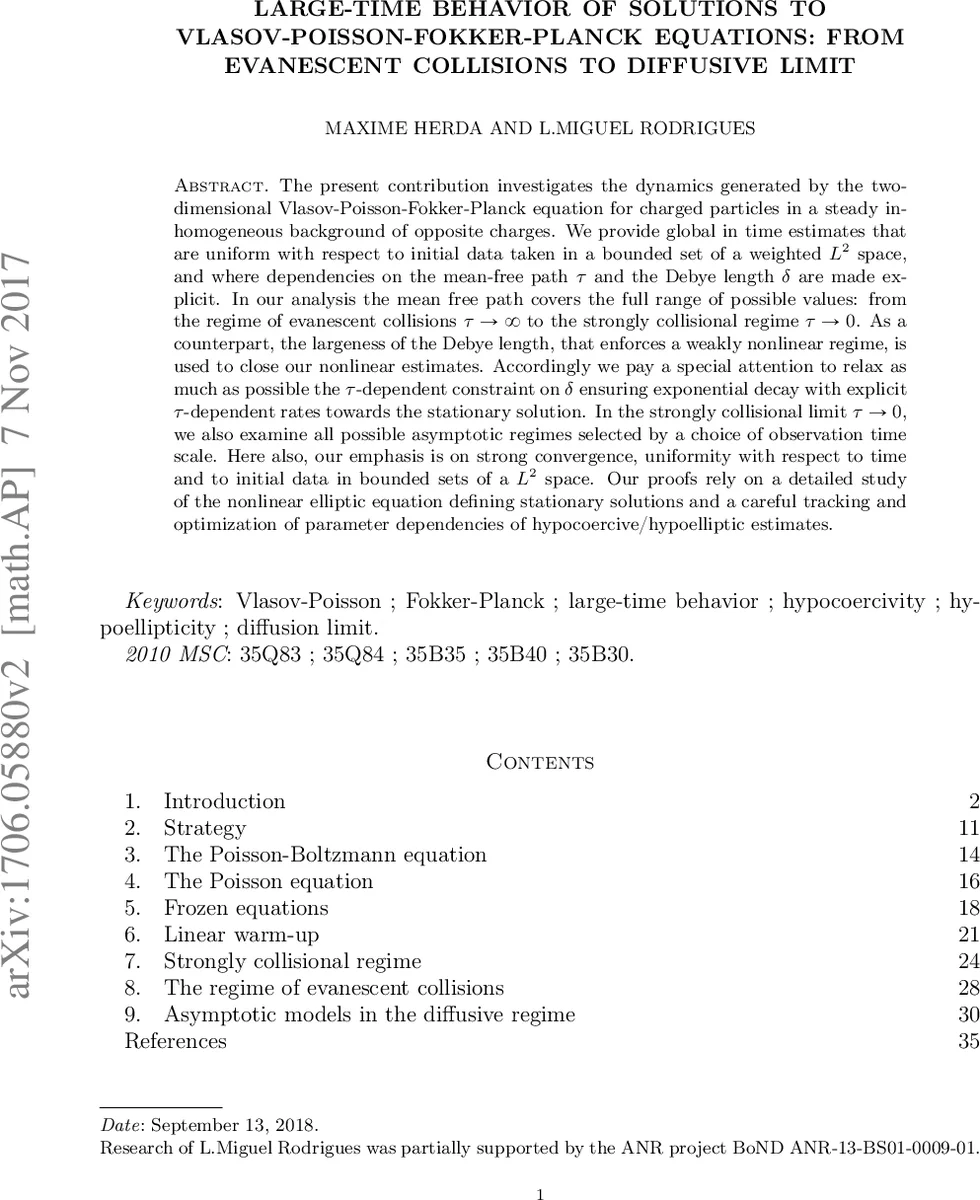
The present contribution investigates the dynamics generated by the two-dimensional Vlasov-Poisson-Fokker-Planck equation for charged particles in a steady inhomogeneous background of opposite charges. We provide global in time estimates that are uniform with respect to initial data taken in a bounded set of a weighted $L^2$ space, and where dependencies on the mean-free path $τ$ and the Debye length $δ$ are made explicit. In our analysis the mean free path covers the full range of possible values: from the regime of evanescent collisions $τ\to\infty$ to the strongly collisional regime $τ\to0$. As a counterpart, the largeness of the Debye length, that enforces a weakly nonlinear regime, is used to close our nonlinear estimates. Accordingly we pay a special attention to relax as much as possible the $τ$-dependent constraint on $δ$ ensuring exponential decay with explicit $τ$-dependent rates towards the stationary solution. In the strongly collisional limit $τ\to0$, we also examine all possible asymptotic regimes selected by a choice of observation time scale. Here also, our emphasis is on strong convergence, uniformity with respect to time and to initial data in bounded sets of a $L^2$ space. Our proofs rely on a detailed study of the nonlinear elliptic equation defining stationary solutions and a careful tracking and optimization of parameter dependencies of hypocoercive/hypoelliptic estimates.
💡 Research Summary
The paper studies the two‑dimensional Vlasov‑Poisson‑Fokker‑Planck (VPFP) system on the periodic torus T², describing the evolution of a charged particle distribution f(t,x,v) under self‑consistent electrostatic forces and a thermal bath. The model contains two dimensionless parameters: the mean free path τ, which measures the strength of collisions with the bath, and the Debye length δ, which quantifies the range of electrostatic interaction. The authors consider initial data belonging to a weighted L² space L²(M⁻¹) (with the Maxwellian M(v) as weight) and uniformly bounded in that norm by a prescribed constant R₀. Their goal is to obtain global‑in‑time existence, uniqueness, and exponential convergence to equilibrium that are uniform with respect to the whole family of admissible initial data, while making the dependence on τ and δ completely explicit.
Stationary states.
A stationary solution must satisfy the Maxwell‑Boltzmann form
f₈(x,v)=M(v) e^{‑φ₈(x)}
and the nonlinear Poisson‑Boltzmann equation
δ²Δφ₈ = e^{‑φ₈} – ρ⁰,
where ρ⁰(x) is the prescribed background charge density. Under the assumption ρ⁰∈W^{1,p}(T²) with p>2 and the normalization ∫{T²}ρ⁰=1, the authors prove that for any δ>0 there exists a unique weak solution φ₈∈H¹∩L^∞. Moreover, they obtain quantitative bounds on ‖∇φ₈‖{L^∞} that decay like 1/δ when δ is large. This “large‑δ” regime is crucial because it makes the nonlinear electric field term small enough to be treated as a perturbation.
Linearized dynamics and hypo‑coercivity.
Linearizing the VPFP equation around (f₈,φ₈) yields the operator
L_τ h = –v·∇_x h – ∇_x φ₈·∇_v h + (1/τ) div_v(v h + ∇v h).
The first two terms are skew‑adjoint (transport and mixing), while the last term is a symmetric dissipative Fokker‑Planck operator acting only in velocity. The system is therefore hypo‑coercive: dissipation in velocity is transferred to space through the transport coupling. The authors construct a τ‑dependent Lyapunov functional
E(t)=‖h‖²{L²(M⁻¹)} + a τ⟨∇_x h,∇_v h⟩ + b τ²‖∇_x h‖²,
with carefully chosen constants a,b>0. By differentiating E(t) along solutions and using commutator estimates, they obtain a differential inequality
dE/dt ≤ –θ(τ) E + C δ^{-2}‖h‖²,
where the decay rate θ(τ) behaves like min{1/τ, τ}. Consequently, in the “evanescent collision” regime τ≫1 the decay is governed by the mixing mechanism and scales like 1/τ, whereas in the “strongly collisional” regime τ≪1 the Fokker‑Planck dissipation dominates and the rate scales like τ.
Nonlinear control and δ‑dependence.
The full nonlinear term involves ∇x φ·∇v f, which can be written as a sum of a linear part (already included in L_τ) and a remainder containing φ–φ₈. Using the Poisson‑Boltzmann estimate, the authors show
‖∇x(φ–φ₈)‖{L^∞} ≤ C δ^{-1}‖h‖{L²(M⁻¹)}.
Thus the nonlinear remainder is multiplied by a small factor C δ^{-1}. By choosing δ larger than a τ‑dependent threshold (explicitly given in the theorems), the remainder can be absorbed into the left‑hand side of the Lyapunov inequality. This yields a closed Grönwall estimate and the main result: for any τ>0 and any initial data with ‖f₀‖{L²(M⁻¹)}≤R₀, the solution satisfies
‖f(t)–f₈‖{L²(M⁻¹)} ≤ K ‖f₀–f₈‖{L²(M⁻¹)} e^{‑θ₀ t},
with constants K>1 and θ₀>0 that depend explicitly on τ, δ, and R₀. The same exponential bound holds for the difference of two solutions, giving Lipschitz continuity of the flow in the weighted L² topology.
Diffusive limit (τ→0) and time‑scale analysis.
When τ is small, the kinetic equation exhibits a separation of time scales: the velocity variable relaxes on the fast scale τ, while the spatial density evolves on a slower scale. The authors consider two rescaled times: t̂ = t/τ (the kinetic relaxation time) and t̃ = t/τ² (the diffusive time). By performing a Chapman‑Enskog‑type expansion and using the uniform bounds obtained earlier, they prove strong convergence (in the same weighted L² space) of the kinetic solution to the solution of a nonlinear diffusion equation for the macroscopic density ρ(t,x). In particular, for the t̂‑scale they obtain
∂_t ρ = Δ_x ρ + O(τ),
and for the t̃‑scale they obtain a further reduced dynamics where the electric field becomes essentially static. The convergence is uniform in time and holds for any family of initial data bounded in L²(M⁻¹).
Comparison with existing literature.
Previous works (e.g., Bedrossian 2020, Hérau‑Thomann 2015) treated the τ→∞ regime using Landau damping and mixing‑enhanced dissipation, obtaining decay rates that involve δ τ^{-1} and require strong regularity. Jin‑Zhu (2021) studied the τ→0 limit but needed a condition of the form δ τ and imposed high Sobolev regularity on the data. The present paper improves on both fronts: it works entirely in the natural weighted L² setting, provides explicit τ‑dependent thresholds for δ, and delivers exponential decay with optimal rates min{1/τ, τ}. Moreover, the strong convergence results in the diffusive limit are new in this low‑regularity framework.
Conclusions and significance.
The authors establish a unified theory for the VPFP system that covers the full spectrum of collision frequencies, from almost collisionless to highly collisional regimes. By exploiting hypo‑coercivity and hypo‑ellipticity simultaneously, they obtain explicit, optimal decay rates and uniform bounds that are robust with respect to the initial data. The explicit dependence on the physical parameters τ and δ offers quantitative guidance for plasma modeling where both collision frequency and Debye length may vary. The strong convergence results in the diffusive limit further bridge kinetic and macroscopic descriptions, providing a rigorous justification of diffusion approximations in a low‑regularity setting. Overall, the work represents a substantial advance in the mathematical analysis of kinetic equations with self‑consistent fields and collisional effects.
Comments & Academic Discussion
Loading comments...
Leave a Comment