AlfaMC: a fast alpha particle transport Monte Carlo code
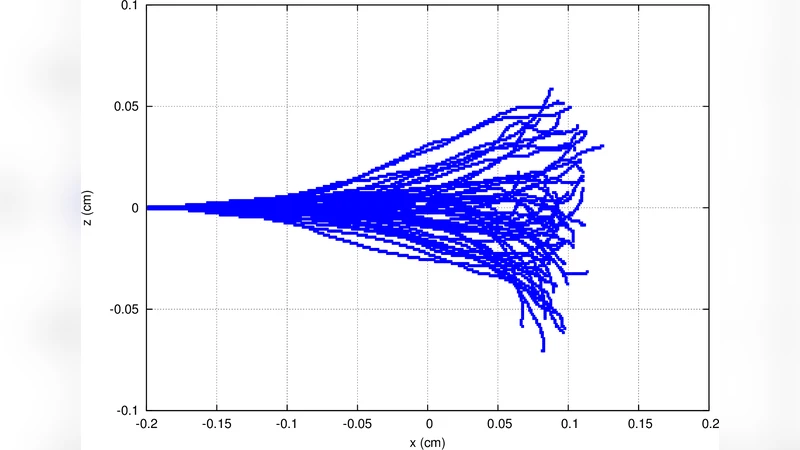
AlfaMC is a Monte Carlo simulation code for the transport of alpha particles. The code is based on the Continuous Slowing Down Approximation and uses the NIST/ASTAR stopping-power database. The code uses a powerful geometrical package allowing the coding of complex geometries. A flexible histogramming package is used which greatly easies the scoring of results. The code is tailored for microdosimetric applications where speed is a key factor. Comparison with the SRIM code is made for transmitted energy in thin layers and range for air, mylar, aluminum and gold. The general agreement between the two codes is good for beam energies between 1 and 12 MeV. The code is open-source and released under the General Public Licence.
💡 Research Summary
AlfaMC is a dedicated Monte Carlo code for simulating the transport of α‑particles, designed with speed as a primary goal for micro‑dosimetric applications. The core physical model relies on the Continuous Slowing‑Down Approximation (CSDA), which treats energy loss as a deterministic, continuous function of depth rather than simulating each individual collision. By coupling CSDA with the NIST/ASTAR stopping‑power database, AlfaMC obtains material‑specific energy‑loss curves that are accurate over the 0.5 MeV–20 MeV range typical for α‑particle beams. This combination yields a fast yet sufficiently precise description of range and transmitted energy, especially in the 1–12 MeV interval examined in the paper.
A major strength of AlfaMC lies in its geometry engine. The code includes a native package that can construct primitive shapes (spheres, cylinders, boxes) and combine them through Boolean operations to form arbitrarily complex volumes. Users describe the geometry in a simple text‑based script, allowing rapid prototyping of multilayer films, masks, micro‑channels, or any experimental setup without resorting to external CAD tools. Material boundaries are explicitly defined, so the code automatically applies the appropriate stopping‑power data when a particle crosses from one medium to another.
Scoring is handled by a flexible histogram module. Users can request one‑dimensional energy spectra, two‑dimensional position‑energy maps, voxel‑wise dose distributions, or any custom binning scheme. Histograms are created and updated on the fly, with memory management optimized for large numbers of histories, thus preventing the memory bottlenecks that often limit traditional Monte Carlo packages.
To validate performance, the authors compared AlfaMC against the widely used SRIM/TRIM code. Simulations were carried out for four representative materials—air, Mylar, aluminum, and gold—over a range of thicknesses from a few micrometres to several tens of micrometres and for incident α‑energies between 1 MeV and 12 MeV. The transmitted‑energy distributions and mean ranges predicted by AlfaMC agreed with SRIM within about 2 % for most cases, with the best agreement at higher energies (>5 MeV). Small deviations appeared for ultra‑thin layers where statistical fluctuations dominate, but overall the agreement is deemed satisfactory for micro‑dosimetric purposes. Importantly, AlfaMC achieved the same statistical precision in roughly one‑tenth of the CPU time required by SRIM, confirming its claim of high computational efficiency.
AlfaMC is released under the GNU General Public License, making the source code freely available for inspection, modification, and redistribution. Its modular architecture encourages extensions such as adding new material libraries, implementing more sophisticated scattering models (e.g., multiple Coulomb scattering or nuclear interactions), and exploiting GPU acceleration for further speed gains. The open‑source nature also facilitates integration with other simulation frameworks or experimental data pipelines.
In summary, AlfaMC provides a lightweight, fast, and reasonably accurate tool for α‑particle transport, particularly suited to applications where large numbers of particle histories must be processed quickly, such as micro‑dosimetry, detector response studies, or thin‑film analysis. The combination of CSDA physics, a powerful geometry description, and a versatile scoring system makes it a valuable alternative to more heavyweight codes like SRIM, while its open‑source status ensures that the community can continue to improve and adapt it to emerging research needs.