Full-Duplex Non-Orthogonal Multiple Access for Modern Wireless Networks
Non-orthogonal multiple access (NOMA) is an interesting concept to provide higher capacity for future wireless communications. In this article, we consider the feasibility and benefits of combining full-duplex operation with NOMA for modern communica…
Authors: Mohammadali Mohammadi, Xiaoyan Shi, Batu K. Chalise
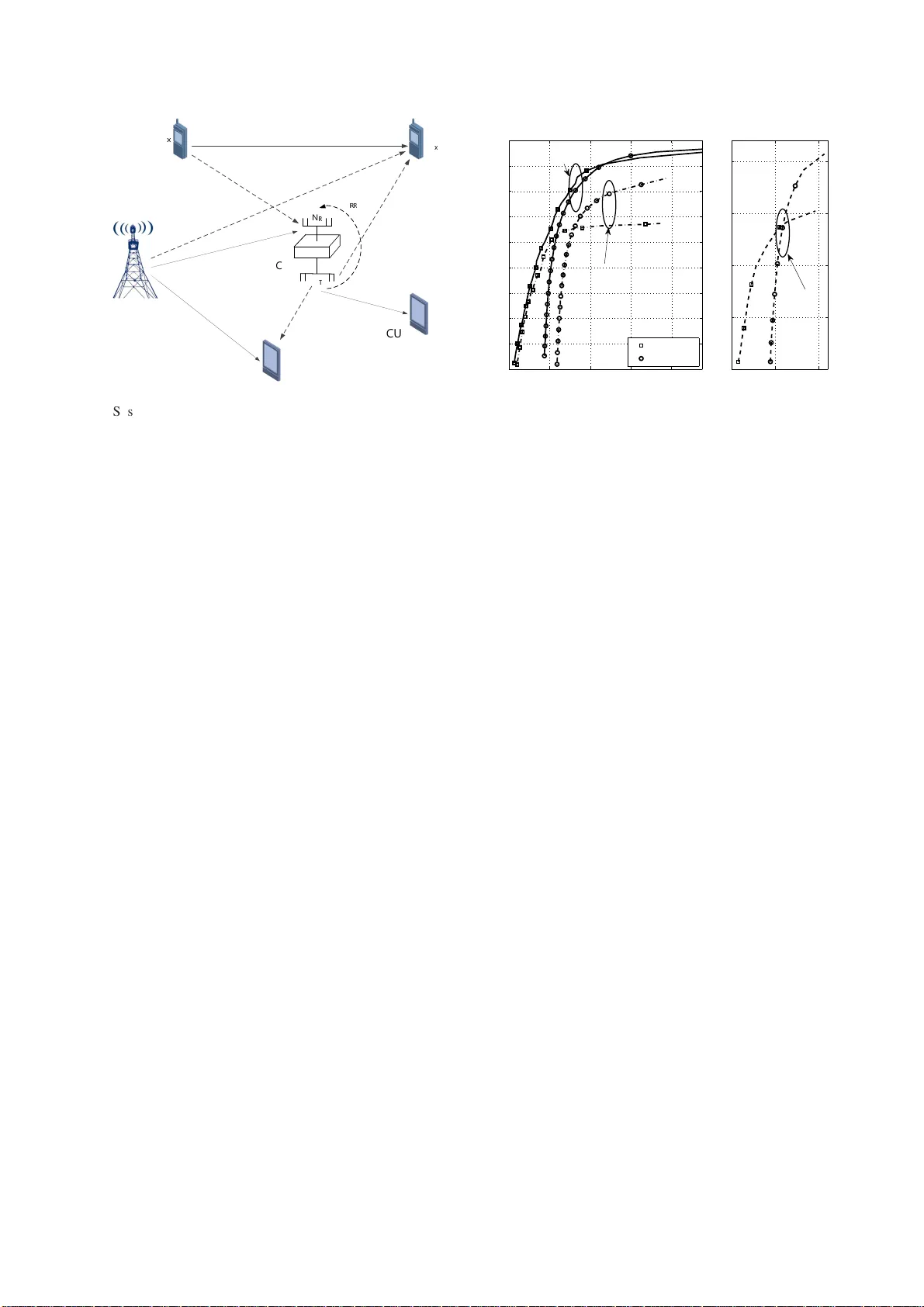
1 Full-Duple x Non-Orthogonal Multiple Acce ss for Modern W ireless Netw orks Mohammadali Mohammadi, Member , IEEE, Xiaoyan Shi, Student Member , IEEE, Batu K. Chalise, Senior Member , IEEE, Himal A. Sura wee ra, Senior Member , IEEE, Caijun Zhong, Seni or Member , IEEE, an d Joh n S. Thompson , F el low , IEEE Abstract Non-or thogon al multiple access (NOMA) is a n interesting concep t to provide higher capacity for f uture wireless commun ications. In this article, we consider the feasibility and benefits of combining full-duplex operation with NOMA for modern communic a tio n systems. Specifically , we provid e a compr ehensive overview on application of full-du plex NOMA in cellular n etworks, coope r ativ e and cog n iti ve r adio net- works, and chara cterize gains possible due to full-du plex oper ation. Accor dingly , we discuss challen ges, particularly the self- interferen ce and inter-user in terference and pr ovide potential solutions to inter ference mitigation and quality-of -service p rovision based on beamf orming, power control, and link scheduling. W e further discuss future research challeng es an d interesting directions to pursue to br ing f ull-duplex NOMA into matur ity and use in practice . I . I N T R O D U C T I O N The proliferation of multimedia services , coupled with ever growing numbe r of mobile subsc ribers, has led to a deman d for increas ed spectral efficiency in the emerging wireless co mmunication networks suc h as fifth ge neration (5G) c ellular co mmu nication networks. T o meet this demand, full-duplex c ommunication, i.e., simultaneou s transmission and rec eption on the sa me c hannel at the same time, h as the potential to M. Mohammad i is with the Faculty of Engineering, Shahreko rd Univ ersity , Shahrekord 115, Iran (email: m.a.mohammadi@eng.sk u.ac.ir). B. K. Chalise is wi th the Clev eland St at e Univ ersity , 2121 Euclid A venue, Clev eland, OH 44115, USA (email: b .chalise@csuohio.edu). H. A. Suraweera is with the Department of Electrical and Electronic Engineering, University of P eradeniya, P eradeniya 20400 , Sri Lanka (email: himal@ee.pdn.ac.lk). C. Zhong is with the Department of Information S cience and Electronic Engineering, Zhejiang Uni versity , Hangzhou 310027, China (email: caijunzhong @zju.edu.cn). X. Shi and J. S. Thompson are with the Institute for Digital Communications, School of Engineering, Univ ersity of Edinbur gh, United Kingdom (email: Xiaoyan.Shi, John.Thompson@ed .ac.uk). Nov ember 3, 2017 DRAFT double the spectral efficiency of traditional half-duplex networks [1]. In practice, h owe ver , the increase in throug hput due to full-duplex o p eration is limited by the pres ence of unav oidab le s elf-interference (SI) cause d by the signal leak age from the transc eiv er o utput to the inpu t [2]. Rece nt a dvances in a n tenna and transceiver design e n able SI canc ellation at practica l co sts, and manag ed to limit SI up to the receiver noise floor [3]. Therefore, full-duplex tec hnology h a s be en rec ognized a s a promising candidate for 5G network design. On a pa rallel d ev elopme nt, non-orthogo n al multiple ac cess (NOMA) is anothe r promising c oncept for improving the s pectral efficiency o f next generation wireless networks [4]. As su ch a downlink version of NOMA, termed as multiuser su perposition transmission (MUST), has be e n included in the 3GPP long term ev olution-advanced (L TE-A) standa rd [5]. NOMA leverages its flexible architecture to provide coverage and throughput expan sion in a cost eff ective mann e r . Although use r multiplexing through p ower allocation among the us ers reduce s the a llocated p ower to ea ch single user , b oth use rs with strong channe l condition (which we refer to as NOMA-strong user) and users with poor cha nnel conditions (which we refer to as NOMA-weak user) benefit from b eing s cheduled more often and be ing assigned more ba ndwidth. Therefore, the a verage through put can be increa sed significa ntly at a moderate increase of the system complexity [4], [5]. Moreover , NOMA is comp a tible with orthogona l frequency division multiple acces s in the downlink, and thu s the n u mber of simultane ously served users can be almost doubled (up to two users multiplex ed in power -domain at the same s ub-band), which is s uitable to add ress the cha llenges related to massive co nnectivity and low trans mission laten cy in 5 G wireles s networks. F urthermore, NOMA provides robust performance even in high mobility sce narios, sinc e the NOMA transmitter does not rely much on channe l s ta te information (CSI) feedb a ck from the re c eiv er for use r multiplexing [6]. NOMA can be a lso applied to multi- an tenna ne tworks which provide additional d egrees-of-freedom for further performance improvement [7]. The multi-antenna aspec t has a lso been address e d in the co ntext of MUST , showing that multiple-input-multiple-output (MIMO) techno logy and NOMA can be used jointly to provide c ombined gain. Most of the work o n NOMA to date, howe ver , is limited to the half-duplex ope ration. Since bo th NOMA and full-duplex techniques improv e the s pectral e f ficiency , it would be interesting to in vestigate the additional b enefit that can be ac h iev ed by comb ining them. A potential application o f full-duplex transceivers in NOMA sys tems is to enab le simultaneou s uplink and downlink transmiss ion s in a cellular network, where data from the paired us ers in the uplink chan nel, and data to the p a ired users in the downlink c hannel are transmitted and rec eiv ed at the same time on the same frequency . Furthermore, b y incorporating the full-duplex operation in downlink transmiss ions, a NOMA use r clos e to the base station (BS) can rec eiv e data and simultaneously forward data to a more distant NOMA user over the s ame carrier frequency . Hence, the requ irement for extra time slots for relaying is av oided. T here have been few recent studies on the combination of full-duplex operation and the NOMA principle, which unanimou sly con cede that the con sideration of full-duplex communica tions in the NOMA-based networks is not a tri vial task. The main con cern with full-duplex ope ration is that transmissions suffer from both SI and inter- use r interference, which sign ificantly affect the design proce s s of NOMA sys tems and degrade the sys tem p e rformance. In this c ontext, we clearly sh ow how SI and inter -user interference affect full-duplex NOMA systems u sing several sys te ms as examples: uplink a nd downlink ce llular commun ications, cooperative, and cogn iti ve radio networks. In this article, we first prese nt the state-of-the-art on full-duplex NOMA sys tems. Then, we introduce various full-duplex NOMA de signs for several networks and quantify the performance gain du e to full- duplex transmiss ion s. Spe cifically , we ch aracterize the uplink and downlink full-duplex NOMA, whe re a full-duplex BS serves uplink an d downlink half-duplex us ers simultaneou sly in the sa me radio resource . The c oncept of co operativ e full-duplex NOMA will then be de scribed an d con sequen tly the application o f the NOMA in the full-duplex c ogniti ve radio networks will b e discuss ed. F rom the optimization algorithm perspec tive, we also discuss resource mana gement for a NOMA system opera ting with the full-duplex technique. Fina lly , research cha llenges and some promising future directions for designing full-duplex NOMA s ystems are highlighted. I I . F U L L - D U P L E X N O M A T R A N S M I S S I O N S A. NOMA Bas ics NOMA re a lizes multiple acc ess by exploiting the p ower do ma in, which is fun damentally different from con ventional orthogona l multiple acc e ss (OMA) tec hnologies [5], [7]. In co ntrast to the c o n ventional “water - filling” power a llocation, NOMA allocates more power to users with worse chan nel co nditions than those with be tter cha n nel conditions, thus, imposing a n add itional fairness cons traint. For the s ake of c onceptua l clarity , let us cons ider a single ce ll d ownlink NOMA with one BS and two users, denoted as DL1 and DL 2 res pectiv ely . Conside r that DL2 is located close to the ce ll-edge, and hence s uf fering from poor chann el c onditions. BS transmits a superpos ition co ded s ignal, which is a s um of both users’ signa ls. Acc ording to the NOMA principle, the transmit power o f the information signal for DL2 must be greater than that for DL1. Since DL2’ s channe l co n dition is very poor , the interference from DL1, caus ed by the su perimposed transmit s ignals, will no t cause much performance degrada tion to DL2. Ac cordingly , DL2 de codes directly its information signal b y treating the interference induc e d by the DL1 as noise. In contras t, DL1 ca n decode its own information signa l a fter removing the DL2’ s signal through a suc cessive interference ca ncellation (SIC) rec eiv er . Therefore, b oth DL1 and DL2 are sche d uled for commun ic a tion a t a time-slot, hence, the s ystem through p ut ca n be s ignificantly improved compa red to the OMA sc hemes. B. State-of-the-Art o n Full-duplex NOMA System s The possible us e cas es of above des cribed NOMA concep t benefiting from full-duplex o peration are a full-duplex BS serving u plink and downlink us ers s imultane ously in the same radio resource [8], and cooperative NO MA systems where full-duplex NOMA users [9], [10] or dedicated full-duplex relays [11] assist the transmissions between the s o urce and NOMA-wea k us ers. T h e a uthors of [8] in vestigated the resource a llocation algorithm des ign for a full-duplex multicarrier NOMA sy stem, where a full-duplex BS is simultaneou s ly se rving multiple ha lf-duplex downlink an d uplink users. The entire frequency band is partitioned into multiple orthogona l subcarriers, whe re e ach su bcarrier is allocated to at most two downlink users and two uplink use rs. Resource allocation algorithm des ign for the maximization of the weighted sum throughpu t of the sy s tem is formulated as a non-con vex optimization p rob lem a nd the o ptimal power and s ubcarrier alloca tion policies have bee n obtaine d . The s econd case is termed as full-duplex cooperative NOMA, where different users in a NOMA n etwork cooperate with each other to e nhance the performanc e. Cooperative relaying ha s bee n extensively studied as an effecti ve method for establishing c onnectivity betwee n the n o des of the network. Hen ce, cooperative NOMA is a natural extension o f relaying sys tems that can take advantage of the redu ced attenua tion between the relay node and NOMA-weak users [9]–[12 ]. In [9], a full-duplex device-to-device aided cooperative NOMA s cheme was propose d where the NOMA-strong user is full-duplex ca p able. Moreover , the authors in [9] propose d an ada p ti ve mu ltiple a ccess scheme, which dynamically switches betwee n the propos ed cooperative NOMA, c on ventional NOMA, and OMA schemes, according to the level of res idual SI and the quality of links , and outperforms all other multiple access s chemes . T he authors in [10] provided a div ersity analysis for cooperative full-duplex NO MA sys tems and proved that the use o f the direct link overcomes the lack of d iversity for the NOMA-wea k user which is otherwise inherent to the full-duplex relaying. In [11 ] a dual-user NOMA sy s tem was studied , where a dedica ted full-duplex relay ass ists information transmission to the user with the we aker chann el cond ition. The propos ed full-duplex coope rati ve NOMA system [11 ] achieves high er ergodic su m capa city c o mpared to the half-duplex coop erati ve NOMA counterpart in the low to mo derate signal-to-noise (SNR) regimes. Methods to determine possible data rates for a full-duplex cooperative NOMA s ystem with relaying were propose d in [12]. Most o f the current work on full-duplex NOMA shows that the achiev able gains are sensiti ve to the amount of res idual SI power . In practice, the residua l SI bring new challenge s in making a SIC rec eiv er feasible. Each full-duplex rec eiv er need s to first c ancel its own SI, an d then proc eed to de code the inter - user interference s ignals and fi n ally recover its own signal. The refore, the accu racy of the adopted SI cance ller will play a piv otal role in the SIC proc ess. The increase d interference at user terminals in full- duplex sc enarios will make it difficult for the receiver to canc el the strong signal be fore d e coding its own messag e . In o rder to fully exploit the b enefits of full-duplex NOMA, a dvanced SI ca ncellation technique s Base Station h h UL 2 g g UL 1 DL 1 DL 2 Information link Interference link H Fig. 1: Sy stem mode l: Full-duplex NOMA with two downlink users and two uplink users. and approache s such as c oordinated multi-point, interference a lignment coupled with s ophisticated e rror correction co ding sc hemes appea r to be ne cessa ry . I I I . U P L I N K A N D D OW N L I N K F U L L - D U P L E X N O M A As ce llular networks ev olve, there h as bee n an increasing empha sis on the need for ef fic ien t transmission scheme s . In legacy cellular networks, orthog onal resource allocation me chanisms limit the max imum number of supp o rted use rs with the finite res ources. NOMA can ac commodate multiple use rs simultaneo u sly via no n -orthogonal resource alloca tion. Initial system implementa tions of NOMA in ce llular networks have demonstrated the s uperior spe ctral efficiency of N OMA. A p o tential way to ac h iev e highe r spectral e f ficiency in NOMA-base d c ellular networks is through the use of full-duplex transmis s ion at the BS, so that the BS ca n transmit to multiple paired downlink u s ers and rece ive from multiple paired uplink us ers in the s ame time and frequency band. However , the bene fits of full-duplex commu nication for ce llular networks canno t be reape d without having some cos t increment. As an illustrating example, Fig. 1 shows a simple dua l-user system where DL1 (UL1) and DL 2 (UL2) represent a NOMA-strong downlink (uplink) use r an d a NOMA-weak downlink (uplink) user , res pectively . As illustrated in Fig. 1, the uplink c ommunication is af fected b y the SI at the BS a nd the downli nk communication s uff ers from the inter -use r interference resu lting from the uplink users sharing the s ame time/frequency resou rce . The a pplication o f multiple antenn as to NOMA provides additional degrees-of-freedom for further performance improvement. A transmission framew ork based on signal alignment was proposed in [7] for MIMO-NOMA systems , wh ich is ap plicable to b o th uplink a n d downlink transmissions and offers a s ignificant pe rformance gain in te rms of reception reliability . Howe ver , full-duplex cellular networks 10 15 20 25 30 35 40 0 2 4 6 8 10 12 ρ b (dB) Ergodic Sum Capacity (bps/Hz/cell) UL/DL FD−NOMA: ZF/MRT UL/DL FD−NOMA: MRC/MRT HD−NOMA Single−cell Multi−cell Fig. 2: E r godic capac ity comp a rison b etween the uplink/downli nk full-duplex and half-duplex NOMA systems in single-cell and multi-cell scena rios and for N T = 3 transmit antenna s and N R = 2 receive antennas at the BS and for σ 2 SI = − 10 dBW . dif fer from their ha lf-duplex cou nterparts in that the uplink transmiss ion will be affected by the SI and the uplink users will interfere with the downlink reception. Therefore, in practice, the trans c eiv er d esign for full- duplex BS mus t be revisited to ac hiev e the p romised gain of the full-duplex o p eration. The BS could use its multiple antennas for spatial SI cancellation and conse quently for improving the signa l-to-interf eren ce-plus- noise ratio (SINR) of bo th up link a n d downlink trans missions. In Fig. 2 we presen t a nu me rical example demonstrating the ergodic sum ca pacity for mu lti-cell and sing le-cell envi ronme n ts. Simulations adopt parameters of the 3GPP L TE for s mall ce ll d eployments. Th e receive beamformer at the BS is designe d with a zero-forcing (ZF) c onstraint. Transmit beamformer is design ed base d on the maximum ra tio trans miss ion (MR T) principle. In single-cell en vironment the ha lf-duplex s ystem outperforms the full-duplex s ystem with maximum ratio c ombining (MRC)/MR T sche me at high S NR . T he results in multi-cell scena rio demons trate that full-duplex o peration significa n tly outpe rforms the half-duplex c ounterpart over the entire SNR regime. Full-duplex NOMA s ystem achieves 75% highe r average s u m rate tha n the half-duplex coun terpart at SNR of 20 dB. In a multi-cell en vironmen t, co -channel interferen c e will determine the performance ga p between full-duplex a nd half-duplex mod es. H owever , c o -channel interference can be reduced significantly by exploiting techniqu es su ch as interference c oordination. Moreover , cho ice of beamforming de sign will also be crucial to rea lize the b e nefits of full-duplex NOMA sys tems as requiremen ts of the ne ar/far users as we ll as constraints imposed b y the NOMA principle must b e incorporated. Base Station f 1 f 2 UE2 h 1 UE1 Slot 1 Slot 2 (a) HD: User assisted Relay Base Station f 1 f 2 UE1 h 1 h 2 UE2 Slot 1 Slot 2 (b) HD: Relay assisted Base Station f 1 f 2 UE2 f r UE1 h 1 (c) FD: User assisted Relay Base Station f 1 f 2 UE1 h 1 h 2 UE2 f r (d) FD: Relay assisted Fig. 3: Sy stem mode l: Dual-user co operativ e NOMA. I V . C O O P E R A T I V E F U L L - D U P L E X N O M A It is well-known that coop erati ve communica tions can be used to extend the c overage an d improve the communic a tion reliability . The a ttractive features of coopera tive c ommunication can b e reaped us ing relati vely simple s ignal proce ssing techniqu es, howe ver its potential is n ot ye t fully explored for NOMA transmissions. In the literature, there are two d if ferent types of coop erati ve NOMA sys te ms , n amely , the user-assisted cooperative NOMA [13] and the rela y -assisted cooperative NOMA [14]. T o explain the bas ic concep t, let us con sider the dual-use r c ooperative NOMA sy stem as ill ustrated in Fig. 3(a) and 3(b). For user-assisted co o perativ e NOMA, the NOMA-strong user , h e lps the NOMA-weak user , exploiting the fact that the NOMA-strong user is able to decode the information for both users. For the relay-ass isted cooperative NOMA, a dedicated relay is employed to ass is t the NOMA-weak user . While coope ration improves the reliability of the NOMA systems, the impleme n tation of co operation among users o r relays requires add itional time resources , which results in a loss o f spe ctral efficiency . Since one of the key features of NOMA is the improvement of s pectral efficiency , s uch spe ctral efficiency degradation due to co operation is h ighly unde sirable. T o ta c kle this critical issue, and capitalize on the recent advances in full-duplex communica tions, we propose to e mpower the c ooperativ e node with the full- duplex capa bility as illustrated in Fig. 3(c) a nd 3(d), where both the NOMA-strong user a nd relay o perate in the full-duplex mod e. In h a lf-duplex relays, two time slots a re required to forward da ta to a relay an d then to the d e stination. The full-duplex co operativ e systems eliminate the add itional time slot required for cooperation, which p otentially doubles the s pectral e f ficien cy . Ho wever , the adoption of full-duplex 0 5 10 15 20 25 30 0 1 2 3 4 5 6 7 8 9 ρ s (dB) Ergodic Sum Capacity (bps/Hz) HD relaying [2] FD relaying: k 1 = 0.1 2 , k 2 = 0.08 2 FD relaying: k 1 = 0.1 2 , k 2 = 0.2 2 FD relaying: k 1 = 0.2 2 , k 2 = 0.2 2 FD relaying: Perfect cancellation Fig. 4: Er godic ca pacity comparison be tween the relay-assisted h alf-duplex and full-duplex cooperative NOMA systems with relay transmit power ρ r = ρ b / 2 , p ower allocation co efficients a 1 = 0 . 05 and a 2 = 0 . 95 , channe l gains for f 1 being λ b 1 = 1 , for f 2 , h 1 and h 2 being λ br = λ r 1 = λ r 2 = 0 . 5 , while for f r being λ r r = 0 . 3 . may signific antly elev ate the interference level. For an exa mple, c onsider the relay -a s sisted full-duplex cooperative NOMA, which, in addition to the SI at the full-duplex rela y also creates h armful interference at the NOMA-strong user . T o se e the p ractical gain o f full-duplex coop erati ve NOMA, let us consider the simple model shown in Fig. 3(d), whe re the BS transmits the sup e rimposed signa l to user equ ipme nt UE1 and the relay , while the relay overhears the superimpos e d signal, and at the same time, transmits a previously receiv ed signal intend ed for UE2. Since b oth UE1 and relay are aware of the signal intende d for UE2, known interference ca ncellation tech niques can be ap plied. Howev er , du e to imperfect cance llation, residual interference is likely to exist. Le t k 1 and k 2 denote the residual interference power lev el a t UE1 and the relay , respectively . According to Fig. 4, the ergodic sum capac ity of the full-duplex cooperative NOMA system is be tter than that o f the half-duplex coo p erati ve NOMA s ystem in the lo w to mo derate SNR range. Moreover , the gain is less sen s iti ve to the strength of the residual SI power , e s pecially in the low SNR regime. This important observation ind icates that the ga in may be realized without stringent requirements on SI can c ellation cap a bility . In con tras t, the ergodic su m c apacity o f the full-duplex coo p erati ve NOMA system is worse than tha t of the h alf-duplex coo perativ e NOMA s ystem in the high SNR regime, mainly due to high interference lev el, indicating the c ritical importance of SI mitigation in this regime. Base Station (CS) h 1 h 2 CU 1 f 1 H CU 2 f 2 h RP h BP h PR P T P R CR N N (a) S ystem model (Dashed lines denote the interference links.) 0 2 4 6 8 0 0.5 1 1.5 2 2.5 3 3.5 4 4.5 Rate of Near User (bpcu) Rate of Far User(bpcu) I th = 0 dBW I th = 15 dBW 0 1 2 0 0.5 1 1.5 2 Rate of Near User (bpcu) Rate of Far User(bpcu) FD, suboptimum FD, optimum HD (b) Rate region achie ved by the optimum and the suboptimum schemes. Fig. 5: Co gniti ve NOMA with full-duplex relaying. V . N O M A I N F U L L - D U P L E X C O G N I T I V E R A D I O N E T W O R K S NOMA can be viewed as a n special case of cogn iti ve radio ne tworks (CRNs ), whe re a user with a strong chann el con dition is s q ueeze d into the spe ctrum occ u pied by a user with a po or c hannel condition. The strong-us er ca n be viewed as a primary user and the weak-use r ca n be viewed a s cognitive us e r in the CRN. Th erefore, ac c ording to the principle of CRNs , the transmit power allocated to the strong-use r is c onstrained by the weak-user’ s SINR. Following this concep t, a variation of NOMA, termed cognitiv e radio inspired NOMA has bee n proposed in [6]. The NOMA conce pt is applica b le for un derlay CRNs, wh e re a cognitiv e s ource (CS) communicates with two o r more c ogniti ve users (CUs) using the NOMA conc ept. All transmission s o f the cognitiv e network occ ur in the transmission band o f the primary network, provided any interference caus ed to a primary user is kept below a pred e fined thresho ld. Giv en this interferenc e con straint, the performanc e of the cog niti ve network is strictly limited. Coope rative techniques help to redu c e the transmiss ion power a s the commu n ication distances in co gniti ve network a re dec rea sed by using a c ognitiv e relay (CR). He nce, the mutual interferenc e between primary and cog n iti ve networks can b e manag ed e f fectively . If the CR operates in a half-duplex mode, at leas t two orthogona l communica tion p hases are neede d, which reduces the throughput. This los s in spectral efficiency can be mitigated with the h elp of full-duplex radio a t the CR as shown in Fig. 5(a). On the other ha nd, however , ad o pting the full-duplex relay into the CRNs c an resu lt in a series of problems. Due to the full-duplex op e ration a t the CR, the primary receiv er simultaneously receiv es interference from CS a nd CR. Therefore, in order to satisfy the interference co nstraint, the transmission powers at the CS and CR, must be lower than those in the ha lf-duplex case. Moreover , the signal receptions at the CR a nd NOMA-strong u ser are c onfronted with SI and co-cha nnel interference, respe cti vely . T o d eal with thes e challenges, we prop ose to employ attracti ve techn iques, such as joint power alloca tion be tween the CS and CR and/or CR beamforming de sign (in cas e of MIMO-CR). Fig. 5(b) depicts the achievable rate region of the CRN in Fig. 5(a) for d ifferent levels of predetermined maximum tolerable interferenc e le vel, I th , at the p rimary rec e i ver , where CR is equipp e d with N T = 3 transmit antennas and N R = 2 rec eiv e a ntennas. W ith the optimum sch e me, rece ive and transmit beamformers at the CR and the transmit power levels at CS a nd CR a re jointly optimized s o that the CU1 ’ s capa city is maximized, while the CU2’ s cap acity is guaranteed to b e a bove a certain value. W ith sub optimum design, the rec eiv e and transmit beamformers a t the CR are de s igned u sing the MRC and MR T principles, resp ectiv ely , an d the transmit power levels at CS a nd CR are optimized. As c an be observed, the achiev able rate of the CU1 and the CU 2 increase signific antly compa red to the half-duplex CRN, particularly wh en the optimum sche me is use d. Full-duplex operation also of fers the potential to achieve simultaneous sensing and transmission in cognitiv e radio NOMA networks (CR-NOMA). Spe cifically , a full- dup lex cogn iti ve trans mitter (CS or CR) is able to d ynamically s ense the sp ectrum ban d and determine if the primary users are busy or idle, and at the same time de cide to se nd d a ta or kee p silent. One p ossible approach to re a lize online spec trum sensing in CRNs is to use multiple antennas at the full- du p lex c ogniti ve transmitter , where s o me ( N S ) antennas are allocated for s ensing, some ( N T ) anten nas for trans mitting data, and some ( N R ) antenna s for rece i ving da ta. This approac h , howev er , requires design of new signal proc essing technique s, reso urce allocation algo rithms, and an tenna s election rules. T o this en d, new algorithms require to jointly take into accoun t different qua lity-of-service lev els for NOMA us ers. V I . R E S O U R C E M A N A G E M E N T I N F U L L - D U P L E X N O M A N E T W O R K S Resource man agement is important for improving the sys te m pe rformanc e and at the same time to guarantee the qu a lity-of-service (QoS) requ irements. W ith full-duplex functions ap plied to the BS, res ource manageme nt strategies for the downli nk a n d uplink transmissions a re c losely related in a full-duplex system. This would generate higher computational comp lexity , compa red with a ha lf-duplex system where the user sched uling d e sign for the downlink is typically indepe ndent of that for the uplink. The introduction of NOMA further aggrav ates the problem. Below we provide several ins ights into how the resou rce manageme nt p roblem in full-duplex NOMA networks ca n be address ed. First, ins tead of merely considering time, freque ncy , a nd spac e a s the b asic elements for res ource optimization, for NOMA transmission, it is important to further in vestigate whe the r it is beneficial for multiple users to sha re one ‘resource block’. Sep a rating them at the rec ei vers by implemen ting SIC, may lead to poorer throughput performance than orthogonal transmission techniques. The user schedu ling policy must conside r the uplink-downlink interference due to full-duplex operation so that the downlink use r is not 0 2 4 6 8 10 2 3 4 5 6 7 8 9 10 Weak User Rate (bit/s/Hz) Strong User Rate (bit/s/Hz) α =1 α =0.5 α =0.35 α =0.25 α =0.1 TDMA Point A P=23dB P=33dB Fig. 6: T wo-user rate region ach iev ed by beamforming with s uperposition cod ing. significantly interfered by the up link signals and a good balan ce between downlink and uplink performanc e can be achieved. Fortunately , since the BSs usually transmit signals with stronger power than the uplink users, the uplink-downlink interference can be commo nly treated as extra n oise a t the downlink u sers [8] or in a n other word, it is unlikely to eliminate the uplink-downlink interference at the downlink receiv er end throu g h SIC. T o deco uple these c hallenges broug h t by NOMA an d full-duplex operation for reso u rce manage ment, let us first cons ider the impac t of NOMA on downlink transmission . It is temporarily assume d tha t the user selections for the downlink and uplink are indepe ndent of eac h other so tha t the uplink-downlink interferenc e is simply treated a s extra noise at the receiver ends . A recent research [15] studies the be amforming optimization algorithm for the downlink NOMA transmission, where the transmitter is equipped with multiple antennas and the user is equ ipp ed with single a ntenna. W e use b eamforming with superpos ition coding (SCBF) to denote such a beamforming proces s in NOMA networks. The algorithm we deriv ed in [15] is general and c an be applied to communication scena rios such as cellular networks a nd sa tellite communications . The s patial c o rrelations be tween the chann els related to different users as we ll a s the channe l asymmetry , created for ins tance by the receiver h eterogeneity , are the two major factors influenc ing the efficiency of SCBF . S p ecifically , in [15] the two-user rate region is used to c h aracterize the maximum throughput performance achieved b y applying SCBF to the downlink transmiss ion. W ith the spatial channe l correlation fixed, Fig. 6 s hows how the two-user rate region is related to the transmission power (repres ented by different values of P) a n d to the degree of chann e l as ymmetry (represented by dif ferent values of α , which is the attenuation factor of the weaker c h annel with respec t to the s tronger one). The compa rison between SCBF and time-di vision multiplexing (TDM) become s straightforward, as the rate region achieved by TDM is approx imately the line segment b etween the x- an d y -axis intercepts o f the SCBF rate region curve. The extens ion of the result to cas es with more than two downlink users can the n be mad e by user grouping and by combining NOMA with orthogon al transmission methods, suc h as ZF and TDM, to minimize inter- group interference. T ranslating the uplink-downlink interference into the cha nnel asymmetry , we can also con veniently us e the above resu lt to achieve a joint design for the downlink and uplink us e r scheduling. For example, when the operational point lies in Point A, as sh own in Fig. 6, increasing the chan nel asymmetry , or eq ui valently introduc ing more up link-downli nk interference to the wea ker user will no t degrade the performance as lon g as the c hannel ratio α is above 0 . 25. W e note tha t the complexity of the link sch eduling problem typica lly grows very rapidly with the number of u sers. Heuristic method s are often desired tha t a chieve go o d compromise between the pe rformance a nd computational complexity . Our ana lysis have so far a ssumed full s pectrum sh aring a mong a ll us ers. It is straightforward to generalize the re s ult to the cases where fl exible frequency allocation is en abled. V I I . F U T U R E R E S E A R C H C H A L L E N G E S In the follo wing, we outline so me intere s ting research ch a llenges and future directions for full-duplex NOMA s ystems. Interference ma nagement f or full -duplex NOMA sys tems: Full-duplex o peration creates a large number of simultaneous transmission s in multi-cell s e ttings which ca n caus e e lev ated interference lev els in wireless systems . Unlike traditional full-duplex communica tions, interference will adversely effect a NOMA us e r’ s ability to su ccess fully dec ode messa g es. Th erefore, when full-duplex NOMA sys te ms a re deployed, interferenc e mu st be carefully studied so tha t e f fective countermea sures can be des ign ed. T o this end, power control scheme s, sch e duling, and error control coding sche mes cou ld be in vestigated in detail. Mo reover , employment of inter/intra-cell interference su ppression tech niques and approa c hes such as interferenc e alignmen t with low c omplexity are promising a s worthwhile d irections to pursue . Low co mplexity multi-antenna sche mes: There has been a signific ant interest to develop low co mp lex MIMO and mass i ve MIMO sys te ms . T o this en d, an ten na s e lection is a po pular te c hnique. Howev er , a ntenna selection used in traditional full-duplex systems c an not be directly applied beca u se the a ntenna se lection in full-duplex NOMA systems mu st ac count bo th SI as well as u ser links into conside ration to satisfy NOMA c onstraints. Henc e design of a ntenna se lection sche mes for full-duplex NOMA systems tha t s trike a good balance between performance and implementation complexity su ch a s the fee d back information of CSI is a promising resea rch direction. User pairing in full-duplex settings: The performance o f the NOMA is very d epende nt on which us ers are se lected to pair . Most existing use r pairing methods in NOMA systems have be en propos ed to suppo rt two users. T o exploit the be n efit of the full-duplex ope ration in NOMA systems, howe ver , gen eral use r pairing algorithms can be d eveloped which are a ble to go b eyond typically assume d d ual-user p a iring ca se. T o this, the impact of SI and inter-user interferenc e has to be carefully co nsidered in new u s er- pairing designs. Massive mac hine-to-machine (M2M) communication acc ess with energy harvesting: NOMA is touted a s a promising approach to implement massive a ccess in emerging M2M communication n etworks. Howe ver , devices in such networks s uf fer from energy co nstraint issu es. T o enab le pe rpetual o peration of M2M devices, energy harvesting techniques offer a ttracti ve s olutions. Adoption of s u ch techniques in full-duplex NOMA systems require sophisticated power a n d time-split optimization solutions as compared to OMA transmissions. Further , in ad dition to transmit power , SI cance llation and SIC will increase the node lev el power c onsumption. The refore, solutions base d on intelligent p ower ma nagemen t algorithms, low- comp lexity o ptimization procedures an d efficient hardware implementation are required to reap the benefits of en e r gy harvesting full-duplex NOMA systems . V I I I . C O N C L U S I O N In this article, the concep t of NOMA with full-duplex ope ration was discus sed. W e first revie wed the state-of-the-art and disc ussed uplink and downlink transmission , coo p erati ve relay and cognitiv e radio with full-duplex NOMA operation. Further , the design of non-orthogo nal bea mforming with sup e rposition coding was discus sed as a n atural way of extending NOMA to MIMO commun ications. Key resea rc h challenges and po tential solutions tha t would hasten the practical deployment of full-duplex NOMA sy stems were also iden tified. R E F E R E N C E S [1] A. Sabharwa l, P . Schniter , D. Guo, D. W . Bliss, S. Rangarajan, and R. Wich man, “In-band full-duplex wireless: Challenges and opportunities, ” IEEE J. Sel. Areas Commun., vol. 32, pp. 1637-165 2, Sep. 2014. [2] T . Ri i honen, S . W erner, and R. Wichman , “Mitigation of l oopback self-interference i n full-duplex MIMO relays, ” IEE E T rans. Signal Proc ess. , vol. 59, pp. 5983-5993, Dec. 2011. [3] M. Duarte, C. Dick, and A. Sabharwal, “Experiment-driv en characterization of full-duplex wireless systems, ” IE EE T rans. W i r eless Commun., vol. 11, pp. 4296-4307, Dec. 2012. [4] Y . Saito, Y . Kishiyama, A. Benjebbour , T . Nakamura, A. Li, and K. Higuchi, “Non-orthogon al multiple access (NOMA) for cellular future radio access, ” in Pr oc. I EEE 77th V eh. T echnol. Conf. (VTC13), Dr esden, German y , June 2013, pp. 1-5. [5] Z. Ding, X. Lei, G. K. Karagiannidis, R. Schober , J. Y uan, and V . K. Bharga va, “ A surve y on non-orthog onal multiple access for 5G network s: Research challenges and future t rends, ” IEE E J. Sel. Areas Commun. , vol. 35, pp. 2181-2195, Oct. 2017. [6] Z. Ding, P . Fan, and H . V . Poor , “Impact of user pairing on 5G nonorthogon al multiple-access downlink transmissions, ” IEEE T rans. V eh. T echnol. , vol. 65, pp. 6010-60 23, Aug. 2016. [7] Z. Ding, R. Schober , and H. V . Poor, “ A general MIMO f r amework for NOMA do wnlink and uplink transmission based on signal alignment, ” IEEE Tr ans. W ir eless Commun. , vol. 15, pp. 44384 454, June 2016. [8] Y . Sun, D. W . K. Ng, Z. Ding, and R. Schober , “Optimal joint power and subcarrier allocation for full-duplex multicarrier non-orthogo nal multiple access systems, ” IEEE T rans. Commun., v ol. 65, pp. 1077-1091, Mar . 2017. [9] Z. Zhang, Z. Ma, M. Xi ao, Z. Di ng, and P . Fan, “Full -duple x device-to-de vice aided cooperativ e non-orthogonal multiple access, ” IEE E T rans. V eh. T echnol. , vol. 66, pp. 4467-447 1, May 2017. [10] X. Y ue, Y . Liu, S . Kang, A. Nallanathan, and Z. Ding, “Outage performance of full/ half-duple x user relaying in NOMA systems, ” in Pro c. IEEE Intl. Conf. Commun. (ICC’17), Paris, France, May 2017, PP . 1-6. [11] C. Zhong and Z. Zhang, “Non-orthogon al multiple access with cooperati ve full-duplex relaying, ” IEEE Commun. Lett., vo l. 20, pp. 2478 -2481, Dec. 2016. [12] J. S o and Y . S ung, “Improving non-orthogonal multiple access by forming relaying broadcast channels, ” IEEE Commun. Lett. , vol. 20, pp. 1816-1819 , S ept. 2016. [13] Z. Ding, M. Peng, and H. V . Poor , “Cooperativ e non-orthog onal multiple access in 5G systems, ” IEEE Commun. Lett. , vol. 19, pp. 1462 -1465, Aug. 2015 . [14] J. Kim and I. Lee, “Non-orthogonal multiple access i n coordinated direct and relay t ransmission, ” IEEE Commun. Lett. , vol. 19, pp. 2037 -2040, Nov . 2015 . [15] X. Shi, J. S. Thompson, M. Safari, and R. Liu, “Beamforming with superpo sition coding in multiple antenna satellite communications, ” in Pr oc. IEE E Intl. C onf. Commun. (ICC’17), (W orkshop on Satellit e Communications) , Paris, France, May 2017, pp. 705-71 0.
Original Paper
Loading high-quality paper...
Comments & Academic Discussion
Loading comments...
Leave a Comment