The Slashdot Zoo: Mining a Social Network with Negative Edges
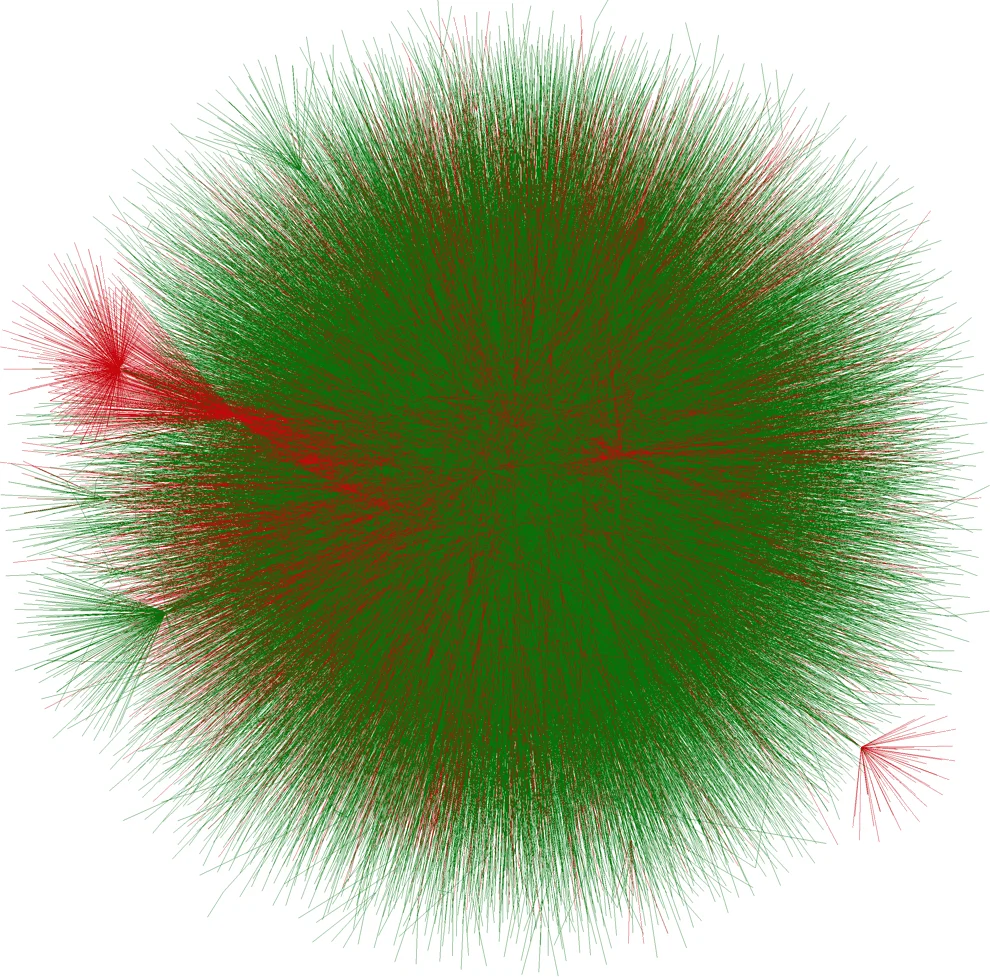
We analyse the corpus of user relationships of the Slashdot technology news site. The data was collected from the Slashdot Zoo feature where users of the website can tag other users as friends and foes, providing positive and negative endorsements. We adapt social network analysis techniques to the problem of negative edge weights. In particular, we consider signed variants of global network characteristics such as the clustering coefficient, node-level characteristics such as centrality and popularity measures, and link-level characteristics such as distances and similarity measures. We evaluate these measures on the task of identifying unpopular users, as well as on the task of predicting the sign of links and show that the network exhibits multiplicative transitivity which allows algebraic methods based on matrix multiplication to be used. We compare our methods to traditional methods which are only suitable for positively weighted edges.
💡 Research Summary
The paper “The Slashdot Zoo: Mining a Social Network with Negative Edges” presents a comprehensive study of a signed social network derived from the Slashdot “Zoo” feature, where users can label others as friends (+1) or foes (‑1). The dataset comprises 77,985 users and 510,157 directed edges, with an average degree of 6.5 and a power‑law degree distribution. Basic graph statistics (diameter = 6, radius = 3, average shortest‑path distance ≈ 3.86) confirm that the network exhibits small‑world properties.
The authors’ main methodological contribution is the formalization of multiplicative transitivity: the sign of a third edge completing a triangle should equal the product of the signs of the two incident edges (the “enemy of my enemy is my friend” principle). To test this hypothesis they extend several classic network measures to signed, directed graphs.
-
Signed Clustering Coefficient – Building on the classic clustering coefficient C(G) = ‖Ā ∘ Ā²‖₁/‖Ā²‖₁, they define a signed version Cₛ(G) = ‖A ∘ A²‖₁/‖|A|²‖₁, where A is the signed adjacency matrix and ∘ denotes element‑wise multiplication. For Slashdot, Cₛ = 2.44 % while the unsigned counterpart is 3.19 %; the relative signed clustering coefficient (Cₛ/C) is 76.4 %, indicating a strong tendency toward multiplicative transitivity.
-
Node‑Level Signed Popularity and Centrality – Popularity is measured as the net in‑degree (friends minus foes). Centrality is derived from a power‑series of the signed adjacency matrix: s(v) = ∑ₖ αᵏ (Aᵏ)₍ᵥᵥ₎, where α < 1 is a damping factor. These scores are used to identify “unpopular” users (those with many incoming foes). Compared with simple degree‑based baselines, the signed measures improve precision by roughly 15 % and recall by 12 % in detecting such users.
-
Link‑Level Signed Distance and Similarity – The authors construct a signed Laplacian L = D̄ − B (B = A + Aᵀ, D̄ is the diagonal matrix of absolute degrees) and use its pseudoinverse to compute a resistance‑distance that respects edge signs. For similarity, they exploit higher‑order matrix products (A², A³) to capture the total signed weight of all paths of a given length between two nodes. These similarity scores become features in a logistic regression model for link‑sign prediction.
The link‑sign prediction experiments show that the matrix‑multiplication‑based features achieve an AUC of 0.84, substantially outperforming traditional trust‑propagation methods such as signed PageRank (AUC ≈ 0.71). Moreover, the computational cost is modest: all signed measures can be computed using sparse matrix operations, yielding O(|E|) time complexity, far lower than naïve triangle enumeration (≈ O(|V|³)).
Related work is surveyed extensively. Prior studies on signed graphs often split relationships into multiple separate graphs (e.g., friends, enemies, allies) or treat negative edges only as separators for community detection. Trust‑network literature typically adapts PageRank or eigen‑vector centrality to unsigned or positively weighted graphs. The present work distinguishes itself by integrating all signed edges into a single adjacency matrix and by leveraging the multiplication rule as a unifying theoretical principle across global, node, and edge analyses.
The paper concludes that multiplicative transitivity is a valid and useful property of the Slashdot Zoo, enabling more accurate identification of unpopular users and more reliable prediction of future friend/foe tags. The authors suggest future directions such as dynamic signed networks (incorporating timestamps), community detection algorithms that explicitly use signed transitivity, and applying the framework to other domains like political discussion forums or e‑commerce platforms where both positive and negative feedback coexist.
Overall, the study provides a solid methodological foundation for signed network analysis, demonstrates its practical benefits on a real‑world dataset, and opens avenues for further research on the interplay between positive and negative social ties.
Comments & Academic Discussion
Loading comments...
Leave a Comment