📝 Original Info
- Title: OBTAIN: Real-Time Beat Tracking in Audio Signals
- ArXiv ID: 1704.02216
- Date: 2017-10-31
- Authors: Researchers from original ArXiv paper
📝 Abstract
In this paper, we design a system in order to perform the real-time beat tracking for an audio signal. We use Onset Strength Signal (OSS) to detect the onsets and estimate the tempos. Then, we form Cumulative Beat Strength Signal (CBSS) by taking advantage of OSS and estimated tempos. Next, we perform peak detection by extracting the periodic sequence of beats among all CBSS peaks. In simulations, we can see that our proposed algorithm, Online Beat TrAckINg (OBTAIN), outperforms state-of-art results in terms of prediction accuracy while maintaining comparable and practical computational complexity. The real-time performance is tractable visually as illustrated in the simulations.
💡 Deep Analysis
Deep Dive into OBTAIN: Real-Time Beat Tracking in Audio Signals.
In this paper, we design a system in order to perform the real-time beat tracking for an audio signal. We use Onset Strength Signal (OSS) to detect the onsets and estimate the tempos. Then, we form Cumulative Beat Strength Signal (CBSS) by taking advantage of OSS and estimated tempos. Next, we perform peak detection by extracting the periodic sequence of beats among all CBSS peaks. In simulations, we can see that our proposed algorithm, Online Beat TrAckINg (OBTAIN), outperforms state-of-art results in terms of prediction accuracy while maintaining comparable and practical computational complexity. The real-time performance is tractable visually as illustrated in the simulations.
📄 Full Content
OBTAIN: Real-Time Beat Tracking in Audio
Signals
Ali Mottaghi, Kayhan Behdin, Ashkan Esmaeili, Mohammadreza Heydari, and Farokh Marvasti
Sharif University of Technology, Electrical Engineering Department, and
Advanced Communications Research Institute (ACRI), Tehran, Iran
Email: aesmaeili@stanford.edu
Abstract—In this paper, we design a system in order to
perform the real-time beat tracking for an audio signal. We
use Onset Strength Signal (OSS) to detect the onsets and
estimate the tempos. Then, we form Cumulative Beat
Strength Signal (CBSS) by taking advantage of OSS and
estimated tempos. Next, we perform peak detection by
extracting the periodic sequence of beats among all CBSS
peaks. In simulations, we can see that our proposed
algorithm, Online Beat TrAckINg (OBTAIN), outperforms
state-of-art results in terms of prediction accuracy while
maintaining comparable and practical computational
complexity. The real-time performance is tractable visually
as illustrated in the simulations. 1
Index Terms—Onset Strength Signal, Tempo estimation,
Beat onset, Cumulative Beat Strength Signal, Peak detection
I. INTRODUCTION
The beat is a salient periodicity in a music signal. It
provides a fundamental unit of time and foundation for the
temporal structure of the music. The significance of beat
tracking is that it underlies music information retrieval
research and provides for beat synchronous analysis of
music. It has applications in segmentation of audio,
interactive musical accompaniment, cover-song detection,
music
similarity,
chord
estimation,
and
music
transcription. It is a fundamental signal processing task of
interest to any company providing information services
related to music [1].
A. Related Works
Many works have been carried out in offline beat
tracking. One can find effective algorithms in the literature
which perform beat tracking in an offline fashion [2]. It is
however important to mention some of previous works on
beat tracking. Aubio [3] is a real-time beat tracking
algorithm which is available as a free application. Aubio
has been used in entertainment applications like Sonic
Runway [4] in 2016. IBT [5] is a state-of-the-art real-time
algorithm in this field. IBT is based on BeatRoot [6]
tracking strategy which is a state-of-the-art offline tracking
algorithm. BeatRoot system takes advantage of two pre-
processing and processing stages. In the pre-processing
stage, a time-domain onset detection algorithm is used
which calculates onset times from peaks in the slope of the
amplitude envelope. The processing stage consists of two
blocks. The first block uses a clustering algorithm on inter-
onset intervals and generates a set of tempo hypotheses by
Manuscript received August 15, 2017; accepted September 6, 2017.
Corresponding author: Ashkan Esmaeili
examining the relationships between clusters. The second
block is a tracking block. In this block, a multiple agent
architecture is used, where each agent represents a
hypothesis about the tempo. Performance of each agent
due to the data is evaluated and the agent with the best
performance returns output of the tracking system.
Another state-of-the-art algorithm is Ellis [2]. Although
Ellis method is not causal, some blocks of our system are
based on this method.
B. Our Contributions
The goal of this paper is to provide a fast and
competitive beat tracking algorithm for audio signals that
can be easily implemented in real-time setting. As our key
contributions, we
- propose a simple yet fast beat tracking algorithm for
audio signals,
2) extend the algorithm to real-time implementation, - compare the algorithm to previous results to show
that it outperforms state-of-art algorithm prediction
accuracy while maintaining comparable and practical
computational complexity,
- implemented our method on an embedded system
(Raspberry Pi 3) to demonstrate its effectiveness and
reliability in real-time beat tracking,
- participated in a real-world challenge (IEEE SP Cup
- and received honorable mention for our
excellent beat tracking algorithm and annotation.
II. OBTAIN ALGORITHM
The proposed approach follows a relatively common
architecture with the explicit design and tries to simplify
each step and modify them. Therefore, they can be applied
in the real-time setting. We call our algorithm OBTAIN (a
pseudo-abbreviation of Online Beat TrAckINg). We will
elaborate upon the blocks of this system throughout the
paper and compare it to state-of- art methods. There are
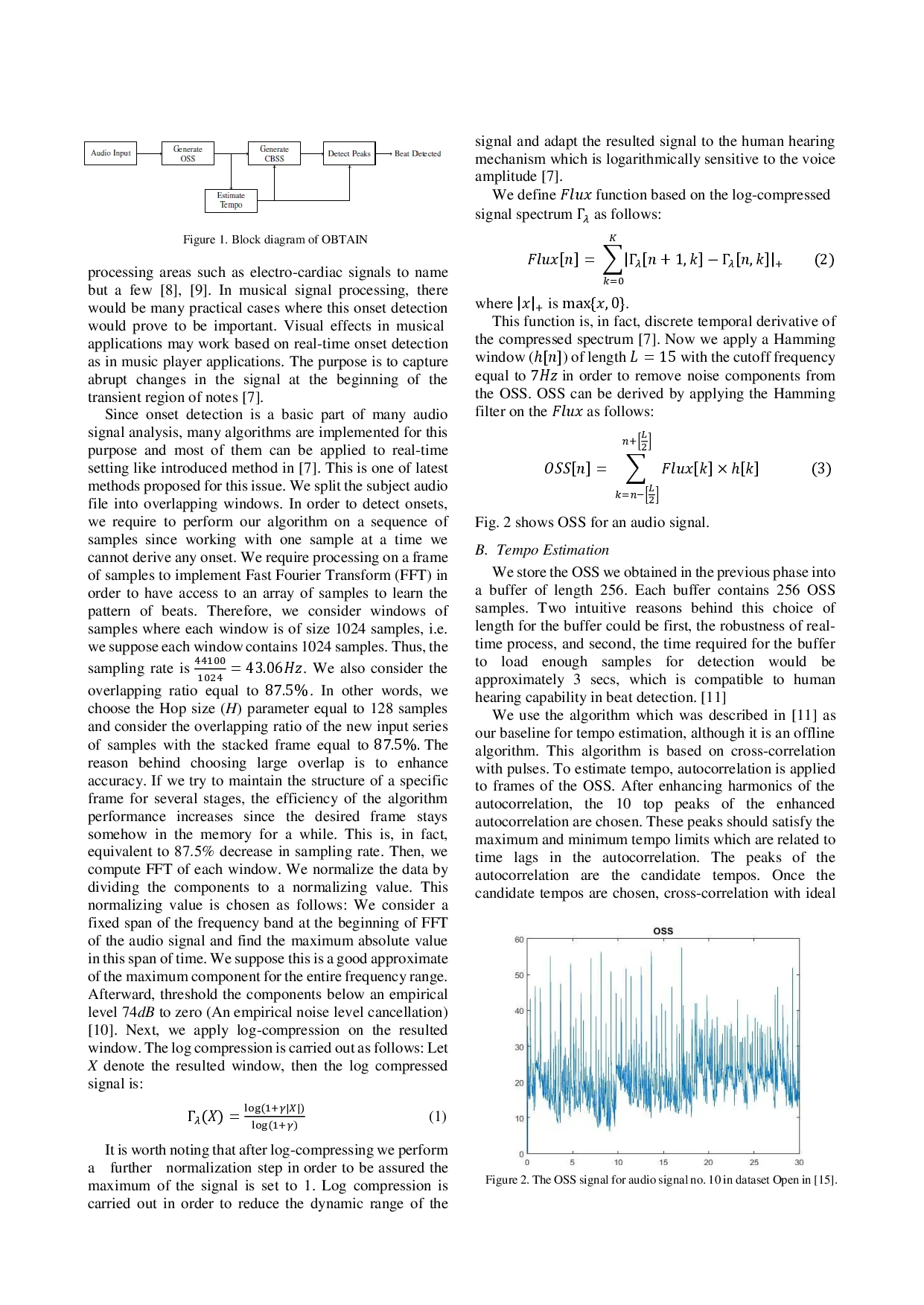
four main stages to the algorithm, as shown in Fig. 1. The
initial audio input has a sampling rate of 44100 Hz.
A. Generating Onset Strength Signal (OSS)
Beat tracking is an audio signal processing tool which is
based on onset detection. Onset detection is an important
issue in signal processing. It can be widely
…(Full text truncated)…
📸 Image Gallery
Reference
This content is AI-processed based on ArXiv data.