Temporal stability in human interaction networks
This paper reports on stable (or invariant) properties of human interaction networks, with benchmarks derived from public email lists. Activity, recognized through messages sent, along time and topology were observed in snapshots in a timeline, and at different scales. Our analysis shows that activity is practically the same for all networks across timescales ranging from seconds to months. The principal components of the participants in the topological metrics space remain practically unchanged as different sets of messages are considered. The activity of participants follows the expected scale-free trace, thus yielding the hub, intermediary and peripheral classes of vertices by comparison against the Erd"os-R'enyi model. The relative sizes of these three sectors are essentially the same for all email lists and the same along time. Typically, $<15%$ of the vertices are hubs, 15-45% are intermediary and $>45%$ are peripheral vertices. Similar results for the distribution of participants in the three sectors and for the relative importance of the topological metrics were obtained for 12 additional networks from Facebook, Twitter and ParticipaBR. These properties are consistent with the literature and may be general for human interaction networks, which has important implications for establishing a typology of participants based on quantitative criteria.
💡 Research Summary
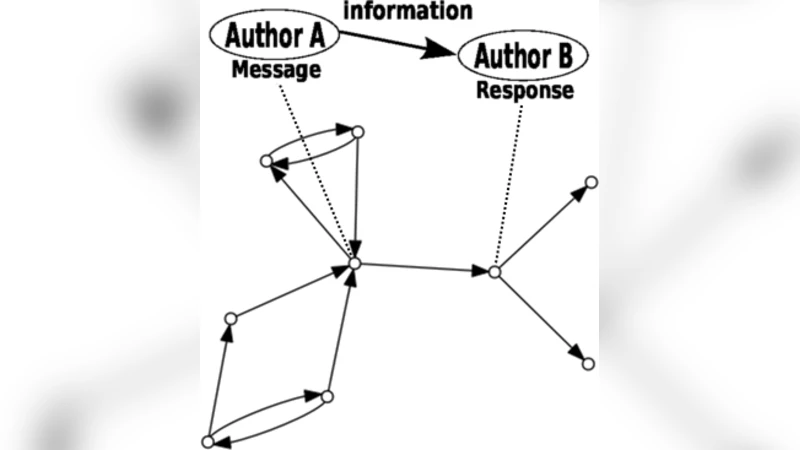
The paper investigates whether the structural properties of human interaction networks remain essentially unchanged over time. Using publicly available email archives from the Gmane repository and additional data from Facebook, Twitter, and the Brazilian civic platform ParticipaBR, the authors construct directed, weighted interaction graphs where an edge A→B represents a reply from participant B to a message originally posted by A. Four representative email lists (Linux Audio Users, Linux Audio Developers, C++ Library Developers, and MetaReciclagem) are each sampled for the first 20 000 messages, and a total of 140 other lists are examined for auxiliary analyses.
Temporal activity is quantified at multiple granularities—seconds, minutes, hours, days of the week, days of the month, and months of the year—by building histograms of message counts. Because conventional linear statistics are unsuitable for periodic data, the authors employ circular statistics: each timestamp is mapped to a unit complex number, and measures such as mean angle, circular variance, circular standard deviation, and a derived dispersion metric δ are computed. Across all time scales the dispersion values remain stable, indicating that the rhythm of communication does not drift over weeks, months, or years.
The interaction graphs are enriched with a comprehensive set of vertex-level metrics. Standard topological descriptors include degree (total, in‑, out‑), strength (total, in‑, out‑), clustering coefficient, and betweenness centrality. In addition, the authors introduce non‑standard measures designed to capture asymmetry and disequilibrium between inbound and outbound activity (e.g., asy_i, dis_i and their averages and standard deviations). All metrics are calculated for the weighted digraphs.
To assess whether the underlying structure changes, the authors perform two complementary analyses. First, a principal component analysis (PCA) on the 22‑dimensional metric space reveals that the first two principal components consistently explain over 70 % of the variance across all temporal snapshots (e.g., windows of 1 000, 5 000, or 10 000 consecutive messages). The positions of vertices in this reduced space exhibit negligible movement when the time window slides, demonstrating that the dominant axes of variation are invariant.
Second, the paper introduces “Erdős sectioning,” a novel classification that compares the empirical degree distribution with that of an Erdős‑Rényi random graph having the same number of vertices and edges. Vertices whose degree is less frequent than in the random model are labeled “intermediary,” those with higher-than‑expected degree are “hubs,” and those with lower-than‑expected degree are “peripheral.” Applying this method to all datasets yields remarkably consistent sector proportions: hubs comprise less than 15 % of vertices, intermediaries 15‑45 %, and peripherals more than 45 %. This pattern holds for the email lists as well as for the twelve external social networks, confirming that the sector composition is a robust, time‑independent property.
The authors discuss the implications of these findings. The temporal stability of activity patterns, the persistence of principal component structure, and the invariant hub‑intermediary‑peripheral ratios suggest that human interaction networks possess a set of “invariant fingerprints” that survive short‑term fluctuations and long‑term evolution. Such fingerprints could serve as quantitative criteria for typologizing participants (e.g., distinguishing core influencers from occasional contributors) and for building predictive models of information diffusion, contagion, or systemic risk in online communities.
Finally, the paper emphasizes reproducibility: all raw data, preprocessing scripts, and analysis code are publicly released via GitHub and PyPI, and the methodology is described in sufficient detail to be replicated on other communication platforms. The authors propose future work to extend the framework to multimodal data (audio, video), to explore the impact of external events (policy changes, crises) on the stability of these fingerprints, and to test the approach on multilayer network representations. In sum, the study provides strong empirical evidence that human interaction networks exhibit a remarkable degree of temporal stability, opening avenues for both theoretical modeling and practical applications in social computing.
Comments & Academic Discussion
Loading comments...
Leave a Comment