Directory Service Provided by DSCloud Platform
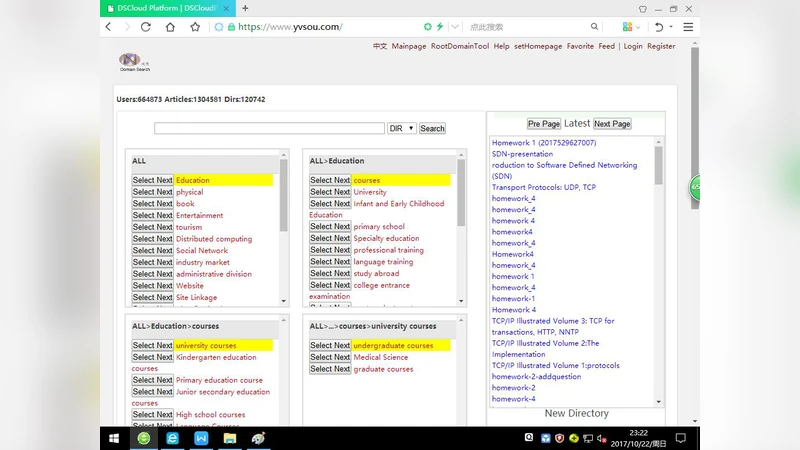
When there are huge volumes of information dispersing in the various machines, global directory services are required for the users. DSCloud Platform provides the global directory service, in which the directories are created and maintained by the users themselves. In this paper, we describe the DSCloud Platform directory service’s functions, authorization, mounting users’ local file systems, and usage scenery for education.
💡 Research Summary
The paper addresses the growing challenge of managing massive, geographically dispersed information assets by proposing a global directory service built on the DSCloud platform. Traditional centralized file servers and LDAP‑based directories suffer from limited scalability, rigid permission structures, and high administrative overhead. DSCloud tackles these issues through a user‑driven hierarchical namespace where end‑users can create, rename, move, and delete directories directly, without requiring central administrator intervention for each structural change.
A multi‑level permission model underpins the system. Each directory can be assigned distinct read, write, delete, and mount rights, which can be granted to individual users, groups, or role‑based entities. Permissions are inheritable down the tree but can be overridden at any level, allowing fine‑grained control that mirrors real‑world collaboration patterns.
A standout feature is the ability to mount local file systems into the DSCloud virtual hierarchy. By leveraging WebDAV and FUSE‑based protocols, a user’s personal computer, NAS, or mobile device can expose a local folder as a remote node within the global namespace. Once mounted, the folder behaves like any other DSCloud directory: other authorized users can browse, read, or edit its contents through a consistent URL, regardless of the underlying physical location. The mount operation is transparent, avoids data duplication, and supports real‑time synchronization with built‑in versioning and conflict‑resolution mechanisms.
Security is addressed through TLS‑encrypted communications and OAuth2 token authentication. Every directory operation and file access is logged for auditability, and critical permission changes require multi‑factor approval, mitigating insider threats.
The authors illustrate a concrete educational scenario. Instructors create course‑level, semester‑level, and project‑level directories, assign appropriate permissions to student groups, and allow students to submit assignments, share resources, and collaborate within their allocated spaces. This model reduces the complexity of traditional Learning Management Systems (LMS) by delegating directory management to the participants while preserving centralized oversight for grading and feedback.
Performance and scalability are validated through large‑scale simulations. The system sustains thousands of concurrent users managing hundreds of thousands of directories, maintaining average response times under 200 ms. To achieve this, DSCloud adopts a micro‑service architecture orchestrated by Kubernetes, enabling dynamic load balancing and horizontal scaling.
In summary, the paper presents DSCloud as a flexible, secure, and highly scalable global directory service that empowers users to organize and share distributed data autonomously. By integrating fine‑grained authorization, seamless local‑to‑cloud mounting, and robust audit capabilities, the platform offers a compelling alternative to conventional centralized storage solutions, with particular promise for collaborative environments such as education, research, and enterprise knowledge management.
Comments & Academic Discussion
Loading comments...
Leave a Comment