Short Presburger arithmetic is hard
We study the computational complexity of short sentences in Presburger arithmetic (Short-PA). Here by “short” we mean sentences with a bounded number of variables, quantifiers, inequalities and Boolean operations; the input consists only of the integer coefficients involved in the linear inequalities. We prove that satisfiability of Short-PA sentences with $m+2$ alternating quantifiers is $\Sigma_{P}^m$-complete or $\Pi_{P}^m$-complete, when the first quantifier is $\exists$ or $\forall$, respectively. Counting versions and restricted systems are also analyzed. Further application are given to hardness of two natural problems in Integer Optimizations.
💡 Research Summary
This paper provides a definitive analysis of the computational complexity of deciding satisfiability for “short” sentences in Presburger arithmetic (PA), where the number of variables, quantifiers, inequalities, and Boolean operations is fixed. The only input is the integer coefficients appearing in the linear inequalities. The central finding is that for sentences with m+2 alternating quantifiers (where m≥1), the decision problem is Σ_P^m-complete if the first quantifier is existential (∃), and Π_P^m-complete if it is universal (∀). This settles a fundamental open problem, disproving conjectures that such problems were tractable.
The technical core involves a sophisticated chain of reductions from known NP-complete problems. The authors start with the AP-COVER problem (covering intervals with arithmetic progressions). Using the theory of finite continued fractions, they encode arithmetic progressions as rational numbers. The geometric properties of the convergents of these continued fractions are then leveraged to “lift” the combinatorial problem into a low-dimensional geometric setting. This allows them to construct, for the base case of three alternating quantifiers (∃∀∃), a short Presburger expression with only 10 inequalities in 5 variables that is NP-complete to decide. The reduction is parsimonious, proving the corresponding counting problem is #P-complete.
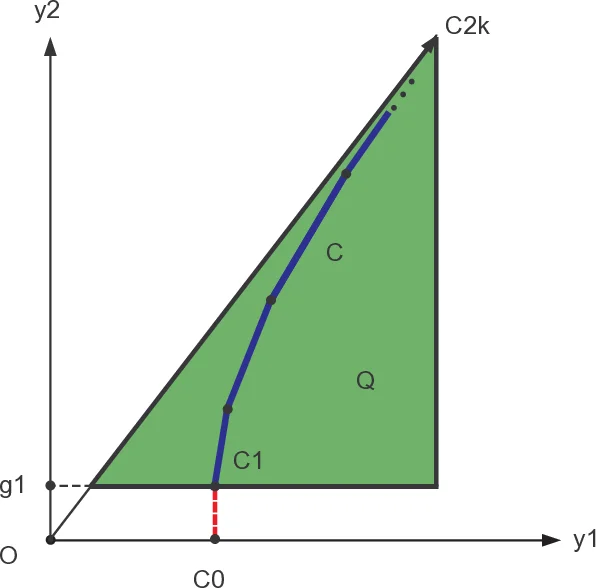
This construction is further refined to show that even the more structured Generalized Integer Programming problem (GIP)—which uses only conjunctions of inequalities in the form ∃z ∀y ∃x: Ax+By+Cz≤b—remains NP-complete and #P-complete. Remarkably, this holds even under severe restrictions: when the parameter spaces are simple (an interval R and a triangle Q), and with a bounded number of variables (e.g., z∈Z, y∈Z², x∈Z³) and a bounded, albeit large, number of inequalities (up to 8400). The results are generalized to any number of quantifier alternations, establishing completeness for the respective levels of the Polynomial Hierarchy.
As applications, the hardness results are used to prove that two natural problems in integer optimization are NP-hard: 1) computing the max-min value of a quadratic function over integer points in a two-level hierarchy, and 2) minimizing a linear function over the Pareto minima defined by two linear and one quadratic function over integer points in a polytope.
Finally, the paper discusses profound implications for Kannan’s Partition Theorem (KPT), a key tool in parametric integer programming. The strong negative results presented here contradict the existence of the polynomial-size partition of the parameter space guaranteed by KPT. The authors provide a quantitative lower bound showing that any such partition must have exponentially many pieces, strongly suggesting a gap in the original proof of KPT and necessitating a re-examination of this foundational result.
Comments & Academic Discussion
Loading comments...
Leave a Comment