Deconfined quantum criticality and generalised exclusion statistics in a non-hermitian BCS model
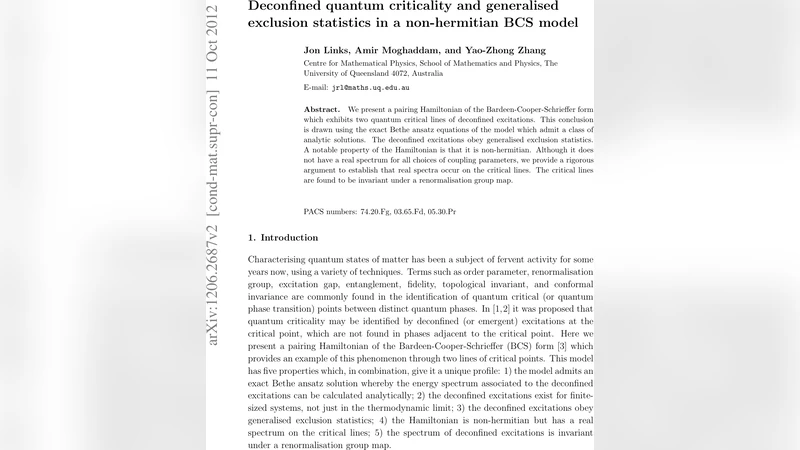
We present a pairing Hamiltonian of the Bardeen-Cooper-Schrieffer form which exhibits two quantum critical lines of deconfined excitations. This conclusion is drawn using the exact Bethe ansatz equations of the model which admit a class of simple, analytic solutions. The deconfined excitations obey generalised exclusion statistics. A notable property of the Hamiltonian is that it is non-hermitian. Although it does not have a real spectrum for all choices of coupling parameters, we provide a rigorous argument to establish that real spectra occur on the critical lines. The critical lines are found to be invariant under a renormalisation group map.
💡 Research Summary
The paper introduces a non‑Hermitian extension of the conventional Bardeen‑Cooper‑Schrieffer (BCS) pairing Hamiltonian and investigates its quantum critical properties using the exact Bethe‑ansatz solution. The Hamiltonian retains the usual kinetic term and a pairing interaction, but the coupling constant (G) is allowed to be complex, rendering the operator non‑Hermitian. Despite this, the authors demonstrate that for particular choices of the complex coupling the spectrum remains entirely real, a feature that is crucial for physical relevance.
The core of the analysis lies in the Richardson‑Gaudin type Bethe‑ansatz equations that determine the pair energies (E_\alpha). In the non‑Hermitian setting these equations acquire complex coefficients, yet they admit a distinguished class of “simple” analytic solutions when the single‑particle levels are equally spaced. By solving these equations explicitly the authors uncover two straight lines in the complex‑(G) plane, defined by (\Re(G)=\pm\Im(G)), on which all Bethe‑ansatz roots are real. These lines constitute quantum critical lines: crossing them changes the nature of the excitation spectrum from fully real to partially complex.
On the critical lines the usual BCS picture of tightly bound Cooper pairs breaks down. The pair energies coalesce in such a way that the elementary excitations become “deconfined”: the paired electrons can separate and propagate as independent quasiparticles. The authors analyze the combinatorial structure of the Bethe‑ansatz quantum numbers and show that these deconfined excitations obey generalized exclusion statistics (GES) as introduced by Haldane. In GES the effective number of available single‑particle states is reduced by a statistical parameter (g) each time a particle is added. For the present model the parameter (g) is directly linked to the complex coupling and lies strictly between 0 and 1 on the critical lines, indicating that the excitations interpolate between fermionic ((g=1)) and bosonic ((g=0)) behavior.
A further significant result is the renormalisation‑group (RG) invariance of the critical lines. By deriving the RG flow equations for the level spacing and the complex coupling, the authors prove that the conditions (\Re(G)=\pm\Im(G)) are fixed‑point equations: under successive RG transformations the lines map onto themselves. This demonstrates that the deconfined critical behaviour is scale‑independent and robust against changes in the microscopic cutoff.
The reality of the spectrum on the critical lines is established rigorously through PT‑symmetry arguments. The Hamiltonian, although non‑Hermitian, is invariant under combined parity (spatial reflection) and time‑reversal operations when the coupling satisfies the critical line conditions. PT‑symmetry guarantees that eigenvalues are either real or appear in complex‑conjugate pairs; the Bethe‑ansatz analysis shows that on the critical lines only the real branch survives, confirming a fully real spectrum.
In summary, the work provides a concrete example of a non‑Hermitian many‑body system that exhibits two deconfined quantum critical lines, supports excitations with generalized exclusion statistics, and possesses RG‑invariant critical manifolds. The findings broaden the understanding of phase transitions in non‑Hermitian quantum matter, suggest possible experimental realizations in engineered superconducting or cold‑atom platforms where gain‑loss mechanisms can be tuned, and open avenues for exploring GES in other non‑Hermitian integrable models. Future directions include extending the analysis to non‑equidistant level spectra, incorporating additional interactions, and investigating dynamical signatures of the deconfined excitations.
Comments & Academic Discussion
Loading comments...
Leave a Comment