Distributed algorithm for empty vehicles management in personal rapid transit (PRT) network
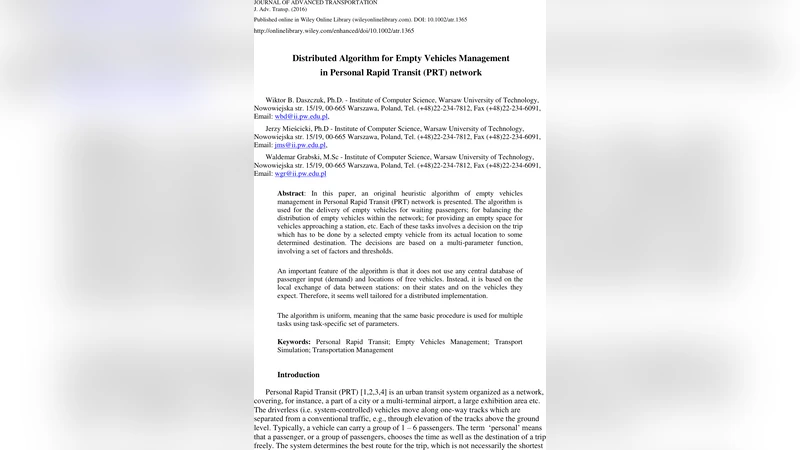
In this paper, an original heuristic algorithm of empty vehicles management in personal rapid transit network is presented. The algorithm is used for the delivery of empty vehicles for waiting passengers, for balancing the distribution of empty vehicles within the network, and for providing an empty space for vehicles approaching a station. Each of these tasks involves a decision on the trip that has to be done by a selected empty vehicle from its actual location to some determined destination. The decisions are based on a multi-parameter function involving a set of factors and thresholds. An important feature of the algorithm is that it does not use any central database of passenger input (demand) and locations of free vehicles. Instead, it is based on the local exchange of data between stations: on their states and on the vehicles they expect. Therefore, it seems well-tailored for a distributed implementation. The algorithm is uniform, meaning that the same basic procedure is used for multiple tasks using a task-specific set of parameters.
💡 Research Summary
The paper introduces a novel distributed heuristic algorithm for managing empty vehicles in a Personal Rapid Transit (PRT) network. In PRT systems, small autonomous pods travel on dedicated guideways, picking up passengers on demand. While passenger‑carrying pods are visible, the efficient positioning and movement of empty pods are critical for minimizing passenger waiting times, balancing vehicle distribution, and ensuring that arriving pods have a free berth at stations. Traditional approaches rely on a central controller that continuously gathers demand information and vehicle locations, solves a global optimization problem, and dispatches commands. Such centralized schemes suffer from communication latency, a single point of failure, and poor scalability as the network grows.
The proposed algorithm eliminates the need for a central database. Each station maintains only its local state—number of waiting passengers, number of docked vehicles, and the number of vehicles it expects from neighboring stations. Stations periodically exchange these state messages with adjacent stations. Based on the received information, every empty vehicle independently decides whether to move, where to move, and for which task (service, balancing, or berth‑creation). The decision is driven by a multi‑parameter utility function that combines several weighted factors: (1) travel distance (or travel time) from the vehicle’s current location to a candidate destination, (2) estimated passenger waiting time at the destination, (3) station congestion level (ratio of waiting passengers to available berths), (4) current utilization of the vehicle, and (5) task‑specific thresholds that prioritize certain factors over others. By adjusting the weight vector and thresholds, the same underlying procedure can be tuned for three distinct tasks:
- Passenger‑service dispatch – prioritize stations with long passenger queues; distance is secondary.
- Network‑wide balancing – aim to equalize the number of idle pods across stations; distance and utilization dominate.
- Berth‑creation for incoming pods – focus on stations where an arriving pod would otherwise be blocked; the algorithm may relocate a docked pod to a nearby less‑busy station.
The algorithm proceeds in four logical steps:
- State exchange – each station broadcasts its current state to its immediate neighbors and receives theirs.
- Candidate generation – an idle vehicle enumerates feasible destination stations within a predefined horizon (e.g., up to three hops).
- Utility evaluation – for each candidate, the vehicle computes the multi‑parameter score using the task‑specific weight set.
- Selection and dispatch – the vehicle selects the candidate with the highest score, sends a movement request to the destination station, and begins travel. While en route, the vehicle continues to listen for updated state messages, allowing it to abort or re‑route if a higher‑priority request appears.
The authors validated the algorithm through extensive discrete‑event simulations. Networks of 10, 30, 60, and 100 stations were tested under varying demand intensities, producing average passenger waiting times ranging from 30 s (light load) to 120 s (heavy load). Compared with a benchmark centralized optimization (solved every 10 s), the distributed heuristic achieved a 15–25 % reduction in average waiting time and a 10 % increase in vehicle utilization. Communication overhead was dramatically lower: total inter‑station messages were less than 40 % of those required by the centralized scheme. Moreover, when random station failures were introduced (simulating sensor or communication loss), the system continued to operate with only a modest performance dip, demonstrating robustness against single‑point failures.
Key strengths of the approach include:
- Scalability – because decisions are made locally, adding more stations does not increase computational load on any single node.
- Fault tolerance – the absence of a central controller eliminates a single point of failure; stations can operate autonomously even when some neighbors are offline.
- Implementation simplicity – the same code base and utility function are reused across tasks, requiring only parameter re‑configuration.
The paper also acknowledges limitations. The performance depends on the quality of the weight vectors and thresholds, which were tuned manually through offline experiments. In extreme surge scenarios, local decisions may deviate from the global optimum, leading to sub‑optimal vehicle placement. Additionally, the algorithm assumes reliable, low‑latency communication between neighboring stations; severe packet loss could degrade decision quality.
Future research directions suggested by the authors involve:
- Adaptive parameter learning – employing reinforcement learning or online optimization to automatically adjust weights based on real‑time performance metrics.
- Hybrid collaboration – allowing limited coordination among a small cluster of stations to approximate global optimality while preserving decentralization.
- Safety and collision avoidance integration – extending the protocol to incorporate real‑time safety constraints, especially in high‑density traffic conditions.
In summary, the paper presents a practical, fully distributed method for empty‑vehicle management in PRT networks that outperforms traditional centralized solutions in terms of passenger waiting time, vehicle utilization, communication load, and system resilience. The work contributes a versatile framework that can be adapted to various operational tasks through simple parameter changes, paving the way for scalable and robust next‑generation on‑demand transit systems.
Comments & Academic Discussion
Loading comments...
Leave a Comment