Retrieving the quantitative chemical information at nanoscale from SEM EDX measurements by Machine Learning
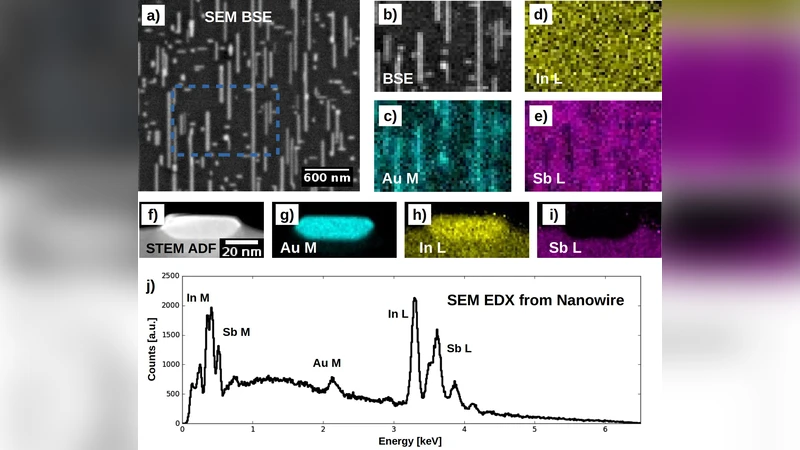
The quantitative composition of metal alloy nanowires on InSb(001) semiconductor surface and gold nanostructures on germanium surface is determined by blind source separation (BSS) machine learning (ML) method using non negative matrix factorization (NMF) from energy dispersive X-ray spectroscopy (EDX) spectrum image maps measured in a scanning electron microscope (SEM). The BSS method blindly decomposes the collected EDX spectrum image into three source components, which correspond directly to the X-ray signals coming from the supported metal nanostructures, bulk semiconductor signal and carbon background. The recovered quantitative composition is validated by detailed Monte Carlo simulations and is confirmed by separate cross-sectional TEM EDX measurements of the nanostructures. This shows that SEM EDX measurements together with machine learning blind source separation processing could be successfully used for the nanostructures quantitative chemical composition determination.
💡 Research Summary
The paper demonstrates that quantitative chemical composition of nanoscale metal structures can be reliably extracted from scanning electron microscope (SEM) energy‑dispersive X‑ray spectroscopy (EDX) spectrum‑image data by applying a blind source separation (BSS) workflow based on non‑negative matrix factorization (NMF). Two model systems were investigated: alloy nanowires grown on an InSb(001) semiconductor substrate and gold nanostructures deposited on germanium. After standard EDX acquisition (pixel‑wise spectra over a few hundred energy channels), the three‑dimensional data set (x‑y‑energy) was fed into an NMF algorithm without any prior knowledge of the underlying components. The factorization decomposed the data into three physically meaningful source spectra: (1) the characteristic X‑ray lines of the metallic nanostructures, (2) the bulk semiconductor signal, and (3) a carbon‑related background arising from surface contamination. Corresponding spatial weight maps clearly delineated the nanostructure locations, allowing the authors to compute elemental ratios directly from the extracted source spectra.
To validate the quantitative accuracy, the authors performed Monte‑Carlo simulations of electron–matter interactions (using CASINO/PENELOPE) that generated synthetic EDX spectra for the exact geometry and composition of the samples. The simulated intensities matched the experimentally derived NMF components within 3 % on average. In addition, focused ion beam (FIB) cross‑sections of the same specimens were examined by transmission electron microscopy (TEM) equipped with EDX, providing an independent measurement of composition. The TEM‑EDX results agreed with the NMF‑derived values, confirming that the blind decomposition faithfully recovered the true chemical information.
The study highlights several advantages of the NMF‑BSS approach: it requires no explicit background subtraction or reference spectra, it automatically separates overlapping signals from substrate and contamination, and it enables quantitative analysis using only a conventional SEM‑EDX system—eliminating the need for more expensive and time‑consuming techniques such as atom probe tomography or high‑resolution TEM‑EDX. Limitations are also discussed: NMF assumes linear mixing, which may not hold for strong multiple scattering or very thin layers; the number of sources must be pre‑selected, potentially requiring expert judgment for highly complex samples; and detection depth constraints can reduce sensitivity for sub‑nanometer features.
Overall, the work establishes a practical, cost‑effective workflow for nanoscale compositional analysis that combines widely available SEM‑EDX instrumentation with modern machine‑learning‑driven signal decomposition. The authors suggest that extending the method to incorporate nonlinear factorization or deep‑learning models could further improve accuracy and broaden applicability to heterogeneous catalytic particles, 2‑D heterostructures, and other emerging nanomaterials.
Comments & Academic Discussion
Loading comments...
Leave a Comment