Fluctuations of gas concentrations in three mineral springs of the East Eifel Volcanic field (EEVF)
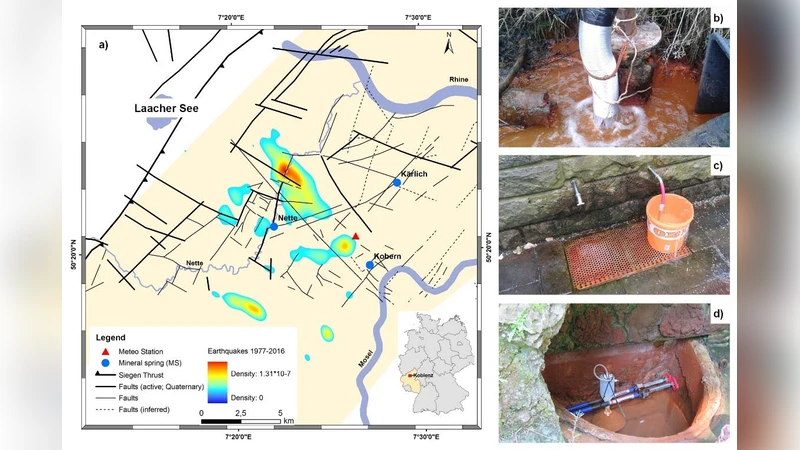
We present a geochemical dataset acquired during continual sampling over 7 months (bi-weekly) and 4 weeks (every 8 hours) in the Neuwied Basin, a part of the East Eifel Volcanic Field (EEVF). We used a combination of geochemical, geophysical, and statistical methods to identify potential causal processes underlying the correlations of degassing patterns of four gases (He, Rn, CO2, O2), earth tides, and tectonic processes in three mineral springs (Nette, Kaerlich and Kobern). We explored whether temporal relations in gas concentrations in the three mineral springs could be indicators of hidden faults through which the gases migrate to the surface from deeper underground. Our results do not confirm CO2 as a primary carrier gas for trace gases in all springs. Temporal analyses of the CO2-He couple indicate that Nette and K"arlich are directly linked via a continuous tectonic fault in an ENE-WSW trending direction. There is also evidence that Kaerlich and Kobern (NNE-SSW fault system) and Nette and Kobern (NW-SE fault system) are tectonically linked. These fault linkages are unknown previously but could be related to the rising numbers of earthquake events occurring in this area since 2010. We did not find any evidence that weather processes (e.g., barometric pressure), earth tides, or low local earthquake magnitudes actively modulate degassing. The volcanic activity in the EEVF is dormant but not extinct and to understand and monitor its magmatic and degassing systems, we recommend bi-weekly samplings at minimum.
💡 Research Summary
The authors conducted an extensive geochemical monitoring campaign in the East Eifel Volcanic Field (EEVF), focusing on three mineral springs—Nette, Kärlich, and Kobern—located in the Neuwied Basin. Over a seven‑month period, samples were collected bi‑weekly, and during a four‑week intensive phase, sampling occurred every eight hours, yielding high‑resolution time series for helium (He), radon (Rn), carbon dioxide (CO₂), and oxygen (O₂). The dataset was subjected to a suite of analytical techniques: data cleaning and outlier removal, log‑transformation and normalization, correlation matrices, cross‑correlation functions (CCF), Granger causality tests, and multivariate regression against external drivers such as barometric pressure, temperature, precipitation, earth tides, and local seismicity (Mw < 3.0).
Statistical analysis revealed strong positive correlations between He and Rn (r ≈ 0.78, p < 0.01) across all springs, indicating a common deep source or transport pathway. CO₂ showed a moderate but significant correlation with He (r ≈ 0.45, p < 0.05). Cross‑correlation analysis identified a consistent lead‑lag relationship in the Nette–Kärlich pair: CO₂ variations precede He fluctuations by roughly 12 hours, a pattern that persisted throughout the monitoring window. Granger causality confirmed that CO₂ “causes” He in these two springs (p < 0.05), whereas the reverse direction was not significant.
External factors were examined in detail. Regression against barometric pressure, temperature, and precipitation yielded non‑significant coefficients (p > 0.1), indicating that atmospheric conditions do not drive the observed gas dynamics. Spectral analysis of tidal constituents (diurnal, semidiurnal, fortnightly) showed no coherent peaks aligning with gas concentration changes, and the occurrence of low‑magnitude earthquakes did not coincide with any abrupt gas spikes. Thus, the authors conclude that short‑term meteorological and tidal forces, as well as minor seismic events, are not primary modulators of degassing at these sites.
Geologically, the temporal coupling of CO₂ and He suggests that Nette and Kärlich share a continuous subsurface conduit oriented ENE‑WSW, a fault system not previously mapped in regional geological surveys. Additional cross‑correlation patterns imply a NNE‑SSW fault linking Kärlich and Kobern, and a NW‑SE fault connecting Nette and Kobern. These three inferred fault orientations correspond spatially with an increase in seismic activity recorded since 2010, hinting that the newly identified structures may be responsible for the recent earthquake swarm.
The study also challenges the assumption that CO₂ acts as the universal carrier gas for trace gases in all mineral springs. While CO₂ is abundant, its role as a transport medium appears variable, with He and Rn sometimes decoupled from CO₂ fluctuations, especially at Kobern. This nuance underscores the importance of multi‑gas monitoring rather than reliance on a single tracer.
From a hazard‑assessment perspective, the EEVF is classified as dormant but not extinct. Persistent He and Rn emissions indicate ongoing deep magmatic or hydrothermal activity, even in the absence of surface eruptions. The authors recommend establishing a baseline monitoring network that samples at least bi‑weekly, complemented by automated eight‑hourly stations at key springs. Integration of gas data with continuous seismic, geodetic, and tidal monitoring would enable the development of predictive models for both volcanic unrest and fault‑related seismicity.
In summary, the paper provides robust evidence that degassing patterns in the three studied springs are governed primarily by previously unrecognized fault networks rather than by atmospheric or tidal influences. The findings have significant implications for regional tectonic mapping, earthquake risk assessment, and the design of long‑term volcanic monitoring strategies in the East Eifel Volcanic Field.
Comments & Academic Discussion
Loading comments...
Leave a Comment