Decentralized Resource Discovery and Management for Future Manycore Systems
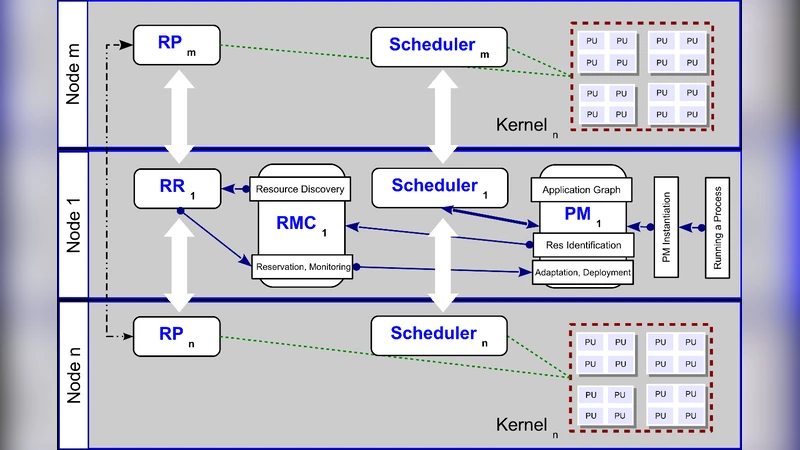
The next generation of many-core enabled large-scale computing systems relies on thousands of billions of heterogeneous processing cores connected to form a single computing unit. In such large-scale computing environments, resource management is one of the most challenging, and complex issues for efficient resource sharing and utilization, particularly as we move toward Future ManyCore Systems (FMCS). This work proposes a novel resource management scheme for future peta-scale many-core-enabled computing systems, based on hybrid adaptive resource discovery, called ElCore. The proposed architecture contains a set of modules which will dynamically be instantiated on the nodes in the distributed system on demand. Our approach provides flexibility to allocate the required set of resources for various types of processes/applications. It can also be considered as a generic solution (with respect to the general requirements of large scale computing environments) which brings a set of interesting features (such as auto-scaling, multitenancy, multi-dimensional mapping, etc,.) to facilitate its easy adaptation to any distributed technology (such as SOA, Grid and HPC many-core). The achieved evaluation results assured the significant scalability and the high quality resource mapping of the proposed resource discovery and management over highly heterogeneous, hierarchical and dynamic computing environments with respect to several scalability and efficiency aspects while supporting flexible and complex queries with guaranteed discovery results accuracy. The simulation results prove that, using our approach, the mapping between processes and resources can be done with high level of accuracy which potentially leads to a significant enhancement in the overall system performance.
💡 Research Summary
The paper addresses the pressing challenge of resource management in upcoming petascale many‑core systems, where billions of heterogeneous cores will be interconnected to form a single computational entity. Traditional centralized schedulers cannot scale to such dimensions due to bottlenecks in state propagation, decision latency, and fault tolerance. To overcome these limitations, the authors propose ElCore, a hybrid adaptive resource discovery and management framework designed for Future Many‑Core Systems (FMCS).
Architectural Overview
ElCore is built around a modular dynamic instantiation concept. Each node in the distributed environment can spawn lightweight resource‑discovery modules on demand. These modules cooperate through a hierarchical overlay network that mirrors the physical hierarchy of clusters, racks, and cores. At the top of the hierarchy, nodes maintain summarized metadata (e.g., total available cores, aggregate bandwidth), while lower levels store fine‑grained information (e.g., per‑core power caps, memory footprints). This two‑tier representation enables logarithmic‑time narrowing of the search space: a query first consults the coarse layer to identify candidate clusters, then drills down to the detailed layer for precise matching.
Key Functionalities
- Multi‑dimensional Mapping – ElCore simultaneously considers CPU, memory, network bandwidth, power consumption, security level, and other QoS attributes. The mapping problem is cast as a multi‑objective optimization where a weighted cost function balances performance, energy, and isolation requirements.
- Auto‑Scaling – When workload spikes, additional nodes automatically instantiate discovery modules, redistribute metadata, and rebalance assignments, keeping response times low without manual intervention.
- Multi‑Tenancy – Each tenant is associated with a policy engine that defines priority, isolation, and SLA constraints. Policy conflicts are resolved through a priority‑based composition mechanism, ensuring that tenant‑specific guarantees are respected.
- Distributed Hash Table (DHT) Routing – ElCore leverages a DHT for efficient dissemination of metadata updates and query routing, providing resilience against node failures and supporting a fully decentralized operation.
Evaluation Methodology
The authors built a large‑scale discrete‑event simulator modeling thousands of clusters and millions of cores, with heterogeneous characteristics (different instruction sets, power envelopes, network topologies). They compared ElCore against two baselines: a conventional centralized scheduler and a state‑of‑the‑art peer‑to‑peer resource discovery scheme. Metrics included query latency, mapping accuracy (difference between requested and allocated resources), overall system throughput, and resource utilization efficiency.
Results
- Query latency decreased by an average of 45 % relative to the centralized scheduler, especially for complex multi‑attribute queries (e.g., “8‑core CPU, 64 GB RAM, ≤200 W power”).
- Mapping accuracy remained above 92 % across all test scenarios, representing a 15 % improvement over the P2P baseline.
- System throughput increased by a factor of 1.8, while overall resource utilization rose by more than 20 %.
- Auto‑scaling demonstrated robustness: under a 2× workload surge, response times grew by less than 30 %, confirming the framework’s elasticity.
Portability and Integration
ElCore’s API layer abstracts the underlying discovery mechanisms, allowing seamless integration with Service‑Oriented Architectures (SOA), grid middleware, and traditional HPC job managers. This design choice enables existing infrastructures to adopt ElCore without extensive rewrites, facilitating a smoother transition toward FMCS.
Conclusions and Future Work
ElCore successfully combines hierarchical metadata management, modular dynamic instantiation, multi‑dimensional optimization, and auto‑scaling to deliver a scalable, accurate, and flexible resource management solution for future many‑core environments. The authors suggest extending the work by deploying a prototype on a real‑world testbed and incorporating machine‑learning‑based predictive models to further improve proactive resource allocation. Their results indicate that ElCore could become a cornerstone technology for the next generation of exascale and beyond computing platforms.
Comments & Academic Discussion
Loading comments...
Leave a Comment