Theoretical Computer Science for the Working Category Theorist
Theoretical computer science discusses foundational issues about computations. It asks and answers questions such as “What is a computation?”, “What is computable?”, “What is efficiently computable?”,“What is information?”, “What is random?”, “What is an algorithm?”, etc. We will present many of the major themes and theorems with the basic language of category theory. Surprisingly, many interesting theorems and concepts of theoretical computer science are easy consequences of functoriality and composition when you look at the right categories and functors connecting them.
💡 Research Summary
The paper “Theoretical Computer Science for the Working Category Theorist” presents a categorical reformulation of the central topics of theoretical computer science, aiming to show that many of its fundamental theorems become almost trivial once the right categories and functors are identified. The author begins by separating the notions of syntax (programs, circuits, logical formulas, etc.) and semantics (the actual input‑output functions) into two distinct categories. A functor from the syntax category to the semantics category maps each description of a function to the function it denotes. Computability theory then asks which objects lie in the image of this functor, while complexity theory studies the pre‑image to classify the computational resources required.
A large symmetric monoidal category Func is introduced whose objects are sequences of types (e.g., ℕ×String×Bool) and whose morphisms are all set‑theoretic functions between such sequences, including partial functions. Composition is ordinary function composition, the monoidal product is concatenation of type sequences (modeling parallel computation), and symmetry swaps components. Within Func the subcategory CompFunc consists of those functions that a computer can mimic (partial computable functions), and TotCompFunc further restricts to total computable functions. The inclusions TotCompFunc → CompFunc → Func are symmetric monoidal functors.
The paper then focuses on a string‑only subcategory CompString, whose objects are finite products of the type String. A key theorem (2.4) shows that the inclusion CompString → CompFunc is an equivalence of categories: every computable function on arbitrary product types can be encoded as a computable function on strings, and conversely any string function can be decoded back. The proof relies on the well‑known fact that data of any finite type can be bijectively encoded as a finite string, and that such encodings are computable. This establishes that “all computation can be reduced to string manipulation”.
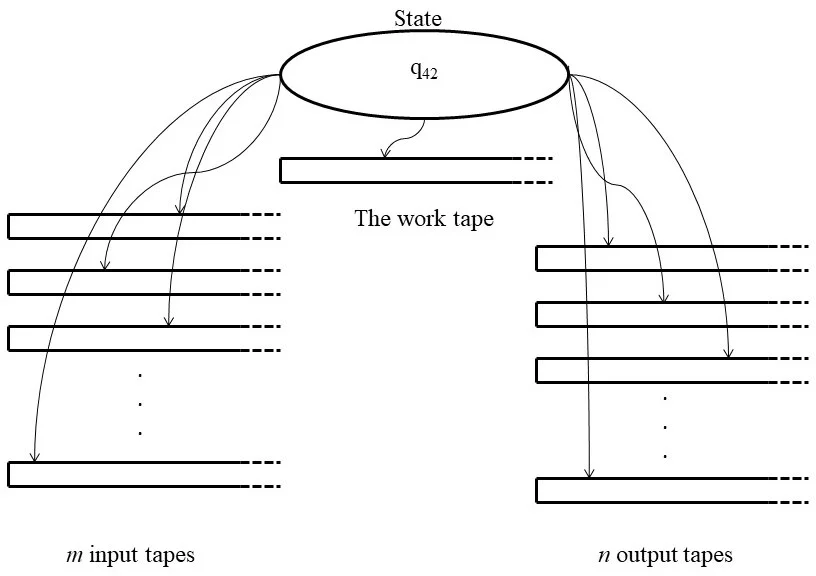
Next, the author formalizes Turing machines as a category Turing. Objects are natural numbers representing the number of input tapes; morphisms are Turing machines with a specified number of input and output tapes. Composition corresponds to feeding the output tapes of one machine into the input tapes of the next, and the monoidal product adds the numbers of tapes, modeling parallel machines. The paper acknowledges a technical subtlety: composition with the identity machine does not give strict equality of machines, only equivalence up to behavior. Three ways to resolve this are discussed: careful definition of composition, passing to equivalence classes of machines, or working with “almost‑categories”. Regardless, there is a natural functor Turing → CompString sending a machine to the string function it computes. The Church‑Turing thesis is restated categorically as the claim that this functor is full (every computable string function arises from some Turing machine). The author notes that this is not a provable theorem but a widely accepted thesis.
Finally, the paper sketches a category Logic of logical formulas designed to capture the operational semantics of Turing machines. Variables of three kinds are introduced to describe tape contents, head positions, and time steps. A functor L : Turing → Logic translates a machine into a set of logical constraints over these variables, thereby linking computation with formal logic. This construction sets the stage for further categorical treatments of complexity theory, Kolmogorov complexity, randomness, and related topics.
Overall, the manuscript argues that by viewing syntax, algorithms, and semantics as objects and morphisms in appropriate symmetric monoidal categories, many classic results of theoretical computer science become immediate consequences of functoriality, equivalence of categories, and simple structural properties. The “big picture” diagram (Figure 1) summarises the relationships among the various categories (Func, CompFunc, CompString, Turing, Logic) and the functors connecting them. The work serves both as an introductory guide for category theorists wishing to understand theoretical computer science and as a conceptual unification that highlights the power of categorical thinking in the foundations of computation.
Comments & Academic Discussion
Loading comments...
Leave a Comment