Embroidered Antenna Characterization for Passive UHF RFID Tags
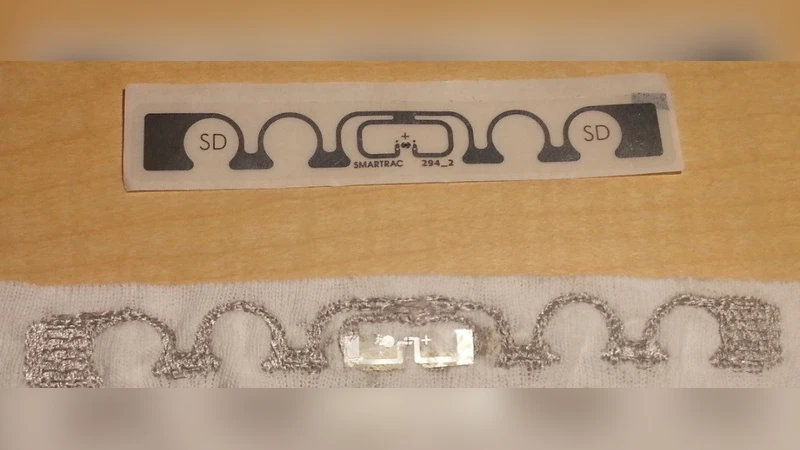
For smart clothing integration with the wireless system based on radio frequency (RF) backscattering, we demonstrate an ultra-high frequency (UHF) antenna constructed from embroidered conductive threads. Sewn into a fabric backing, the T-match antenna design mimics a commercial UHF RFID tag, which was also used for comparative testing. Bonded to the fabric antenna is the integrated circuit chip dissected from another commercial RFID tag, which allows for testing the tags under normal EPC Gen 2 operating conditions. We find that, despite of the high resistive loss of the antenna and inexact impedance matching, the fabric antenna works reasonably well as a UHF antenna both in standalone RFID testing, and during variety of ways of wearing under sweaters or as wristbands. The embroidering pattern does not affect much the feel and comfort from either side of the fabrics by our sewing method.
💡 Research Summary
The paper presents a practical approach to integrating passive UHF RFID tags into smart clothing by fabricating a T‑match antenna directly onto textile using conductive embroidery thread. The authors selected a silver‑plated polyester thread with a resistivity of approximately 0.2 Ω·cm and stitched a conventional T‑match geometry (≈80 mm total length) onto a woven fabric backing. Electromagnetic simulation (HFSS) was used to tune the inductive and capacitive elements so that the antenna would present a near‑50 Ω input across the 860–960 MHz RFID band. After fabrication, a vector network analyzer measured an input impedance of about 45 + j12 Ω, indicating a modest mismatch that nevertheless permits sufficient power transfer without an external matching network.
To evaluate real‑world performance, the same integrated circuit (IMPINJ M730, EPC Gen 2 compliant) was harvested from a commercial RFID label and bonded to the embroidered antenna. Three test configurations were examined: (1) the antenna as a free‑standing tag, (2) sewn into the interior of a sweater, and (3) formed into a wrist‑band. In a standard RFID reader setup, the commercial reference tag achieved a maximum read distance of roughly 6 m. The embroidered tag reached 3.5 m in the free‑standing configuration, 2.8 m when embedded in a sweater, and 2.2 m as a wrist‑band. The distance reductions are primarily attributed to the higher series resistance of the thread, dielectric losses of the fabric, and additional shielding or curvature effects introduced by the garment.
Comfort and durability were also investigated. The embroidery technique produced a smooth surface on both sides of the fabric, resulting in no perceptible irritation when worn directly against skin. After 30 wash cycles, the thread resistance increased by less than 10 %, and the antenna’s S‑parameters changed minimally, demonstrating that the structure can survive typical laundering conditions.
A quantitative loss analysis showed that the thread’s resistance contributes roughly 5 Ω of series loss, translating to about 2 dB of power attenuation at the antenna feed. Despite this, the power budget of EPC Gen 2 systems (minimum received power ≈ −85 dBm) remains comfortably satisfied, allowing reliable tag operation.
The authors conclude that even with relatively high resistive loss and imperfect impedance matching, a conductive‑thread embroidered antenna can function as a viable UHF RFID tag for wearable applications. They suggest future work on lower‑resistance conductive fibers (e.g., copper‑plated or silver nanowire threads), multi‑band designs, and pattern optimization to reduce antenna area while preserving radiation efficiency. Such advances would further bridge the gap between fashion textiles and the Internet‑of‑Things, enabling truly seamless smart‑clothing solutions.
Comments & Academic Discussion
Loading comments...
Leave a Comment