A Century of Science: Globalization of Scientific Collaborations, Citations, and Innovations
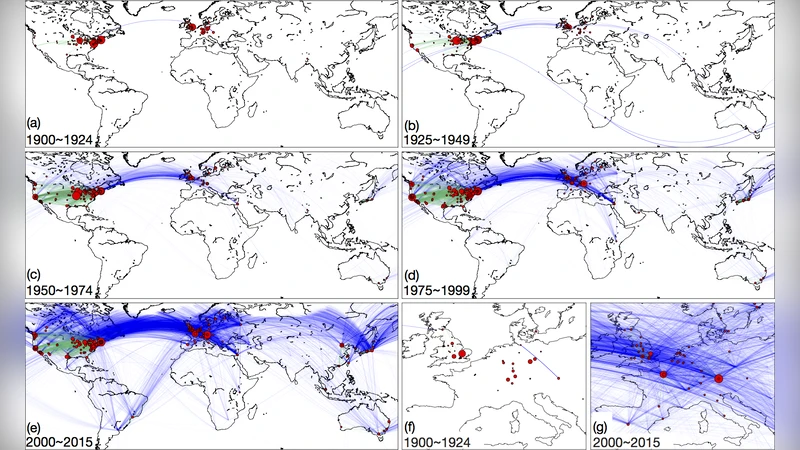
Progress in science has advanced the development of human society across history, with dramatic revolutions shaped by information theory, genetic cloning, and artificial intelligence, among the many scientific achievements produced in the 20th century. However, the way that science advances itself is much less well-understood. In this work, we study the evolution of scientific development over the past century by presenting an anatomy of 89 million digitalized papers published between 1900 and 2015. We find that science has benefited from the shift from individual work to collaborative effort, with over 90% of the world-leading innovations generated by collaborations in this century, nearly four times higher than they were in the 1900s. We discover that rather than the frequent myopic- and self-referencing that was common in the early 20th century, modern scientists instead tend to look for literature further back and farther around. Finally, we also observe the globalization of scientific development from 1900 to 2015, including 25-fold and 7-fold increases in international collaborations and citations, respectively, as well as a dramatic decline in the dominant accumulation of citations by the US, the UK, and Germany, from ~95% to ~50% over the same period. Our discoveries are meant to serve as a starter for exploring the visionary ways in which science has developed throughout the past century, generating insight into and an impact upon the current scientific innovations and funding policies.
💡 Research Summary
The paper “A Century of Science: Globalization of Scientific Collaborations, Citations, and Innovations” presents a comprehensive, data‑driven investigation of how scientific activity has evolved from 1900 to 2015. Using the Microsoft Academic Graph, the authors assembled a massive dataset comprising 89 million papers, 795 million citation links, and 1.23 billion author‑collaboration edges, covering 53 million distinct researchers and their institutional affiliations worldwide.
The study is organized around three analytical dimensions: (1) collaboration patterns, (2) citation and referencing behavior, and (3) scientific impact. For each dimension a set of concrete research questions (13 in total) is posed and answered with longitudinal statistics, distribution analyses, and network visualizations.
Collaboration Findings
- The number of active scholars doubled roughly every 11 years, while the total volume of publications doubled every 12 years, confirming an exponential growth of the scientific enterprise.
- Individual productivity (papers per author per year) remained stable at about two papers per researcher, indicating that the surge in output is driven mainly by larger teams rather than higher per‑person productivity.
- The share of single‑author papers fell dramatically from ~80 % in the early 1900s to 15‑20 % in the 2000s. Papers with ten or more co‑authors grew from a negligible fraction to over 20 % of all publications.
- International collaborations increased 25‑fold; today roughly 12 % of papers involve co‑authors from different countries, compared with less than 0.5 % a century ago.
- Top‑1 % most‑cited papers are overwhelmingly produced by collaborative teams: over 90 % of these breakthrough works involve multiple authors, and papers with >10 authors have a four‑fold higher likelihood of entering the top‑1 % than single‑author papers.
Citation and Referencing Findings
- Self‑citation rates have dropped sharply: at the author level from 30 % to 10 % and at the country level from 90 % to 30 %, suggesting a move toward more open, outward‑looking scholarship.
- Researchers are reaching further back in time when citing prior work; the average “citation age” has increased, indicating that modern science builds on a broader historical base.
- The geographic concentration of citations has weakened. In the early 20th century the United States, United Kingdom, and Germany accounted for roughly 95 % of all citations received worldwide; by 2015 this share fell to about 50 %, with China, Japan, South Korea, and other emerging economies gaining substantial citation inflows.
Impact Findings
- The distribution of citations remains highly skewed: the top 1 % of papers receive roughly ten times the average citation count, confirming the “rich‑get‑richer” dynamics of scientific influence.
- Harvard University consistently ranks as the most‑cited institution, and the top 200 institutions together capture a disproportionate share of global citations.
- Analysis of Nobel laureates shows a diversification of high‑impact research beyond the traditional Anglo‑German core, mirroring the broader decentralization observed in citation flows.
Methodological Considerations
The authors acknowledge limitations such as name disambiguation errors, incomplete coverage of non‑English venues, and the cumulative nature of citation counts that may under‑represent the impact of recent publications. Nevertheless, the breadth of the dataset (over a century, worldwide) provides a robust macro‑level view of scientific evolution.
Implications
Policy makers are urged to foster international collaborative projects, design evaluation metrics that discourage excessive self‑citation, and invest in research infrastructure in emerging regions. For scientists, the findings encourage participation in larger, interdisciplinary teams and deeper literature mining to maximize the likelihood of high‑impact contributions.
In sum, the paper demonstrates that over the past 116 years science has transitioned from a predominantly individual, regionally concentrated activity to a globally networked, collaborative, and more evenly distributed system of knowledge creation. These insights have direct relevance for funding agencies, institutional leaders, and researchers aiming to shape the future trajectory of scientific discovery.
Comments & Academic Discussion
Loading comments...
Leave a Comment