Fast optical control of spin in semiconductor interfacial structures
We report on a picosecond-fast optical removal of spin polarization from a self-confined photo-carrier system at an undoped GaAs/AlGaAs interface possessing superior long-range and high-speed spin transport properties. We employed a modified resonant spin amplification technique with unequal intensities of subsequent pump pulses to experimentally distinguish the evolution of spin populations originating from different excitation laser pulses. We demonstrate that the density of spins, which is injected into the system by means of the optical orientation, can be controlled by reducing the electrostatic confinement of the system using an additional generation of photocarriers. It is also shown that the disturbed confinement recovers within hundreds of picoseconds after which spins can be again photo-injected into the system.
💡 Research Summary
**
The paper addresses a central challenge in semiconductor spintronics: achieving both long spin lifetimes and ultra‑fast spin manipulation within the same material system. The authors focus on an undoped GaAs/Al₀.₄Ga₀.₆As heterointerface in which a built‑in electric field, arising from surface states and residual bulk charges, spatially separates photo‑generated electrons and holes. This separation creates a quasi‑static electron sub‑system confined near the interface, effectively acting as an optically induced n‑type doping layer. Because the electron‑hole overlap is minimal, radiative recombination is strongly suppressed, allowing the electron spin lifetime (τₛ) to extend to ~16 ns—more than two orders of magnitude longer than the typical recombination time (≈70 ps) in undoped bulk GaAs.
Spin injection and detection are performed using optical orientation (circularly polarized pump) and time‑resolved magneto‑optical Kerr rotation (probe). The experimental setup employs a mode‑locked Ti:sapphire laser operating at 80 MHz (12.5 ns pulse spacing). Crucially, the authors modify the conventional resonant spin amplification (RSA) technique by deliberately making every second pump pulse much weaker (≥30× reduction) using a non‑ideal pulse picker. The weak pulse creates a low‑density spin population without perturbing the electrostatic confinement, while the strong pulse generates a dense carrier population that temporarily screens the built‑in field, thereby “opening” the confinement and causing rapid depolarization of the pre‑existing spins.
The total Kerr signal S(Δt, B) is modeled as a sum over contributions from successive pump pulses (Eq. 1). Each term includes an amplitude Aₘ, exponential decay with τₛ, and a cosine factor representing Larmor precession at frequency ω = gμ_BB/ħ. By fixing the pump‑probe delay Δt and sweeping the in‑plane magnetic field B, the authors obtain RSA curves that contain two distinct precession frequencies when both weak and strong pulses contribute. For Δt = 500 ps and 150 ps, the data show a larger‑amplitude, lower‑frequency component (originating from the strong pulse at Δt = 0) superimposed on a smaller‑amplitude, higher‑frequency component (originating from the weak pulse at Δt = −12.5 ns). At Δt = −400 ps only the weak‑pulse component remains, confirming that the spin lifetime is shorter than twice the pulse spacing (τₛ ≈ 16 ns < 2t₀).
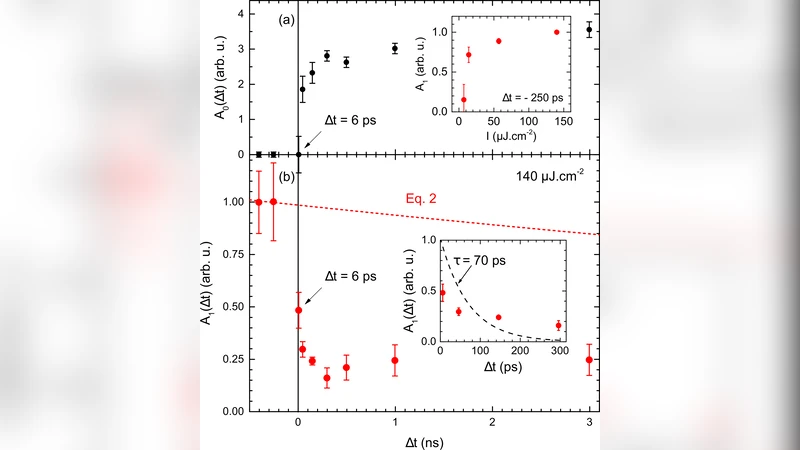
Fitting the RSA data yields the time‑dependent amplitudes Aₘ(Δt). In the absence of any disturbance, Aₘ would follow a simple exponential decay (Eq. 2). However, the measured amplitudes deviate markedly: the strong pulse reduces the amplitude of the weak‑pulse‑generated spin population by roughly 30 % immediately after its arrival, demonstrating that the additional photocarriers effectively screen the confinement field and accelerate spin depolarization. Importantly, the confinement recovers within a few hundred picoseconds, as evidenced by the re‑appearance of the weak‑pulse signal at later delays. This rapid recovery indicates that the spatial separation of electrons and holes re‑establishes the built‑in field on a sub‑nanosecond timescale, allowing the system to be re‑polarized repeatedly.
The work thus establishes three key advances: (1) identification of a self‑confined, long‑lived electron spin reservoir at an undoped GaAs/AlGaAs interface; (2) development of a modified RSA technique with alternating weak/strong pump pulses that enables simultaneous monitoring of multiple spin populations and quantitative assessment of optical control; and (3) demonstration of picosecond‑scale optical switching of spin polarization via transient reduction and rapid restoration of electrostatic confinement. These capabilities satisfy the dual requirements of long‑range spin transport (tens of micrometers, as shown in prior work) and high‑speed spin manipulation, positioning the GaAs/AlGaAs interface as a promising platform for spin‑logic devices, spin‑Hall transistors, and ultrafast MRAM concepts. The authors’ methodology provides a versatile toolbox for probing and engineering spin dynamics in other semiconductor heterostructures where built‑in fields can be optically modulated.
Comments & Academic Discussion
Loading comments...
Leave a Comment