Dynamic Uplink/Downlink Resource Management in Flexible Duplex-Enabled Wireless Networks
Flexible duplex is proposed to adapt to the channel and traffic asymmetry for future wireless networks. In this paper, we propose two novel algorithms within the flexible duplex framework for joint uplink and downlink resource allocation in multi-cel…
Authors: Qi Liao
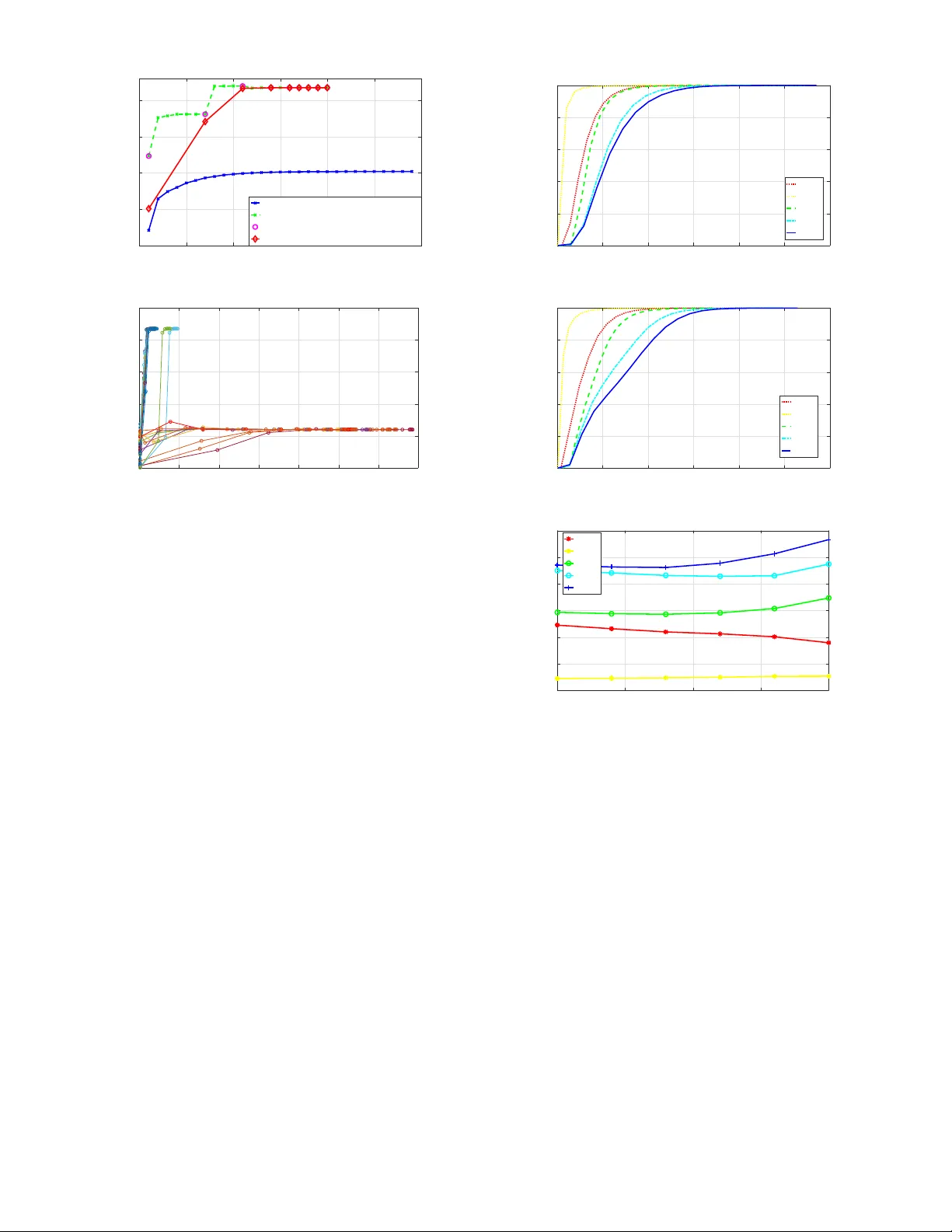
Dynamic Uplink/Do wnlink Resource Management in Fle xible Duplex-Enabled W ireless Networks Qi Liao Nokia Bell Labs, Stuttgart, Germany Email: qi.liao@nokia- bell- labs.com Abstract —Flexible duplex is proposed to adapt to the channel and traffic asymmetry for future wireless networks [1]. In this paper , we propose two novel algorithms within the flexible duplex framework for joint uplink and downlink resource allocation in multi-cell scenario, named successive approximation of fixed point (SAFP) and resour ce muting for dominant interfer er (RMDI), based on the awareness of interference coupling among wireless links. Numerical r esults show significant perf ormance gain over the baseline system with fixed uplink/downlink r esource configuration, and over the dynamic time division duplex (TDD) scheme that independently adapts the configuration to time- varying traffic volume in each cell. The proposed algorithms achieve two-f old increase when compared with the baseline scheme, measured by the worst-case quality of service satisfaction level, under a low level of traffic asymmetry . The gain is more significant when the traffic is highly asymmetric, as it achieves three-f old increase. I . I N T R O D U C T I O N Flexible duplex is one of the key technologies in fifth generation (5G) to optimize the resource utilization depend- ing on traffic demand [1]. The main objectiv e is to adapt to asymmetric uplink (UL) and downlink (DL) traf fic with flexible resource allocation in the joint time-frequenc y domain, such that the distinction between TDD and frequency di vision duplex (FDD) is blurred, or completely removed. Despite the advantage of adaptation to the dynamic traffic asymmetry , the dra wback is the newly introduced inter-cell interference (ICI) between duplexing mode DL and UL, here- inafter referred as inter-mode interfer ence (IMI) . The DL-to- UL interference plays a more important role due to the large difference between DL and UL transmission power . Many works focus on physical layer design to ov ercome IMI. In [2], special kinds of radio frames with different ratio of UL/DL are introduced to FDD, and heuristic approach is proposed to find the most suitable one solely based on the traffic volume. A few studies target the problem of dynamic UL/DL resource configuration. In [3], the authors formulate a utility maximiza- tion problem to minimize the per-user difference between UL and DL rates; while in [4] the problem is formulated as a two- sided stable matching game to optimize the average utility per user . Both works consider a single cell system where IMI does not play a role. Howe ver , in a multi-cell system the optimal UL/DL configuration depends not only on the traffic volume but also the interference coupling between all transmission links. Although very few studies provide solutions within the flexible duplex framework, similar problem exists in dynamic TDD. A popular solution is the cell-cluster-specific UL/DL reconfiguration [5], but ho w to coordinate the clusters for inter - cluster IMI mitigation still remains a challenge. In this paper , we optimize UL/DL resource configuration in multi-cell scenario, by recasting max-min fairness problem into a fixed point framew ork. Such frame work is widely used for power control [6], [7] and load estimation [8], [9] for UL or DL systems independently . Our previous work [10] exploits the framew ork to tackle the joint UL/DL resource allocation and power control problem within fle xible duplex, assuming that ICI is simply proportional to the load. This assumption, howe ver , is valid only when each resource unit has the same chance to be allocated to UL or DL, which may result in high probability of generating IMI. W e improved the model in this paper . The main contribution is summarized in below . • A new interference model is defined, which allows to prioritize the positions of the resources for UL and DL transmission, to reduce the probability of generating IMI. • W e propose a nov el algorithm SAFP to find algorithmic solution to optimize UL/DL resource configuration. Un- like the models in pre vious works [6], [8], [9], the ne w interference model is nonlinear and nonmonotonic . • Further we enhance SAFP to RMDI by detecting sequen- tially the dominant interferer in the system, and muting the partial resource in neighboring cells to reduce ICI. • W e compare SAFP and RMDI numerically with two con ventional schemes: a) fixed UL/DL configuration, and b) dynamic TDD that adapts UL/DL configuration solely based on traf fic v olume, and sho w a performance gain varying from two to three fold depending on the traf fic asymmetry . The rest of the paper is or ganized as follows. In Section II, the system model is described together with the correspondent notation. The problem statement is given in Section III. The proposed algorithms SAFP and RMDI are introduced in Section IV and V, respectively . Finally , in Section VI, the numerical results are presented. I I . S Y S T E M M O D E L In this paper , we use the follo wing definitions. The non- negati ve and positiv e orthant in k dimensions are denoted by R k + and R k ++ , respectiv ely . Let x ≤ y denote the component- wise inequality between two v ectors x and y . Let diag ( x ) denote a diagonal matrix with the elements of x on the main diagonal. For a function f : R k → R k , f n denotes the n -fold composition so that f n = f ◦ f n − 1 . The cardinality of set A is T ABLE I: NOT A TION SUMMAR Y N set of BSs with | N | = N K set of UEs with | K | = K S set of services with | S | = S W set of MRUs with | W | = W S ( u ) ( S ( d ) ) set of UL (DL) services S n set of services served by the n th BS n s index of BS serving the s th service A UE-to-service association matrix B BS-to-service association matrix B ( u ) ( B ( d ) ) BS-to-UL (BS-to-DL) association matrix δ t ( δ f ) length of time duration (range of frequency) of an MR U W t ( W f ) number of smallest time (frequency) units in MRU set W w fraction of resource allocated to services ν cell load ν ( u ) ( ν ( d ) ) cell load in UL (DL) p transmit power allocated to services d traffic demand of services H channel gain matrix V link gain coupling matrix ρ s per service QoS satisfaction level ρ worst-case QoS satisfaction level denoted by | A | . The positiv e part of a real function is defined by [ f ( x )] + := max { 0 , f ( x ) } . The notation that will be used in this paper is summarized in T able I. W e consider an orthogonal frequency di vision multiplexing (OFDM)-based wireless network system, consisting of a set of base stations (BSs) N := { n : n = 1 , 2 , . . . , N } and a set of user equipments (UEs) K := { k : k = 1 , 2 , . . . , K } . W e assume that the network enables flexible duplex, where the resource in both frequency and time domains can be dynamically assigned to UL and DL. W e define minimum r esource unit (MR U) as the smallest time-frequency unit, that has a length of δ t seconds in time domain and a range of δ f Hz in frequency domain. W e consider a set of MR Us, denoted by W , consisting of W t smallest time units and W f smallest frequency units, and we have W := | W | = W t · W f . W e assume that K UEs generate a set of UL and DL services S := S ( u ) ∪ S ( d ) within the time duration of W MR Us (i.e., W t δ t seconds). Let the UE-to-service association matrix be denoted by A ∈ { 0 , 1 } K × S , where a k,s = 1 means that the s th service is generated by the k th UE, and 0 otherwise. Let B ∈ { 0 , 1 } N × S denote the BS-to-service association matrix. T o differentiate UL and DL services, we further define BS-to-UL and BS-to-DL association matrices, denoted by B ( u ) ∈ { 0 , 1 } N × S and B ( d ) ∈ { 0 , 1 } N × S , respectiv ely . Let the set of services served by BS n be denoted by S n and let the BS associated with service s be denoted by n s . Let w := [ w 1 , . . . , w S ] T ∈ [0 , 1] S be a vector collecting the fraction of resource allocated to all services s ∈ S . The cell load , defined as the fraction of occupied resource within a cell, is denoted by ν = Bw ∈ [0 , 1] N . The cell load in UL and DL are denoted by ν ( u ) = B ( u ) w and ν ( d ) = B ( d ) w respectiv ely , and we hav e ν = ν ( u ) + ν ( d ) . W e collect the transmit po wer (in W att) allocated to all services in a vector p := [ p 1 , . . . , p S ] T . A. Link Gain Coupling Matrix W e assume that average channel gains over W MRUs from each transmitter (TX) to each receiver (RX) are known, Fig. 1: Example: Interference link gain. collected in H := ( h i,j ) ∈ R ( N + K ) × ( N + K ) ++ . Note that the TXs and RXs include both UEs and BSs. Let v l,s denote the channel gain of the link between the TX of link l and the RX of link s . If l = s , v l,s is the channel gain of link s , otherwise if l 6 = s , v l,s is the channel gain of the interference link caused by service l to s . W e define link gain coupling matrix ˜ V as ˜ V := ( ˜ v l,s ) ∈ R S × S + , with ˜ v l,s := v l,s /v s,s , (1) where ˜ v l,s is the ratio between the interference link gain from service l to service s and the serving link gain of s . An example is shown in Fig. 1, where we consider a system enabling downlink and uplink decoupling in 5G [11]. The interference caused by UL service 3 (link l 3 ) to DL service 1 (link l 1 ) has a link gain of v 3 , 1 = h 3 , 4 , i.e., the link gain between TX 3 (transmitter of l 3 ) and RX 4 (recei ver of l 1 ). Giv en that the channel gain of l 1 is h 2 , 4 , the interference coupling ratio is giv en by ˜ v 3 , 1 = h 3 , 4 /h 2 , 4 . Remark 1 (Incorporating different interference conditions) . W ithout loss of generality , we can modify ˜ V to take into account differ ent interference conditions. F or example, to allow self-interfer ence cancellation we can define ˜ v s,s := 0 for every s ∈ S , while to allow zero intra-cell interfer ence we have ˜ v l,s := 0 if l and s are associated with the same BS. B. Quality of Service Metric In [10] we assume that the probability that l causes ICI to s associated with a different BS is approximated by the fraction of its allocated resource w l , which leads to Pr { l interferes s | n l 6 = n s } ≈ w l for l, s ∈ S . (2) The average signal-to-interference-plus-noise ratio (SINR) 1 of s ∈ S is approximated by SINR s ≈ p s P l ∈ S ˜ v l,s p l w l + σ 2 s v s,s = p s h ˜ V T diag( w ) p + ˜ σ i s , (3) where ˜ σ := σ 2 1 /v 1 , 1 , σ 2 2 /v 2 , 2 , . . . , σ 2 S /v S,S T , σ 2 s denotes the noise power in the receiv er of s . Note that in (3) w l serves as a probability . The interference condition is taken into account in ˜ v l,s as illustrated in Remark 1. 1 Note that ˜ v l,s is computed with av erage channel gain over W MRUs. Thus, (3) is the ratio between average receiv ed signal strength and average receiv ed interference, rather than the actual average SINR. Since we do not assume to kno w the distribution of the channel gain, here we use (3) to approximate the average SINR. Howe ver , the approximations (2) and (3) are only valid under the assumption that each MRU is considered to be “equal” for all the services to be allocated, namely , the position of resource is not specified for UL or DL. Unfortunately , such assumption results in a high probability of IMI. In the following we introduce an improved SINR model based on a simple UL/DL resource positioning strategy to reduce IMI. Recall that con ventional TDD or FDD specifies a set of resource for UL and DL respectiv ely to pre vent IMI. W ith flexible duplex, the challenge is to allow different resource partitioning between UL and DL in each cell, while limiting the probability of generating IMI. Let us take an example, cell m with UL load ν ( u ) m and cell n with DL load ν ( d ) n share same set of available resource. It is obvious that the minimum o verlapping area between UL resource in cell m and DL resource in cell n is h ν ( u ) m + ν ( d ) n − 1 i + , which can be easily achiev ed by allocating the set of resource to UL traffic in cell m in some priority order while allocating the same set of resource to DL traffic in cell n in rev erse order . Giv en the aforementioned strategy , to deri ve the interference coupling matrix that incorporates the probability that a link causes ICI to another , we introduce a r euse factor coupling matrix C ( w ) depending on w . Let x s ∈ { u , d } denote the UL or DL traffic type of service s ∈ S , and recall that n s denotes the serving BS of s , C ( w ) is defined as C ( w ) := C := ( c l,s ) ∈ R S × S + , (4) c l,s := h ν ( x l ) n l + ν ( x s ) n s − 1 /ν ( x s ) n s i + if x l 6 = x s min n 1 , ν ( x l ) n l /ν ( x s ) n s o if x l = x s , where the load of cell n s occupied by traffic type x s is computed by ν ( x s ) n s := h B ( x s ) w i n s . In general, c l,s is defined as the ratio of the ov erlapping area on the resource plane between the load of cell n l serving traf fic type x l and the load of cell n s serving traffic type x s to the load of cell n s serving traffic type x l . W ith C ( w ) in hand, given the power vector p , we can modify (3) and deriv e the SINR of service s ∈ S as SINR s ( w ) ≈ p s C ( w ) ◦ ˜ V T diag( p ) w + ˜ σ s , (5) where with a slight abuse of notation, X ◦ Y denotes the Hadamard (entrywise) product of matrices X and Y . Note that the first term in the denominator is the interference power receiv ed by service s divided by the channel gain of s , and it is equiv alent to P l c l,s w l v l,s p l /v s,s , where c l,s · w l approximates the probability that service l causes interference to service s . The maximum achiev able number of bits for service s ∈ S within the time span of resource set W is η s ( w ) = δ t δ f W w s log (1 + SINR s ( w )) , (6) where the unit of δ t δ f is Hz · s/MR U, while W w s is the number of MR Us allocated to s . Assuming that the nonzero traffic demands d := ( d 1 , . . . , d S ) T ∈ R S ++ is kno wn, where d s is defined as number of required bits of s during the time span of W , we introduce per service quality of service (QoS) satisfaction level , written as ρ s ( w ) = η s ( w ) /d s , s ∈ S . (7) I I I . P R O B L E M F O R M U L AT I O N The objective is to partition the resource set W in each cell n ∈ N into three subsets: resource for UL, resource for DL, and blanked resource 2 , respectiv ely , to maximize the worst- case QoS satisfaction level , defined as ρ ( w ) := min s ∈ S ρ s ( w ) . (8) All demands of the services are feasible, when ρ ( w ) ≥ 1 . W e formulate the problem in Problem 1, where (9a) and (9b) imply the objectiv e of maximizing the worst-case QoS satisfaction level ρ ∗ , and (9c) is the per-cell load constraint. Problem 1 max . w ∈ R S + ,ρ ∈ R + ρ (9a) s.t. w ≥ ρ f ( w ) , (9b) g ( w ) := k Bw k ∞ ≤ 1 , (9c) where the vector -valued function f is defined by f : R S + → R S ++ : w 7→ [ f 1 ( w ) , . . . , f S ( w )] T , (10a) where f s ( w ) := d s δ t δ f W log (1 + SINR s ( w )) . (10b) In [10], we show that with con ventional model of SINR (3), Problem 1 is equi valent to solve a nonlinear system of equations such that w = ρ f ( w ) , g ( w ) = 1 and that ρ is maximized. It is worth mentioning that, with the modified models of interference coupling (4) and SINR (5), Problem 1 is a multi-v ariate nonconv ex optimization problem. More- ov er , the constraint (9b) is neither conv ex nor continuously differentiable, and Problem 1 is not necessarily equiv alent to the nonlinear system of equations. In Section IV we provide algorithmic solution to Problem 1, denoted by w ∗ . The per-cell fraction of resource to allocated to UL and DL are then obtained as ν ( u ) , ∗ = B ( u ) w ∗ and ν ( d ) , ∗ = B ( d ) w ∗ , respectiv ely . If ρ ∗ := ρ ( w ∗ ) ≥ 1 , all demands are feasible. Howe ver , if ρ ∗ < 1 , the solution to Problem 1 is not a good operating point, since the demands of all services are infeasible. In other words, all users are unsatisfied. Therefore, a further question arises: how can we transform the desir ed demands in Pr oblem 1 fr om infeasible to feasible? One of the f actors causing infeasible demand is the bottleneck services. In Section V we modify Problem 1 by dedicating partial resources for bottleneck services, while muting them for others, and dev elop an algorithm with heuristic strategies. 2 Under certain conditions, enhanced interference mitigation can be achie ved by muting partial resources in some cells. Howev er , it is also possible that the optimal solution returns an empty set of the blanked resource. Remark 2 (New challenge due to comple x interference coupling) . Pr oblem 1 is formulated along similar lines to our pr evious work [10, Problem 2a]. However , in [10], the r eceived interfer ence in SINR (3) is an affine function of w , which further leads to some nice pr operties of f (as shown in Lemma 1). In this paper , because we intr oduce more complex interfer ence coupling (4) and the r esulting modified SINR model (5) , the desir ed pr operties of f do not e xist, whic h brings new challenge with developing efficient algorithmic solution. I V . S U C C E S S I V E A P P RO X I M A T I O N O F F I X E D P O I N T In this section, we first provide background information about the mathematical tool to solve the problem. Then, we propose a novel efficient algorithm SAFP to find a feasible point of w with good, if not optimal, objective value of ρ ∗ . A. Backgr ound Information and Pre vious Results W ith the con ventional SINR model in (3), f defined in (10) has the following property . Lemma 1 ([10, Lemma 1]) . W ith SINR defined in (3) , f : R S + → R S ++ is a standar d interfer ence function (SIF) (see Appendix A for definition). Knowing that f is SIF, and that g : R S ++ → R ++ in (9c) is a monotonic norm, we encounter the same type of problem as [10, Problem 2a]. The following proposition is provided based on the pre vious result [10, Theorem 1], which gi ves rise to an algorithmic solution to Problem 1 with con ventional SINR model based on the fixed point iteration scheme. Proposition 1. Suppose SINR is modeled with (3) , and • f : R S + → R S ++ is SIF, • g : R S ++ → R ++ is monotonic, and homogeneous with de gree 1 (i.e., g ( α x ) = αg ( x ) for all α > 0 ) Ther e e xists a unique solution to Pr oblem 1, denoted by { w ∗ , ρ ∗ } , wher e w ∗ can be obtained by performing the following fixed point iteration: w ( t +1) = f w ( t ) g ◦ f w ( t ) , t ∈ N , (11) wher e with a slight abuse of notation, g ◦ f denotes the com- position of functions g and f . The iteration in (11) con ver ges to w ∗ , and we have ρ ∗ = 1 /g ◦ f ( w ∗ ) and g ( w ∗ ) = 1 . Pr oof. The proof is omitted here since it uses our previous result [10, Theorem 1] and is along the same lines as [10, Proposition 1]. B. Successive Approximation of F ixed P oint Proposition 1 provides an algorithmic solution to Problem 1 with SINR (3), by utilizing the properties of SIF. Unfortu- nately , with the modified SINR in (5), f is not SIF because the coupling matrix C ( w ) depends on w in a non-monotonic and non-differentiable manner . Ho wev er , it is easy to show that by replacing C ( w ) in (5) with some approximation C 0 := C ( w 0 ) computed with fixed w 0 , the SINR in (5) falls into the same class as (3), and the approximated problem can be solved by Proposition 1 with f ( w ) replaced by f C 0 ( w ) := f ( w , C ( w 0 )) . Therefore, our essential, natural idea is to efficiently com- pute a suboptimal solution of Problem 1 by solving a sequence of (simpler) max-min fairness subproblems whereby the non- contractiv e mapping f is replaced by suitable contraction approximation f C 0 . These subproblems can be solved with Proposition 1. More specifically , the proposed SAFP algorithm consists in solving a sequence of approximations of Problem 1 in the form max . w ∈ R S + ,ρ ∈ R + ρ ; s.t. w ≥ ρ f C 0 ( w ) ; g ( w ) ≤ 1 , (12) where f C 0 ( w ) represents approximation of f ( w ) at the current iterate w 0 . The unique solution to (12) can be obtained by the fixed point iteration (11), with C ( w ) replaced by C ( w 0 ) . Unfortunately , due to the complexity of C ( w ) , the con- ver gence of SAFP to a limit point cannot be guaranteed, since multiple fixed points can e xist in the system where the inequality sign in (9b) is replaced by the equality sign. Different initial values of ˆ w may lead to dif ferent fixed points. Mor eover , the solution to the system of nonlinear equations may not be the optimal solution to the original pr oblem of maximizing the minimum, due to the nonmonotonicity of the mapping f when including C into the interference model. Thus, we design the searching algorithm to guarantee the utility increase with initial v alues of { ρ ∗ , w ∗ } , maximum number of random initiation N max , and algorithm stopping criterion depending on the maximum number of iterations N iter and the distance threshold , illustrated as belo w . • The algorithm runs for N max times, each with a different random initialization of ˆ w and the corresponding C ( ˆ w ) . • For each initialization ˆ w n , n = 1 , 2 , . . . , N max , we iterativ ely perform the fix ed point iteration in (11) with f ( w ) replaced by f ˆ C n ( w ) where ˆ C n := C ( ˆ w n ) . The iteration stops if the number of iterations exceeds N iter or the distance yields k w 0 − w k ≤ and returns the solution { w 0 , ρ 0 } with respect to the n th random initialization. The solution is updated with w ∗ ← w 0 , ρ ∗ ← ρ 0 if ρ 0 > ρ ∗ . The proposed SAFP algorithm is summarized in Algorithm 1. Although the con vergence of SAFP to a global optimum cannot be guaranteed and heuristics are introduced, numerical results in Section VI (e.g., Fig. 2b) show that each random initialization con verges to a fixed point, and with limited number of initializations, the algorithm finds a suboptimal, if not optimal, solution among multiple fixed points. V . R E S O U R C E M U T I N G F O R D O M I N A N T I N T E R F E R E R The proposed SAFP finds a feasible point of w ∗ with suboptimal, if not optimal, objectiv e v alue of ρ ∗ . If ρ ∗ ≥ 1 , the obtained w ∗ provides fairness on the services, and the demands of all services are feasible. Ho wev er , if ρ ∗ < 1 , w ∗ is not a good operating point since the traffic demands of all services are infeasible. Therefore, in this section we focus the following question: how can we transform the desired demands in Pr oblem 1 fr om infeasible to feasible? Algorithm 1: SAFP algorithm for resource partitioning input : i ← 1 , N max > 1 , N iter > 1 , > 0 , ρ ∗ ← 0 , w ∗ ← 0 output: { w ∗ , ρ ∗ } while i ≤ N max do random initialization of w 0 ; C 0 ← C ( w 0 ) ; j ← 0 , w ← 0 ; ∆ ( j ) ← k w 0 − w k ∞ ; w ( j ) ← w 0 ; while j ≤ N iter or ∆ ( j ) ≥ do % solving appr oximated subpr oblem with C 0 ; while k w 0 − w k ∞ ≥ do w ← w 0 ; w 0 ← f C 0 ( w ) /g ◦ f C 0 ( w ) ; % Update C with optimized w 0 ; w ( j +1) ← w 0 ; C ( j +1) = C 0 ← C ( w 0 ) ; ∆ ( j +1) ← k w ( j +1) − w ( j ) k ∞ ; j ← j + 1 ; ρ 0 = ρ 0 ( w 0 ) ← min s ∈ S w 0 s /f C 0 ,s ( w 0 ) ; % update the solution if ρ 0 exceeds the stored value ; if ρ 0 > ρ ∗ then ρ ∗ ← ρ 0 ; w ∗ ← w 0 ; i ← i + 1 ; In [12], the authors propose a remo v al selection criterion for an infeasible DL power control problem, that removes sequentially the bottleneck services until the demands for all the remaining services are feasible. Howe ver , is there a method of further increasing ρ ∗ without remov al of services? Motiv ated by coordinated muting using almost blank subframe (ABS) for time domain intercell interference coordination introduced in [13], we are interested in exploring the tradeof f between resource utilization and interference reduction by introducing the resource muting in flexible duplex. A. Modified Load Constraints Incorporating Resour ce Muting The key concept is to sequentially reserve some resource in a cell for the dominant interferer , while muting them in the cells strongly impacted by the interferer . T o this end, we rank the services based on the interference level that they generate to others, giv en by I s ( w ) := c 0 s ˜ v 0 s T p s w s , for s ∈ S , (13) where c 0 s := ro w s C ( w ) denotes the s th ro w of C ( w ) , and ˜ v 0 s := ro w s ˜ V denotes the s th row of ˜ V . Moreov er , to pre vent the waste of resource, we select the strongly affected cells to mute their resource. The set of cells to mute the resource reserved for s is selected by M s := { m ∈ N \ { n s } : J s,m ( w ) ≥ α } , (14) where α is a threshold and J s,m ( w ) is the interference generated from service s to a cell m 6 = n s , defined as J s,m ( w ) := h B c 0 s ◦ ˜ v 0 s T i m p s w s . (15) If a set of dominant interferers S is chosen, and for each s ∈ S a subset of the cells M s is selected to mute resource w s , then, in each cell we hav e the load constraint g 0 m ( w ) := X s ∈ S 1 { m ∈ M s } w s + X l ∈ S m w l ≤ 1 , for m ∈ N , (16) where 1 {·} is the indication function, the first term is the total amount of resource to be muted in cell m , and the second term is the amount of av ailable resource for services in m . Since g 0 m ( w ) ≤ 1 needs to be held for e very m ∈ N , the load constraint can be rewritten as g 0 ( w ) := max m ∈ N g 0 m ( w ) ≤ 1 . (17) Note that without the muting scheme, i.e., if ¯ S = ∅ , the first term in (16) is zero and (17) is equiv alent to the per -cell load constraints in (9c). B. Design of Heuristic Algorithm It is ob vious that the modified g 0 is also monotonic and homogeneous with degree 1 , which enables le verage of Propo- sition 1 to solve the modified Problem 1, with g ( w ) replaced by g 0 ( w ) to incorporate the resource reservation and muting strategy . Compared to the solution to the original Problem 1, resource muting may not necessarily improve the desired utility ρ , because muting of w s in cell m ∈ M s may lead to waste of resource. Therefore, we de velop a heuristic algorithm RMDI to guarantee a utility that is no less than the ρ deri ved in Algorithm 1. The Algorithm is described briefly in the following steps. 1. Derive w (0) = w ∗ to Problem 1 with Algorithm 1 and compute the corresponding ρ (0) = ρ ∗ . 2. Compute I s ( w ∗ ) and rank the services based on I s . Let q s denote the rank of s , e.g., the maximum interferer ˆ s := arg max s I s has a rank of q ˆ s = 1 . Set k = 1 . 3. Add the service with highest rank into ¯ S ( k ) , e. g., ¯ S ( k ) = { s : q s ≤ k } . 4. Solve modified Problem 1 with ¯ S ( k ) using Algorithm 1 (with g replaced by g 0 ), deriv e w ( k ) and ρ ( k ) . 5. If ρ ( k ) ≥ ρ ( k − 1) , increment k and go back to Step 3; otherwise stop the algorithm. 6. Obtain solution w ? = w ( k − 1) . V I . N U M E R I C A L R E S U LT S In this section, we analyze the performance of the proposed algorithms SAFP and RMDI, by considering the asymmetry of UL and DL traf fic in two-cell scenario. The distance between the two BSs is 2 km. The transmit power of BS and UE are 43 and 22 dBm respectiv ely and all the other simulation parameters mainly related to channel gain can be found in [14, T ab . A2.1.1-2]. W e define the minimum time unit δ t as 0 . 5 ms and the minimum frequency unit δ f as 15 kHz. Further we hav e W t = 20 and W f = 300 , i. e., a resource plane that spans a time duration of 0 . 01 seconds and frequency of 5 MHz (including the guard band). W e defined a fixed total traffic demand Λ = P s d s = 50 kbits within W t δ t = 0 . 01 seconds, which implies a to- tal serving data rate of 5 Mbit/s. The total traffic can be asymmetrically distributed between the two cells with dif- ferent ratios among T inter := { 1 / 9 , 2 / 8 , 3 / 7 , . . . , 9 / 1 , 10 / 0 } . W ithin each cell, the traffic can be asymmetrically distributed between UL and DL traf fic with ratios among T intra := { 1 / 9 , 2 / 8 , 3 / 7 , . . . , 9 / 1 } . UEs with either UL or DL traf fic are generated with uniform distribution within the intersection of two balls with radius 2 km, and with BS 1 and 2 as their centers respectiv ely , to analyze the scenario of high inter-cell interference. W ithout loss of generality , we can place one UL and one DL service in each cell with the traf fic demand computed by the traffic ratio mentioned above. 1) Algorithm con verg ence of SAFP. Let us first examine the con vergence of Algorithm 1, and compare it with Algorithm “FP” that is summarized in Proposition 1 with con ventional SINR model (3). The parameters are set as N max = 30 , N iter = 1000 , = 10 − 4 . In Fig. 2a we sho w the con- ver gence of the SAFP with one particular initialization of w 0 and C ( w 0 ) and compare it with FP . The magenta circle indicates the starting point with an updated C w ( j ) , and the green dashed line sho ws that with each fixed C w ( j ) , by performing fixed point iteration, ρ monotonically increases and con verges to the fixed point with respect to C w ( j ) . Note that the green dashed line is not the “actual” utility ρ , since it is computed with updated w ( i ) and the approximation C w ( j − 1) . Therefore, we plot the red line to show the con vergence of the actual utility at each step of updating C , computed with w ( j ) and C w ( j ) . By comparing the red curve and the blue curve (conv ergence of FP algorithm), we observe a significant increase of utility ρ by using SAFP. This is because, comparing with FP that randomly places the UL and DL resource, SAFP is based on an improv ed interference model, where ICI only appears in the intersection of the sets of allocated MR Us between different cells. Fig. 2b illustrates that with each random initialization of w 0 , the proposed SAFP con verges to a fix ed point. The example sho ws that 30 initializations con ver ge to tw o different fixed points with utilities 4 . 35 and 1 . 19 respecti vely . w ∗ corresponding to higher utility is chosen as the final solution. 2) P erformance comparison. W e compare the performance of SAFP and RMDI to the performance of the other three protocols, described in below . • FIX: Fixed ratio and same position of the UL and DL resource in different cell. IMI does not exist due to the orthogonal frequency band for UL and DL. The amounts of the UL and DL resource are fixed to be the same. • dTDD: Adaptive UL and DL resource proportional to the traffic volume in each cell independently . • FP: Proposed algorithm in [10] (summarized in Proposi- tion 1) that solves Problem 1 with old SINR model (3). T o compare the performance of protocols FIX, dTDD, FP , SAFP, and RMDI under different traffic asymmetry , we define a measure inter-cell traf fic distance , given by D m,n := k ϑ n − ϑ m k , where ϑ n := h ϑ ( u ) n , ϑ ( d ) n i T characterizes the UL and DL traffic distrib ution in cell n , and ϑ ( x ) n := h B ( x ) d i n / Λ , n = 1 , 2 , x ∈ { u , d } denotes the fraction of the total traffic Λ that traffic of type x in cell n accounts for, such that P n ∈ N P x ∈{ u , d } ϑ ( x ) n = 1 . For example, if ϑ 1 = ϑ 2 = [0 . 25 , 0 . 25] T , we hav e D 1 , 2 = 0 . Fig. 3a and 3b show the cumulati ve distribution function (CDF) of utility ρ deriv ed by applying the fiv e protocols under low and high inter-cell traffic distance, respectively . The CDF is deriv ed from 1000 simulation run times, each with different user locations and channel propagation, for ev ery combination of the inter-cell traffic distribution ratio in set T inter and intra- cell traffic distribution ratio in set T intra . All cases with D 1 , 2 ≤ 0 . 5 are considered as low inter-cell traf fic distance , while with D 1 , 2 > 0 . 5 as high inter-cell traf fic distance . Both Fig. 3a and 3b show that CDF F ( dTDD ) d (1) > 0 . 95 for dTDD, implying that service outage pr obability , i.e., the probability that at least one service cannot be served with satisfied QoS requirement, is abov e 95 %. The performance is worse than protocol FIX with F ( FIX ) d (1) > 0 . 45 . This is because although UL/DL resource splitting is adapted to the traf fic volume, the full occupation of the resource may cause sev ere IMI to some services. Such observation encour- ages the application of our proposed algorithms, which are able to reduce the interference coupling among services. By comparing FP , SAFP and RMDI, we show that FP further decreases the outage probability to below 20 %, and SAFP and RMDI significantly outperform FP , with the outage probability for low traffic distance belo w 10 %. Among the three, RMDI provides the best performance of the utility distribution. By comparing Fig. 3a and 3b, we observe that SAFP and RMDI provides ev en higher performance gain under high traf fic asymmetry . 3) P erformance gain depending on traffic asymmetry . T o an- alyze the performance gain depending on the traffic asymme- try , we average the utility obtained from 1000 simulation run times for D 1 , 2 falling into the intervals [0 , 0 . 16) , [0 . 16 , 0 . 32) , [0 . 32 , 0 . 48) , [0 . 48 , 0 . 64) , [0 . 64 , 0 . 80) , [0 . 80 , 1] , respectiv ely . Let us consider FIX as the baseline. Fig. 3c sho ws that the performance of FIX decreases with the traffic asymmetry , and the a verage utility is below 1 (infeasible QoS target) when traffic distance D 1 , 2 > 0 . 6 . Although dTDD adaptiv ely splits the UL/DL resource, the full occupation of the resource causes sev ere IMI, leading to the worst performance. On the other hand, FP reduces interference coupling among services, and provides 25 % gain when traffic asymmetry is low , and almost 2 -fold gain when the asymmetry is ultra high. The proposed SAFP incorporates interference coupling with UL/DL resource localization, which improv es the gain to 2 -fold when the traf fic asymmetry is low while 2 . 7 -fold when asymmetry is high. The enhanced version RMDI further improv es the gain by muting partial resource for interference cancellation. The gain is more significant when the traffic is highly asymmetric, achie ving 3 . 2 -fold increase when D 1 , 2 ≥ 0 . 64 . 0 5 10 15 20 25 30 Number of iterations 0 1 2 3 4 Utility ρ FP: updated ρ at each FP iteration SAFP: updated ρ at each FP iteration SAFP: optimized ρ for each SA SAFP: actual ρ at each iteration of SA (a) Comparison between FIX and SAFP . 0 50 100 150 200 250 300 350 Number of iterations 0 1 2 3 4 5 Utility ρ (b) Examination of the random initialization. An example: W ith 30 randomly initialized ˆ w , SAFP con ver ges to two local optima with ρ ∗ (1) = 4 . 35 and ρ ∗ (2) = 1 . 19 . Fig. 2: Examination of SAFP . A P P E N D I X A Definition 1. A vector function f : R k + → R k ++ is a standard interfer ence function (SIF) if the following axioms hold: 1. (Monotonicity) x ≤ y implies f ( x ) ≤ f ( y ) 2. (Scalability) for each α > 1 , α f ( x ) > f ( α x ) In Definition 1 we drop positi vity from its original definition [6] because it is a consequence of the other two properties [15]. R E F E R E N C E S [1] NGMN, “NGMN 5G white paper, ” Next generation mobile networks (NGMN), A deliverable by the NGMN Alliance, Feb . 2015. [2] H. Liu, Y . Jiao, Y . Gao, L. Sang, and D. Y ang, “Performance ev aluation of flexible duplex implement based on radio frame selection in L TE heterogeneous network, ” in ICT . IEEE, 2015, pp. 308–312. [3] A. M. El-Hajj and Z. Da wy , “On optimized joint uplink/do wnlink resource allocation in OFDMA networks, ” in ISCC . IEEE, 2011, pp. 248–253. [4] A. M. El-Hajj, Z. Dawy , and W . Saad, “ A stable matching game for joint uplink/downlink resource allocation in ofdma wireless networks, ” in ICC . IEEE, 2012, pp. 5354–5359. [5] Z. Shen, A. Khoryae v , E. Eriksson, and X. Pan, “Dynamic uplink- downlink configuration and interference management in TD-L TE, ” IEEE Communications Magazine , vol. 50, no. 11, pp. 51–59, 2012. [6] R. D. Y ates, “ A framew ork for uplink power control in cellular radio systems, ” IEEE Journal on selected areas in commun. , vol. 13, no. 7, pp. 1341–1347, 1995. [7] C. J. Nuzman, “Contraction approach to po wer control, with non- monotonic applications, ” in GLOBECOM . IEEE, 2007, pp. 5283–5287. [8] I. Siomina and D. Y uan, “ Analysis of cell load coupling for L TE network planning and optimization, ” IEEE T rans. on W ireless Commun. , vol. 11, no. 6, pp. 2287–2297, 2012. 0 2 4 6 8 10 12 Utility ρ 0 0.2 0.4 0.6 0.8 1 CDF FIX dTDD FP SAFP RMDI (a) Utility CDF under low inter-cell traffic distance. 0 2 4 6 8 10 12 Utility ρ 0 0.2 0.4 0.6 0.8 1 CDF FIX dTDD FP SAFP RMDI (b) Utility CDF under high inter-cell traffic distance. 0 0.2 0.4 0.6 0.8 Inter-cell traffic distance 0 0.5 1 1.5 2 2.5 3 Average Utility FIX dTDD FP SAFP RMDI (c) A verage utility under different inter-cell traffic distance. Fig. 3: Performance comparison among protocols. [9] R. L. Cav alcante, Y . Shen, and S. Sta ´ nczak, “Elementary properties of positiv e concave mappings with applications to network planning and optimization, ” IEEE T rans. on Signal Processing , vol. 64, no. 7, pp. 1774–1783, 2016. [10] Q. Liao, D. Aziz, and S. Stanczak, “Dynamic joint uplink and downlink optimization for uplink and downlink decoupling-enabled 5G heterogeneous networks, ” arXiv pr eprint , 2016. [Online]. A vailable: http://arxiv .or g/abs/1607.05459 [11] H. Elshaer , F . Boccardi, M. Dohler , and R. Irmer, “Downlink and uplink decoupling: A disruptive architectural design for 5G networks, ” in GLOBECOM, 2014 . IEEE, 2014, pp. 1798–1803. [12] N. T akahashi, M. Y ukawa, and I. Y amada, “ An efficient distributed power control for infeasible do wnlink scenarios–global-local fix ed-point- approximation technique, ” IEICE Tr ans. on fundamentals of electr onics, commun. and computer sciences , vol. 89, no. 8, pp. 2107–2118, 2006. [13] 3GPP, “TR 36.133, Requirements for support of radio resource man- agement, Rel-14, ” Oct. 2016. [14] ——, “TR 36.814, Further advancements for E-UTRA physical layer aspects, Rel-9, ” Mar. 2010. [15] K. K. Leung, C. W . Sung, W . S. W ong, Lok, and T at-Ming, “Conver - gence theorem for a general class of power-control algorithms, ” IEEE T rans. on Commun. , vol. 52, no. 9, pp. 1566–1574, 2004.
Original Paper
Loading high-quality paper...
Comments & Academic Discussion
Loading comments...
Leave a Comment