Micromechanical microphone using sideband modulation of nonlinear resonators
We report the successful detection of an audio signal via sideband modulation of a nonlinear piezoelectric micromechanical resonator. The 270$\times$96-$\mu$m resonator was shown to be reliable in audio detection for sound intensity levels as low as ambient room noise and to have an unamplified sensitivity of 23.9 $\mu$V/Pa. Such an approach may be adapted in acoustic sensors and microphones for consumer electronics or medical equipment such as hearing aids.
💡 Research Summary
This paper demonstrates a novel microphone concept based on side‑band modulation of a nonlinear piezoelectric MEMS resonator. A rectangular AlN‑based resonator measuring 270 µm × 96 µm (area ≈ 2.6 × 10⁻⁸ m²) is driven electrically at its strong mechanical resonance (15.168 MHz) with a 19 dBm (≈79 mW) signal. When an acoustic wave in the audible range (typically 200 Hz) impinges on the device, the nonlinear cubic stiffness term in the resonator’s equation of motion generates frequency mixing: the acoustic frequency appears as an upper sideband at f_r + f_m (and a corresponding lower sideband). The authors model the dynamics with
m ¨x + γ ẋ + k x + k₃ x³ = A_r cos(2πf_r t) + A_m cos(2πf_m t),
where A_m ∝ P·A (acoustic pressure times modal area). In the linear limit (k₃ = 0) the sideband disappears, confirming that the observed spectral line is a direct signature of the resonator’s nonlinearity.
The device stack consists of a 5 µm Si/1 µm SiO₂ substrate, a 300 nm Mo ground plane, a 1 µm AlN piezo layer, and 300 nm interdigitated Mo electrodes. Sixteen 15 × 3 µm suspension legs support the plate. The 15.168 MHz mode has an effective mass of 57.7 ng, stiffness 5.238 kN/m, and linear damping 6.1 × 10⁻⁶ Ns/m, giving a quality factor of only a few hundred in air.
Experimental verification proceeds as follows. The resonator is driven at a fixed frequency while a speaker emits a pure tone (200 Hz). The spectrum analyzer records the response. With the speaker off, only the drive tone and background noise appear. With the speaker on, a distinct peak appears exactly 200 Hz above the drive frequency, confirming sideband generation. To rule out electronic interference, a mechanical tuning fork (384 Hz) is used; the same sideband appears only when the fork is sounding, demonstrating that the effect originates from acoustic pressure rather than electrical crosstalk.
Systematic measurements explore three dependencies:
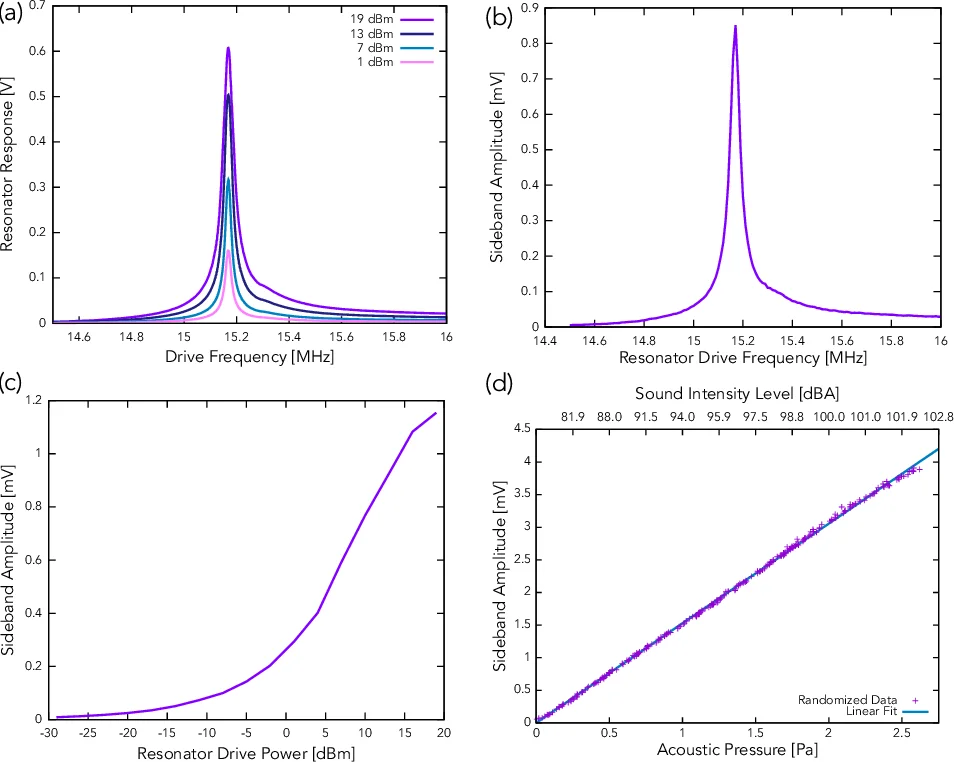
- Drive frequency – Scanning the drive frequency across the resonance shows that sideband amplitude follows the resonator’s amplitude response, peaking at the resonance center.
- Drive power – Varying the drive from 19 dBm down to –29 dBm reveals a linear relationship between drive amplitude and sideband magnitude, confirming that stronger nonlinear motion yields larger mixing products.
- Acoustic pressure – Using calibrated sound levels (0–2.7 Pa, 54 dBA to ~90 dBA) the sideband voltage scales linearly with pressure, yielding an unamplified sensitivity of 23.9 µV/Pa (‑92.4 dBV). With a commercial low‑noise pre‑amplifier (ADMP401, –42 dBV gain), the effective sensitivity improves to 1.53 mV/Pa.
These figures compare favorably with state‑of‑the‑art MEMS microphones, which typically report 200 µV/Pa without leveraging nonlinearity. The authors note that the high drive power required for strong nonlinearity (≈80 mW) is a drawback; linear MEMS microphones can operate with microwatt power budgets. Nonetheless, the demonstrated sensitivity and the ability to detect ambient‑room‑level sounds (≈54 dBA) with a diaphragm area orders of magnitude smaller than commercial devices suggest a promising route for ultra‑compact acoustic sensors.
The paper discusses potential improvements: employing higher‑piezoelectric‑coefficient materials such as Sc‑AlN, using ultra‑stiff substrates like diamond to raise the quality factor, and designing resonator geometries that enhance the nonlinear coupling coefficient. Arraying many such resonators could increase effective area while preserving the small individual footprint, enabling integration into smartphones, wearables, or hearing‑aid platforms where space and power are at a premium.
In conclusion, the work validates that sideband modulation of a strongly driven nonlinear MEMS resonator provides a viable mechanism for acoustic detection. It achieves a sensitivity of 23.9 µV/Pa without amplification and demonstrates linear, predictable behavior across drive power, frequency, and acoustic pressure. While power consumption remains a challenge, the approach opens a new design space for miniature microphones that exploit mechanical nonlinearity rather than relying solely on linear transduction.
Comments & Academic Discussion
Loading comments...
Leave a Comment