On the economics of knowledge creation and sharing
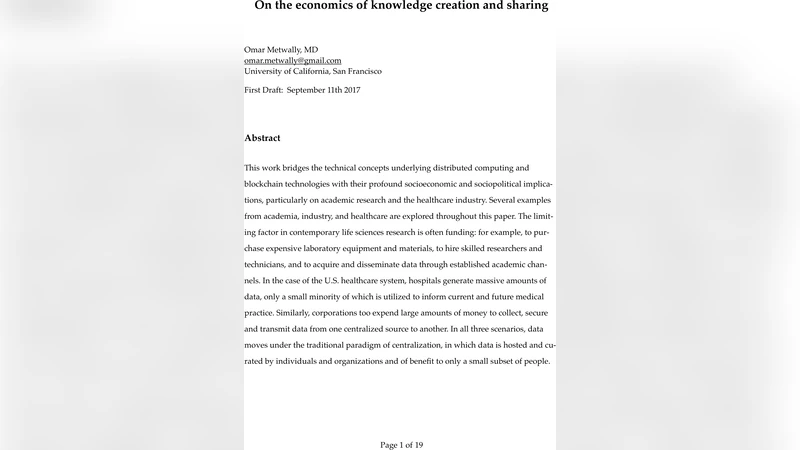
This work bridges the technical concepts underlying distributed computing and blockchain technologies with their profound socioeconomic and sociopolitical implications, particularly on academic research and the healthcare industry. Several examples from academia, industry, and healthcare are explored throughout this paper. The limiting factor in contemporary life sciences research is often funding: for example, to purchase expensive laboratory equipment and materials, to hire skilled researchers and technicians, and to acquire and disseminate data through established academic channels. In the case of the U.S. healthcare system, hospitals generate massive amounts of data, only a small minority of which is utilized to inform current and future medical practice. Similarly, corporations too expend large amounts of money to collect, secure and transmit data from one centralized source to another. In all three scenarios, data moves under the traditional paradigm of centralization, in which data is hosted and curated by individuals and organizations and of benefit to only a small subset of people.
💡 Research Summary
The paper examines how the prevailing centralized paradigm for data handling hampers progress in three critical domains: academic life‑science research, the U.S. healthcare system, and corporate data management. In academia, funding scarcity forces researchers to allocate large portions of their budgets to expensive equipment, consumables, and the traditional publication pipeline, which often restricts data to a narrow circle of privileged institutions. In hospitals, massive streams of electronic health records, imaging, and genomic data are generated daily, yet only a tiny fraction is repurposed for clinical decision‑making or future research, largely because the data reside in siloed, proprietary systems. Corporations, too, invest heavily in gathering, securing, and transmitting data through centralized data lakes, incurring high operational costs and creating single points of failure.
To address these systemic inefficiencies, the authors propose a decentralized data‑sharing architecture built on distributed computing and blockchain technologies. Peer‑to‑peer networks combined with consensus mechanisms (PoW, PoS, BFT variants) ensure that data are replicated, validated, and immutable without reliance on a central authority. Smart contracts automate the terms of data access, usage, and remuneration, while token‑based incentive schemes reward contributors in proportion to the value they add. Privacy‑preserving cryptographic tools such as zero‑knowledge proofs and homomorphic encryption enable verification of sensitive health or research data without exposing raw information. Scalability challenges are mitigated through sharding and layer‑2 solutions (e.g., roll‑ups, plasma), making it feasible to store and process large‑scale genomic or imaging datasets at modest cost.
In the academic sphere, the model creates an “open‑science ledger” where raw datasets, protocols, and even negative results are permanently recorded, dramatically improving reproducibility and allowing any qualified researcher worldwide to re‑analyze the same data. Decentralized Autonomous Organizations (DAOs) can replace traditional grant‑making bodies, distributing funding tokens automatically based on measurable contributions, thus reducing bureaucratic overhead and bias.
Within healthcare, patient‑centric data ownership is realized by giving individuals control of private keys that gate access to their medical records. When a researcher or clinician needs data, a smart contract mediates the transaction, ensuring compliance with consent and regulatory requirements while instantly compensating the patient or data custodian. This approach not only accelerates cohort assembly for clinical trials but also lowers the cost of data exchange by eliminating intermediaries and their associated fees.
For industry, a distributed data marketplace allows raw data providers—such as IoT sensor owners or consumer‑app developers—to sell their streams directly to AI model trainers, with token‑based reputation systems guaranteeing data quality. The removal of centralized storage and brokerage layers cuts operational expenditures and improves the timeliness of data fed into machine‑learning pipelines.
The authors conclude with a set of policy recommendations: enact data‑sovereignty legislation that recognizes individual ownership rights; establish regulatory sandboxes to test blockchain‑based data platforms; develop international standards for metadata schemas and interoperable APIs; and invest in education and infrastructure to build a skilled workforce capable of deploying and maintaining these systems. By aligning technical innovation with economic incentives and sociopolitical reforms, the paper argues that knowledge creation and sharing can become far more inclusive, transparent, and cost‑effective, ultimately reshaping the research, health, and corporate ecosystems for the better.
Comments & Academic Discussion
Loading comments...
Leave a Comment