Data-driven goodness-of-fit tests
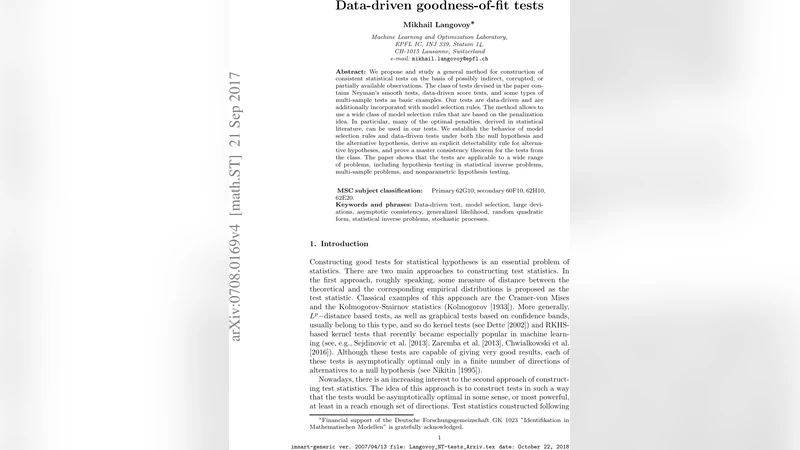
We propose and study a general method for construction of consistent statistical tests on the basis of possibly indirect, corrupted, or partially available observations. The class of tests devised in the paper contains Neyman’s smooth tests, data-driven score tests, and some types of multi-sample tests as basic examples. Our tests are data-driven and are additionally incorporated with model selection rules. The method allows to use a wide class of model selection rules that are based on the penalization idea. In particular, many of the optimal penalties, derived in statistical literature, can be used in our tests. We establish the behavior of model selection rules and data-driven tests under both the null hypothesis and the alternative hypothesis, derive an explicit detectability rule for alternative hypotheses, and prove a master consistency theorem for the tests from the class. The paper shows that the tests are applicable to a wide range of problems, including hypothesis testing in statistical inverse problems, multi-sample problems, and nonparametric hypothesis testing.
💡 Research Summary
The paper introduces a unified, data‑driven framework for constructing consistent goodness‑of‑fit tests that remain powerful even when the available observations are indirect, corrupted, or only partially observed. Traditional tests such as Neyman’s smooth tests, score tests, or multi‑sample chi‑square procedures assume clean, fully observed data and a fixed model dimension. In many modern applications—statistical inverse problems, high‑dimensional multi‑group comparisons, non‑parametric density testing—these assumptions are violated, leading to loss of power or inflated type‑I error.
The authors propose to generate a family of candidate test statistics ({T_n(k): k\in\mathcal K}), where the index (k) encodes model complexity (e.g., polynomial degree, number of basis functions, kernel bandwidth). A model‑selection rule based on a penalized criterion
\
Comments & Academic Discussion
Loading comments...
Leave a Comment