📝 Original Info
- Title: Interdependence of Transmission Branch Parameters on the Voltage Levels
- ArXiv ID: 1709.06930
- Date: 2017-09-21
- Authors: ** - Mir Hadi Athari (Virginia Commonwealth University, Electrical and Computer Engineering, atharih@vcu.edu) - Zhifang Wang (Virginia Commonwealth University, Electrical and Computer Engineering, zfwang@vcu.edu) **
📝 Abstract
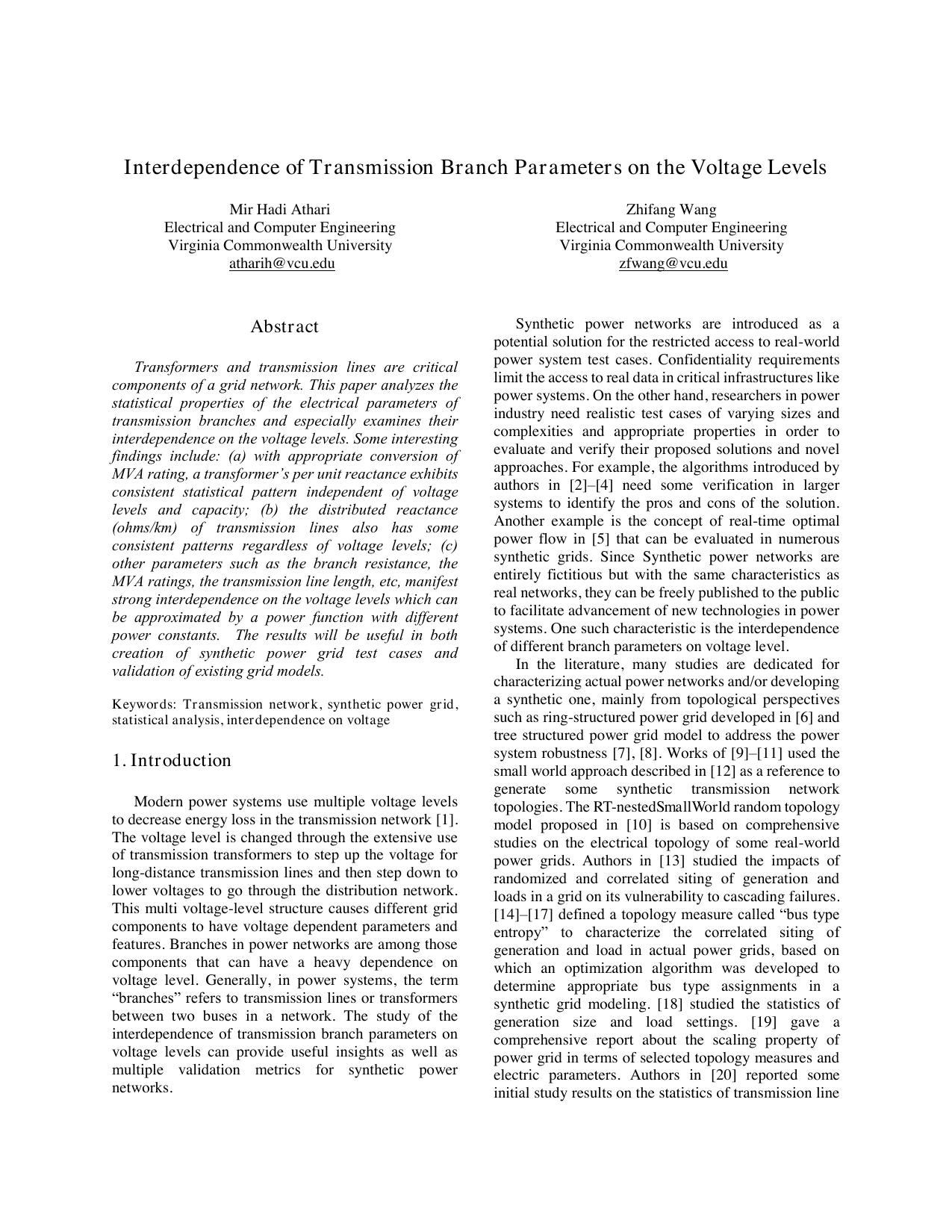
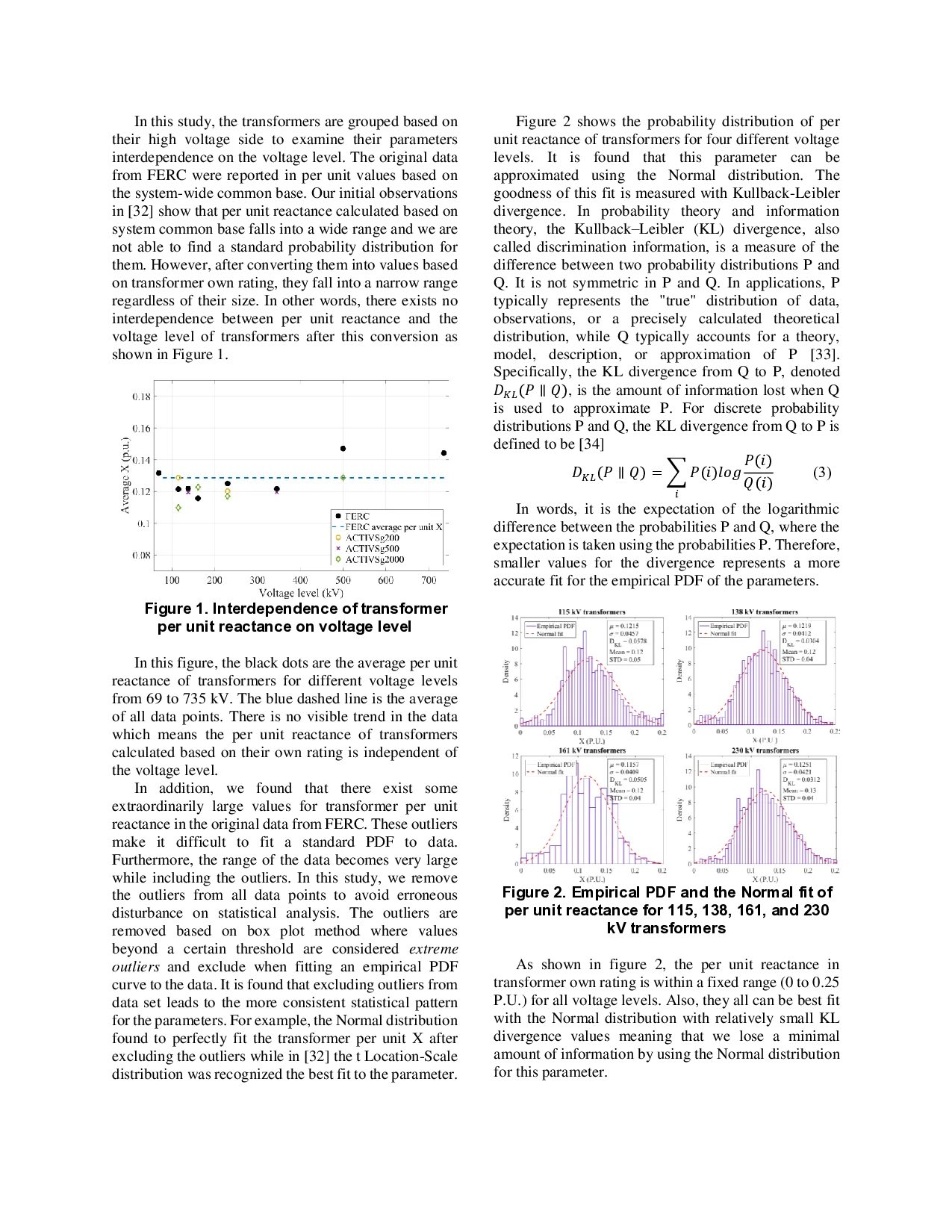
Transformers and transmission lines are critical components of a grid network. This paper analyzes the statistical properties of the electrical parameters of transmission branches and especially examines their interdependence on the voltage levels. Some interesting findings include: (a) with appropriate conversion of MVA rating, a transformers per unit reactance exhibits consistent statistical pattern independent of voltage levels and capacity; (b) the distributed reactance (ohms/km) of transmission lines also has some consistent patterns regardless of voltage levels; (c) other parameters such as the branch resistance, the MVA ratings, the transmission line length, etc, manifest strong interdependence on the voltage levels which can be approximated by a power function with different power constants. The results will be useful in both creation of synthetic power grid test cases and validation of existing grid models.
💡 Deep Analysis
Deep Dive into Interdependence of Transmission Branch Parameters on the Voltage Levels.
Transformers and transmission lines are critical components of a grid network. This paper analyzes the statistical properties of the electrical parameters of transmission branches and especially examines their interdependence on the voltage levels. Some interesting findings include: (a) with appropriate conversion of MVA rating, a transformers per unit reactance exhibits consistent statistical pattern independent of voltage levels and capacity; (b) the distributed reactance (ohms/km) of transmission lines also has some consistent patterns regardless of voltage levels; (c) other parameters such as the branch resistance, the MVA ratings, the transmission line length, etc, manifest strong interdependence on the voltage levels which can be approximated by a power function with different power constants. The results will be useful in both creation of synthetic power grid test cases and validation of existing grid models.
📄 Full Content
Interdependence of Transmission Branch Parameters on the Voltage Levels
Mir Hadi Athari
Electrical and Computer Engineering
Virginia Commonwealth University
atharih@vcu.edu
Zhifang Wang
Electrical and Computer Engineering
Virginia Commonwealth University
zfwang@vcu.edu
Abstract
Transformers and transmission lines are critical
components of a grid network. This paper analyzes the
statistical properties of the electrical parameters of
transmission branches and especially examines their
interdependence on the voltage levels. Some interesting
findings include: (a) with appropriate conversion of
MVA rating, a transformer’s per unit reactance exhibits
consistent statistical pattern independent of voltage
levels and capacity; (b) the distributed reactance
(ohms/km) of transmission lines also has some
consistent patterns regardless of voltage levels; (c)
other parameters such as the branch resistance, the
MVA ratings, the transmission line length, etc, manifest
strong interdependence on the voltage levels which can
be approximated by a power function with different
power constants. The results will be useful in both
creation of synthetic power grid test cases and
validation of existing grid models.
Keywords: Transmission network, synthetic power grid,
statistical analysis, interdependence on voltage
- Introduction
Modern power systems use multiple voltage levels
to decrease energy loss in the transmission network [1].
The voltage level is changed through the extensive use
of transmission transformers to step up the voltage for
long-distance transmission lines and then step down to
lower voltages to go through the distribution network.
This multi voltage-level structure causes different grid
components to have voltage dependent parameters and
features. Branches in power networks are among those
components that can have a heavy dependence on
voltage level. Generally, in power systems, the term
“branches” refers to transmission lines or transformers
between two buses in a network. The study of the
interdependence of transmission branch parameters on
voltage levels can provide useful insights as well as
multiple validation metrics for synthetic power
networks.
Synthetic power networks are introduced as a
potential solution for the restricted access to real-world
power system test cases. Confidentiality requirements
limit the access to real data in critical infrastructures like
power systems. On the other hand, researchers in power
industry need realistic test cases of varying sizes and
complexities and appropriate properties in order to
evaluate and verify their proposed solutions and novel
approaches. For example, the algorithms introduced by
authors in [2]–[4] need some verification in larger
systems to identify the pros and cons of the solution.
Another example is the concept of real-time optimal
power flow in [5] that can be evaluated in numerous
synthetic grids. Since Synthetic power networks are
entirely fictitious but with the same characteristics as
real networks, they can be freely published to the public
to facilitate advancement of new technologies in power
systems. One such characteristic is the interdependence
of different branch parameters on voltage level.
In the literature, many studies are dedicated for
characterizing actual power networks and/or developing
a synthetic one, mainly from topological perspectives
such as ring-structured power grid developed in [6] and
tree structured power grid model to address the power
system robustness [7], [8]. Works of [9]–[11] used the
small world approach described in [12] as a reference to
generate
some
synthetic
transmission
network
topologies. The RT-nestedSmallWorld random topology
model proposed in [10] is based on comprehensive
studies on the electrical topology of some real-world
power grids. Authors in [13] studied the impacts of
randomized and correlated siting of generation and
loads in a grid on its vulnerability to cascading failures.
[14]–[17] defined a topology measure called “bus type
entropy” to characterize the correlated siting of
generation and load in actual power grids, based on
which an optimization algorithm was developed to
determine appropriate bus type assignments in a
synthetic grid modeling. [18] studied the statistics of
generation size and load settings. [19] gave a
comprehensive report about the scaling property of
power grid in terms of selected topology measures and
electric parameters. Authors in [20] reported some
initial study results on the statistics of transmission line
parameters. The substation placement method and
transmission lines assignment based on population and
energy data in [21] uses the methodology introduced in
[22], [23], where they employ a clustering technique to
ensure that synthetic substations meet realistic
proportions of load and generation. [24] addressed the
need for synthetic l
…(Full text truncated)…
📸 Image Gallery
Reference
This content is AI-processed based on ArXiv data.