Title: A new experimental method to study the influence of welding residual stresses on fatigue crack propagation
ArXiv ID: 1709.06942
Date: 2017-09-21
Authors: Researchers from original ArXiv paper
📝 Abstract
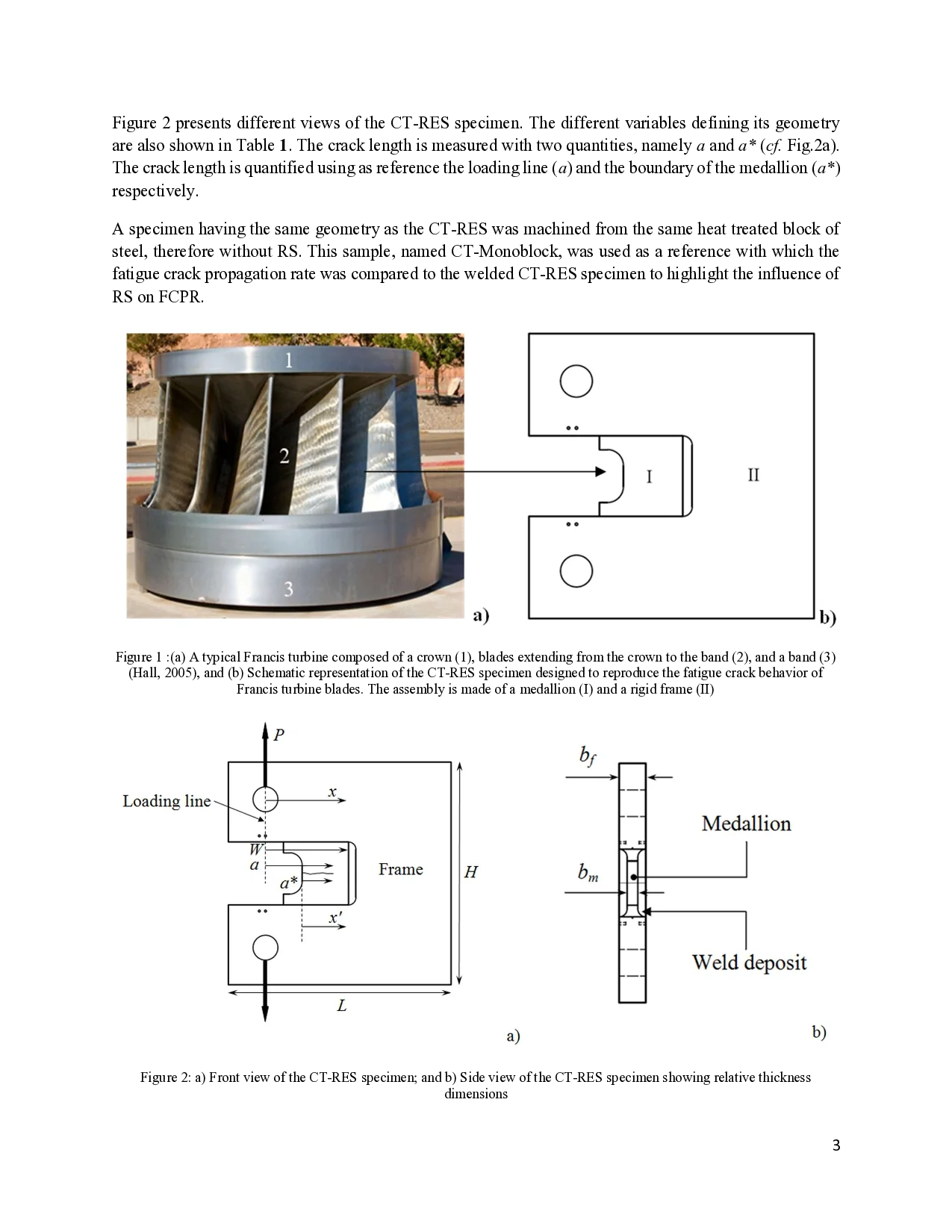
This paper presents a study on the influence of welding residual stresses (RS) on fatigue crack propagation rate (FCPR) in mode I. The objective of this work is to develop a novel methodology that allows a variation of a RS field in the studied specimen while keeping constant all other variables influencing FCPR. This led to the development of a novel specimen geometry, named CT-RES, in which RS are introduced by weld bead deposition far from the region in which fatigue crack propagation (FCP) occurs. As a consequence, the effect of factors influencing FCPR other than RS such as microstructural changes or plastic deformation, often introduced by welding processes, can be avoided. The welding RS introduced in the CT-RES specimen were determined by the contour method and the weight functions method was used to calculate the stress intensity factor (SIF), Kres, resulting from the RS as the fatigue crack propagates into the specimen. The evolution of cyclic stress ratio at the crack tip, Rlocal, was then computed from Kres to quantify the influence of RS on the cyclic stress ratio. The results show that for a given stress intensity range, dK, the FCPR of the welded geometry with fixed externally low R ratio (R = 0.1), but constantly increasing Rlocal, is the same as for the as-machined geometry without RS, solicited at high cyclic stress ratio (R = 0.7). These observations partially validate the BS7910 standard philosophy in which the remaining life of a flawed structure in presence of tensile RS is calculated from a high cyclic stress ratio (R > 0.5) crack propagation curve to eliminate crack closure effects.
💡 Deep Analysis
Deep Dive into A new experimental method to study the influence of welding residual stresses on fatigue crack propagation.
This paper presents a study on the influence of welding residual stresses (RS) on fatigue crack propagation rate (FCPR) in mode I. The objective of this work is to develop a novel methodology that allows a variation of a RS field in the studied specimen while keeping constant all other variables influencing FCPR. This led to the development of a novel specimen geometry, named CT-RES, in which RS are introduced by weld bead deposition far from the region in which fatigue crack propagation (FCP) occurs. As a consequence, the effect of factors influencing FCPR other than RS such as microstructural changes or plastic deformation, often introduced by welding processes, can be avoided. The welding RS introduced in the CT-RES specimen were determined by the contour method and the weight functions method was used to calculate the stress intensity factor (SIF), Kres, resulting from the RS as the fatigue crack propagates into the specimen. The evolution of cyclic stress ratio at the crack tip, R
Introduction
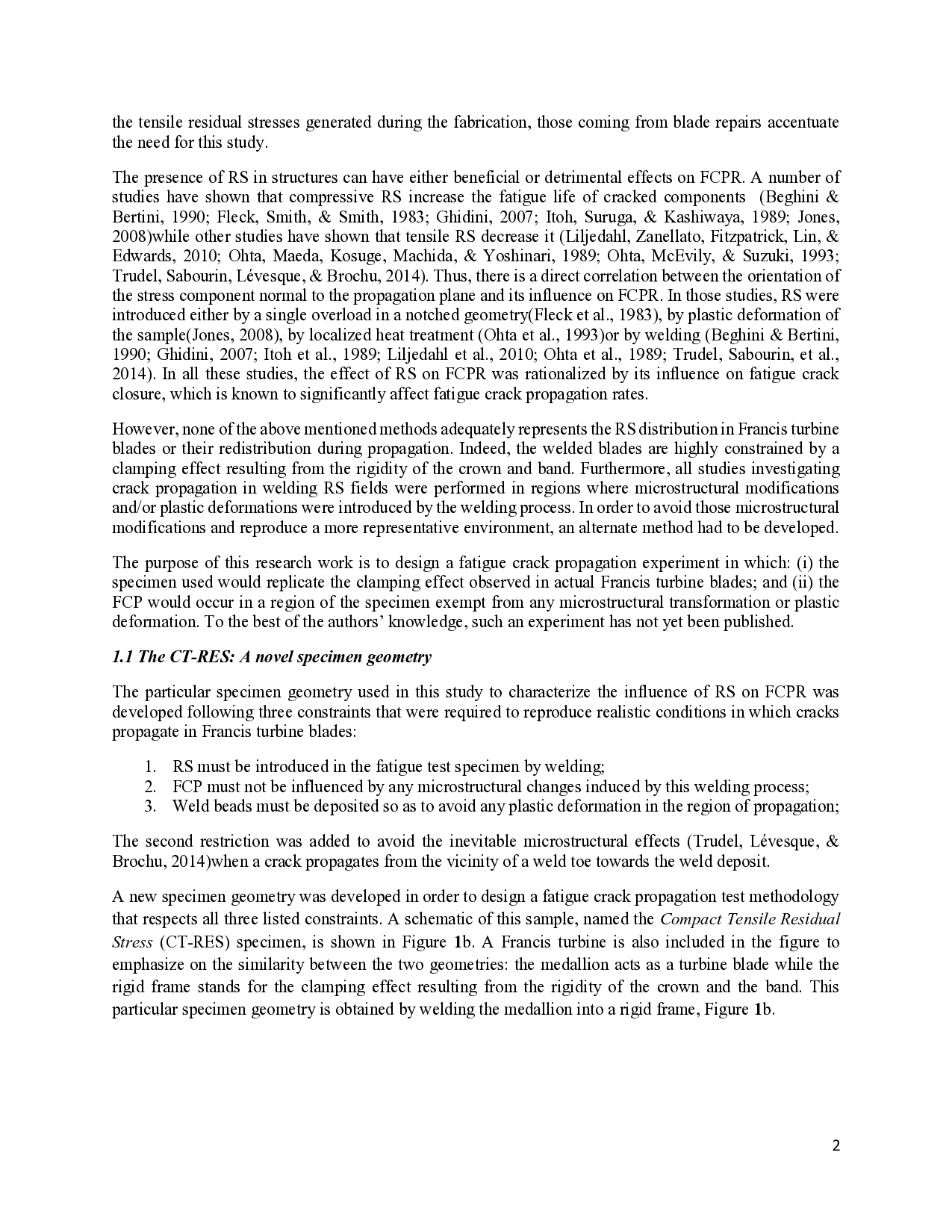
Francis runners used in the hydropower industry are composed of a crown (1), blades extending from the
crown to the band (2), and a band (3), as shown in Figure 1a. These steel components are assembled by
welding. It was demonstrated that performing a stress relief heat treatment does not completely eliminate
welding RS introduced in turbine runners during their fabrication(Lanteigne, Baillargeon, & Lalonde,
1998). Moreover, during blades repair, E309L austenitic stainless steel is often chosen as the weld material,
since using martensitic stainless steel as filler material requires a post-weld heat treatment. This type of
heat treatment is complex and expensive to do in a turbine environment, as during blade repairs, hence the
preference for E309L. However, the blade is left with a large amount of tensile residual stresses. Thus, like
2
the tensile residual stresses generated during the fabrication, those coming from blade repairs accentuate
the need for this study.
The presence of RS in structures can have either beneficial or detrimental effects on FCPR. A number of
studies have shown that compressive RS increase the fatigue life of cracked components (Beghini &
Bertini, 1990; Fleck, Smith, & Smith, 1983; Ghidini, 2007; Itoh, Suruga, & Kashiwaya, 1989; Jones,
2008)while other studies have shown that tensile RS decrease it (Liljedahl, Zanellato, Fitzpatrick, Lin, &
Edwards, 2010; Ohta, Maeda, Kosuge, Machida, & Yoshinari, 1989; Ohta, McEvily, & Suzuki, 1993;
Trudel, Sabourin, Lévesque, & Brochu, 2014). Thus, there is a direct correlation between the orientation of
the stress component normal to the propagation plane and its influence on FCPR. In those studies, RS were
introduced either by a single overload in a notched geometry(Fleck et al., 1983), by plastic deformation of
the sample(Jones, 2008), by localized heat treatment (Ohta et al., 1993)or by welding (Beghini & Bertini,
1990; Ghidini, 2007; Itoh et al., 1989; Liljedahl et al., 2010; Ohta et al., 1989; Trudel, Sabourin, et al.,
2014). In all these studies, the effect of RS on FCPR was rationalized by its influence on fatigue crack
closure, which is known to significantly affect fatigue crack propagation rates.
However, none of the above mentioned methods adequately represents the RS distribution in Francis turbine
blades or their redistribution during propagation. Indeed, the welded blades are highly constrained by a
clamping effect resulting from the rigidity of the crown and band. Furthermore, all studies investigating
crack propagation in welding RS fields were performed in