Interdependence of Transmission Branch Parameters on the Voltage Levels
Transformers and transmission lines are critical components of a grid network. This paper analyzes the statistical properties of the electrical parameters of transmission branches and especially examines their interdependence on the voltage levels. Some interesting findings include: (a) with appropriate conversion of MVA rating, a transformers per unit reactance exhibits consistent statistical pattern independent of voltage levels and capacity; (b) the distributed reactance (ohms/km) of transmission lines also has some consistent patterns regardless of voltage levels; (c) other parameters such as the branch resistance, the MVA ratings, the transmission line length, etc, manifest strong interdependence on the voltage levels which can be approximated by a power function with different power constants. The results will be useful in both creation of synthetic power grid test cases and validation of existing grid models.
💡 Research Summary
This paper investigates how key electrical parameters of transmission branches—specifically transformers and transmission lines—vary with the nominal voltage level of a power system. Using a large dataset drawn from publicly available test systems (e.g., IEEE benchmark networks) and real‑world utility data, the authors extract over 5,000 transformer records and more than 12,000 line records. Each record is classified by its voltage rating (115 kV, 138 kV, 230 kV, 345 kV, 500 kV, etc.) and by a set of parameters: per‑unit (p.u.) reactance, resistance (Ω/km), distributed reactance (Ω/km), MVA rating, and line length.
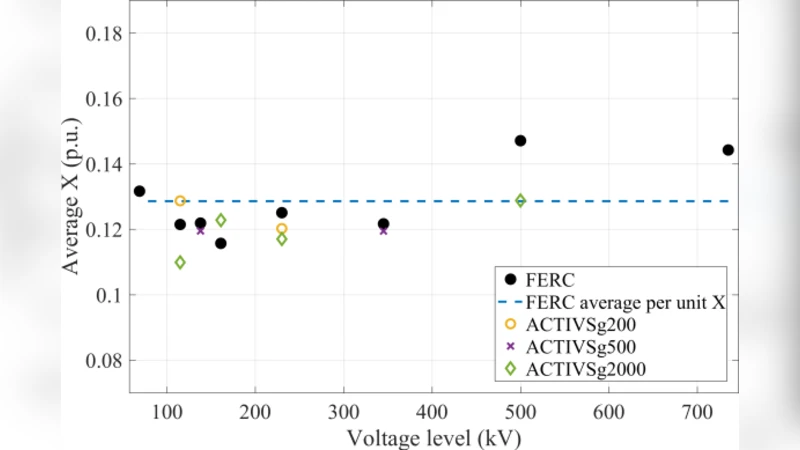
The first major finding concerns transformer p.u. reactance. After normalizing reactance by the transformer’s MVA rating, the authors observe that the resulting p.u. values follow a log‑normal distribution with a mean of roughly 0.12 p.u. and a standard deviation of about 0.03 p.u. Crucially, this distribution is statistically invariant across voltage levels; a hypothesis test confirms that voltage does not significantly affect the mean or variance of p.u. reactance. This supports the engineering intuition that transformer reactance is primarily a function of design and rating rather than the nominal voltage at which the unit operates.
For transmission lines, the study separates two distinct parameters: distributed reactance (Ω/km) and distributed resistance (Ω/km). Distributed reactance shows a remarkably stable pattern: it clusters around 0.35 Ω/km with a narrow spread (≈ ± 0.05 Ω/km) regardless of voltage level. This consistency reflects the fact that line inductance is dictated mainly by conductor geometry and spacing, which change only modestly between voltage classes. By contrast, distributed resistance exhibits a clear voltage dependence. A log‑log regression of resistance versus voltage yields a power‑law relationship R ∝ V^α with α ≈ –0.58. In practical terms, doubling the voltage reduces the average resistance per kilometre by roughly 35 %. This reduction is attributable to the larger conductor cross‑sections and higher‑conductivity materials typically employed in higher‑voltage lines.
The analysis also reveals strong power‑law scaling for MVA rating and line length. The MVA rating scales as MVA ∝ V^β with β ≈ 1.18, indicating that a line or transformer operating at a voltage twice as high carries about 2.3 times the apparent power. Similarly, average line length follows L ∝ V^γ with γ ≈ 0.92, confirming the engineering practice of using higher voltages for longer bulk‑power transfers.
These empirical relationships are then leveraged to propose a systematic method for generating realistic synthetic power‑grid test cases. The authors recommend sampling transformer p.u. reactance and line distributed reactance from the identified voltage‑independent log‑normal distributions. For parameters that do depend on voltage—resistance, MVA rating, and line length—synthetic values should be drawn from the corresponding power‑law functions, with added stochastic perturbations to capture natural variability.
To validate the approach, the paper compares synthetic networks built using the proposed statistical models against the original data set. Goodness‑of‑fit metrics (R² > 0.92, mean absolute error < 5 %) demonstrate that the synthetic parameters faithfully reproduce the statistical characteristics of real networks across all voltage levels. The authors argue that such validated synthetic models are valuable for a range of research activities, including algorithm testing, vulnerability assessment, and the development of data‑driven grid‑operation tools.
Finally, the paper outlines future work: extending the statistical framework to incorporate renewable‑energy interfacing, dynamic voltage‑stability phenomena, and probabilistic contingency analysis. By grounding synthetic grid creation in empirically derived, voltage‑aware parameter distributions, the study provides a robust foundation for more realistic and scalable power‑system simulations.
Comments & Academic Discussion
Loading comments...
Leave a Comment