Mist Computing: Principles, Trends and Future Direction
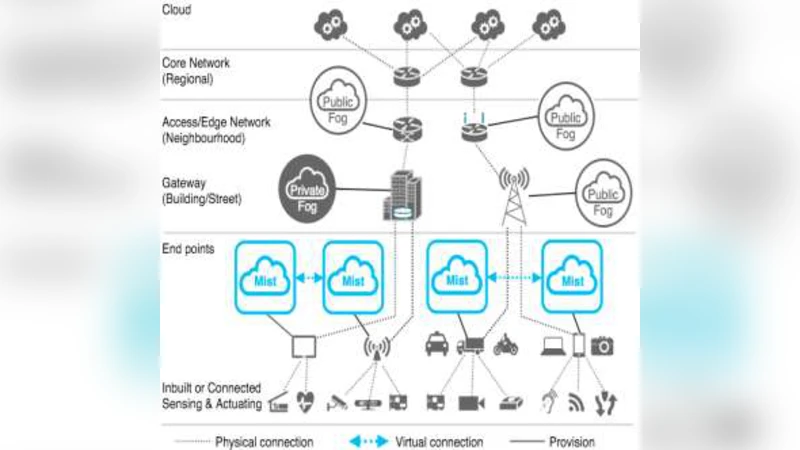
In this paper we present the novel idea of computing near the edge of IOT architecture which enhances the inherent efficiency while computing complex applications. This concept is termed as mist computing. We believe this computing will bring about an massive revolution in future computing technologies. instead of thrusting the control responsibility to gateways while data transmission the control is decentralised to end nodes which decrease the communicational delay of the network thereby increasing the throughput.
💡 Research Summary
**
The paper introduces “mist computing” as a new paradigm for extending computation to the very edge of the Internet‑of‑Things (IoT) – that is, directly onto sensors and actuators. The authors argue that, as the number of IoT devices approaches 75 billion, traditional cloud‑centric or even fog‑centric architectures become inefficient because of limited RAM, ROM, bandwidth, and battery life on end‑nodes. By decentralising control from gateways to the end devices themselves, mist computing aims to reduce communication latency, lower power consumption, and increase overall throughput.
Four guiding principles are presented: (1) the network should deliver information rather than raw data; (2) information must be supplied only when explicitly requested; (3) a subscriber‑provider model should enable dynamic system creation based on information needs; and (4) devices must be situation‑aware, adapting to both network configuration and physical environment without static binding rules. The authors contrast mist computing with edge computing, emphasizing that mist services are dynamic, re‑configurable at run‑time, and can be assembled from existing devices on demand.
At the device level, rules and data are expressed as three‑tuple structures similar to RDF triples. A lightweight LISP‑like language and a compact binary representation are proposed for inter‑node communication, with direct conversion to XML for human readability. The paper claims that conventional wireless routing protocols are unsuitable for mist environments because sub‑optimal paths increase bandwidth usage. Instead, a “gateway‑independent” routing approach is suggested, where any node can connect to any gateway, and new routes are established quickly after a gateway failure.
Figure 1 (described in the text) depicts a three‑tier architecture: mist nodes at the bottom process sensor/actuator data and monitor link quality; gateways in the middle load application rules, monitor node health, and execute computationally intensive services; the cloud at the top deploys new applications and performs global service‑quality monitoring.
A real‑world implementation is cited: Thinnect’s mist stack, reportedly fitting within 100 KB of memory, has been deployed for six years in a security system (by DEFENDEC) and more recently in smart‑city projects (by CITYNTEL). However, the paper provides no quantitative performance data, power consumption figures, or scalability tests for this deployment.
In the conclusion the authors acknowledge that mist computing is still in its nascent stage. They argue that mist, fog, and cloud should be viewed as complementary layers: computationally heavy tasks run on fog/gateway nodes, while lightweight, latency‑sensitive tasks execute on mist nodes. They call for more capable micro‑controllers, richer functionality at the edge, and standardised protocols to realise the full potential of mist computing.
Overall, the manuscript offers an intriguing high‑level vision but suffers from several shortcomings. The definition of “mist” remains vague, the guiding principles are not backed by formal models, and the lack of experimental validation makes it difficult to assess the claimed benefits. Numerous typographical and grammatical errors further undermine its scholarly credibility. Future work should focus on precise architectural specifications, rigorous performance benchmarking (latency, bandwidth, energy), security and privacy considerations, and the development of interoperable standards to move mist computing from concept to practice.
Comments & Academic Discussion
Loading comments...
Leave a Comment