Social Network Differences of Chronotypes Identified from Mobile Phone Data
Human activity follows an approximately 24-hour day-night cycle, but there is significant individual variation in awake and sleep times. Individuals with circadian rhythms at the extremes can be categorized into two chronotypes: “larks”, those who wake up and go to sleep early, and “owls”, those who stay up and wake up late. It is well established that a person’s chronotype can affect their activities and health. However, less is known on the effects of chronotypes on the social behavior, even though it is evident that social interactions require coordinated timings. To study how chronotypes relate to social behavior, we use data collected using a smartphone app on a population of more than seven hundred volunteer students to simultaneously determine their chronotypes and social network structure. We find that owls maintain larger personal networks, albeit with less time spent per contact. On average, owls are more central in the social network of students than larks, frequently occupying the dense core of the network. Owls also display strong homophily, as seen in an unexpectedly large number of social ties connecting owls to owls.
💡 Research Summary
This paper investigates how individual chronotypes—specifically “larks” (morning‑type) and “owls” (evening‑type)—relate to social network structure using high‑resolution smartphone data from a cohort of university students. Instead of relying on self‑report questionnaires, the authors infer chronotype from the timing of “screen‑on” events recorded by a custom app. For each participant, the frequency of screen activations is aggregated into hourly bins over the four weekdays (Monday‑Thursday). Participants whose activity peaks in the early morning (5–7 am) relative to the population average are labeled as larks, while those with peaks in the late night (midnight–2 am) are labeled as owls. Using these criteria, 20 % of the 222 participants with sufficient data are classified as larks, another 20 % as owls, and the remaining 60 % as intermediate.
Social ties are reconstructed from call‑ and text‑message logs: an undirected edge is created between two individuals if there is at least one reciprocal communication event. The resulting network comprises 734 students, of whom 222 have an assigned chronotype. Personal network size (degree) and tie strength (total number of interactions) are computed for each node, including contacts outside the study cohort.
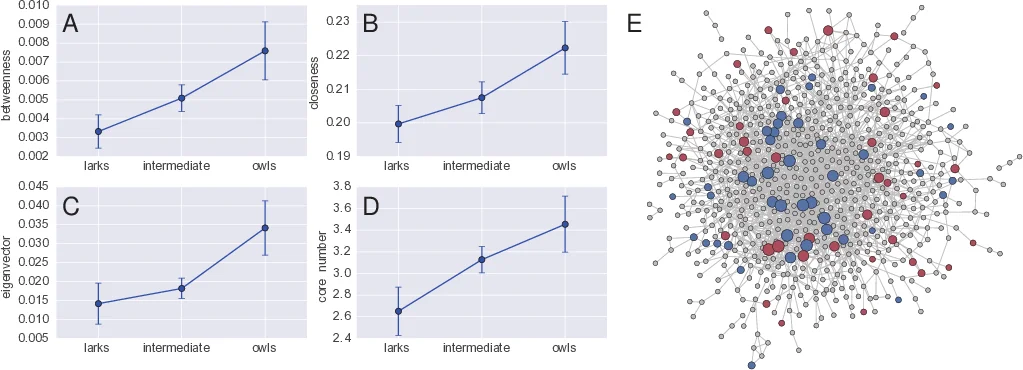
Key findings: (1) Owls maintain significantly larger personal networks than larks (average degree ≈ 35 vs. 31.7). However, owls exhibit shorter average call durations and lower interaction frequencies per contact, indicating a sub‑linear scaling between degree and strength that is typical in social networks. (2) Centrality analyses—betweenness, closeness, eigenvector centrality, and core number—show a consistent gradient: owls score highest on all measures, larks lowest, and intermediates fall in between. Network visualizations confirm that owl nodes are disproportionately located in the dense core of the graph. (3) Homophily is pronounced for owls: the observed number of owl‑owl edges (52) far exceeds the expectation under a random‑mixing null model (≈ 6.5), yielding a Z‑score of 17.9. In contrast, lark‑lark edges are not more frequent than expected (Z ≈ ‑0.6). This asymmetry suggests that evening‑oriented social activities (e.g., late‑night gatherings) facilitate the formation of ties among owls, whereas early‑morning social opportunities are scarce, limiting lark‑lark connections.
The study demonstrates that passive behavioral logs can reliably infer chronotype and that chronotype correlates with both local (personal network size) and global (network centrality, homophily) social network properties. Limitations include reliance on communication metadata as a proxy for real‑world interaction, the homogenous student sample, and the assumption that screen‑on events fully capture activity rhythms. Future work should expand to diverse populations, integrate additional sensor modalities (e.g., location, app usage), and explore causal mechanisms linking circadian preferences to social behavior.
Comments & Academic Discussion
Loading comments...
Leave a Comment