Synchronization and Power Sharing for Droop-Controlled Inverters in Islanded Microgrids
Motivated by the recent and growing interest in smart grid technology, we study the operation of DC/AC inverters in an inductive microgrid. We show that a network of loads and DC/AC inverters equipped with power-frequency droop controllers can be cast as a Kuramoto model of phase-coupled oscillators. This novel description, together with results from the theory of coupled oscillators, allows us to characterize the behavior of the network of inverters and loads. Specifically, we provide a necessary and sufficient condition for the existence of a synchronized solution that is unique and locally exponentially stable. We present a selection of controller gains leading to a desirable sharing of power among the inverters, and specify the set of loads which can be serviced without violating given actuation constraints. Moreover, we propose a distributed integral controller based on averaging algorithms which dynamically regulates the system frequency in the presence of a time-varying load. Remarkably, this distributed-averaging integral controller has the additional property that it maintains the power sharing properties of the primary droop controller. Our results hold without assumptions on identical line characteristics or voltage magnitudes.
💡 Research Summary
This paper investigates the operation of voltage‑source inverters (VSIs) in an islanded microgrid where loads and inverters are interconnected by inductive lines. The authors show that the dynamics of a network equipped with conventional power‑frequency droop controllers can be exactly reformulated as a generalized Kuramoto model of coupled phase oscillators. By establishing this equivalence, they are able to apply results from the theory of coupled oscillators to the microgrid context.
The main contributions are as follows. First, the authors derive a necessary and sufficient condition for the existence of a synchronized (phase‑locked) solution of the droop‑controlled system. Assuming the underlying graph is acyclic, they define a scaled power imbalance ω̄ = (∑ P* i)/(∑ D i) where D i = 1/n i are the inverse droop coefficients. They prove that a synchronized equilibrium exists and is locally exponentially stable if and only if |ω̄| is smaller than the second smallest eigenvalue λ₂ of the weighted Laplacian divided by the largest time constant, i.e., |ω̄| < λ₂(L)/max D i. Under this condition the equilibrium is unique, and a lower bound on the exponential convergence rate is provided in terms of the Laplacian spectrum.
Second, the paper addresses power sharing. By selecting droop coefficients proportionally to the rated power of each inverter (D i ∝ P_i), the authors prove that, at the synchronized equilibrium, the active power injected by each inverter is proportional to its rating. This proportional sharing holds without assuming identical line impedances or fixed voltage magnitudes. Explicit bounds on the set of admissible loads are derived: the total nominal power must not exceed the sum of inverter ratings, and each inverter’s output must stay within its individual limits.
Third, a distributed secondary controller is proposed to restore the system frequency when the load varies. The controller is based on a distributed averaging algorithm: each inverter integrates the deviation of its own phase from the average of its neighbors and adjusts its frequency accordingly. The resulting dynamics remain a Kuramoto‑type system, preserving the proportional power‑sharing property of the primary droop loop. Importantly, the analysis does not rely on a time‑scale separation between the primary droop and the secondary integral loops; local Lyapunov arguments guarantee exponential stability of the combined system.
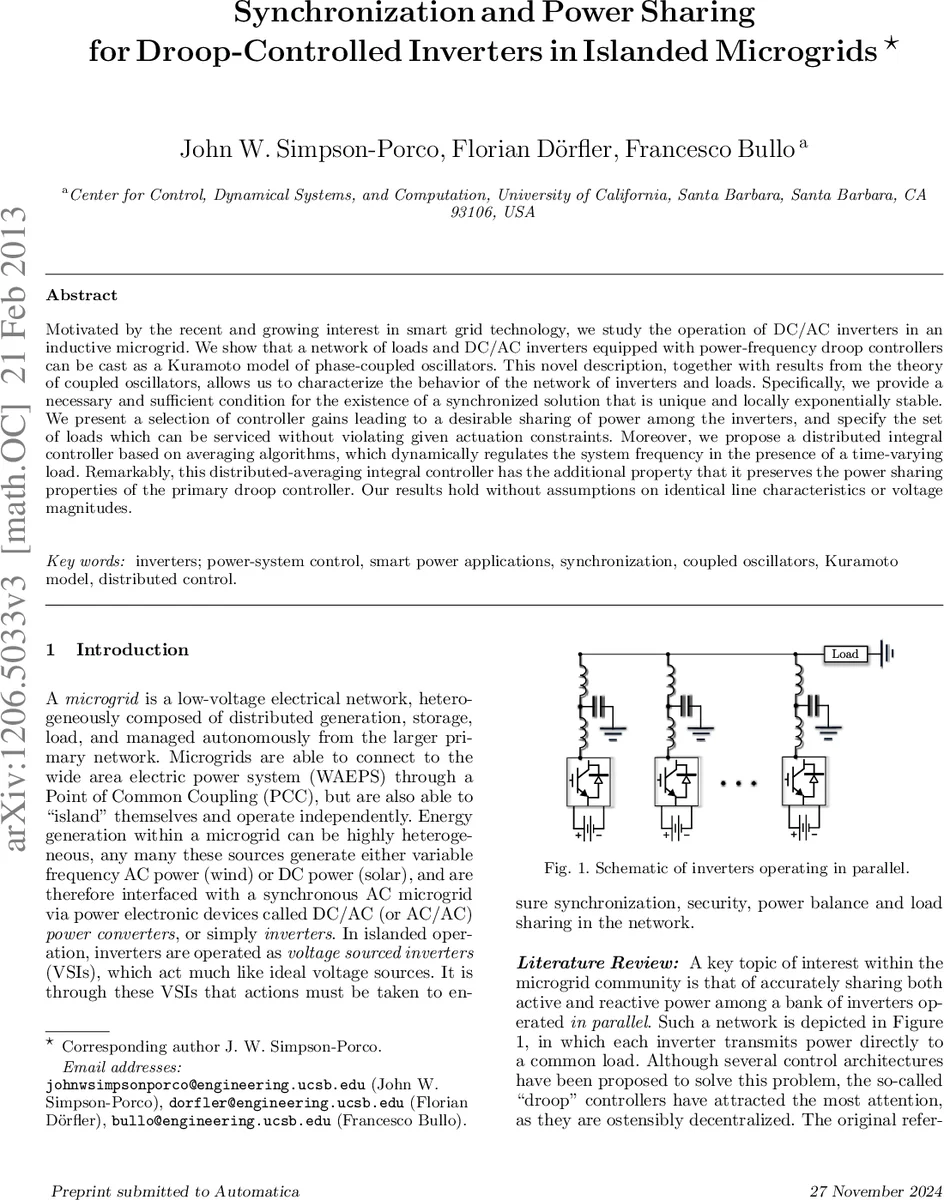
Finally, the authors extend all results from the simple parallel topology to generic acyclic interconnections of inverters and loads. The analysis accommodates heterogeneous line susceptances and non‑uniform voltage magnitudes, making the theory applicable to realistic microgrid configurations. Simulation studies on a four‑inverter, six‑load tree network illustrate the theoretical findings: the droop gains chosen according to the proportional rule achieve the predicted power sharing, the synchronization condition is satisfied, and the distributed averaging integral controller quickly restores the nominal frequency after step changes in load while maintaining the sharing ratios.
In summary, the paper provides a rigorous nonlinear stability framework for droop‑controlled islanded microgrids, links droop control to the Kuramoto model, offers concrete design guidelines for droop coefficients to achieve proportional power sharing, and introduces a distributed secondary control scheme that guarantees frequency regulation without sacrificing the primary sharing objectives. These contributions advance the understanding of decentralized microgrid control and offer practical tools for engineers designing resilient, islanded power systems.
Comments & Academic Discussion
Loading comments...
Leave a Comment