Warping Peirce Quincuncial Panoramas
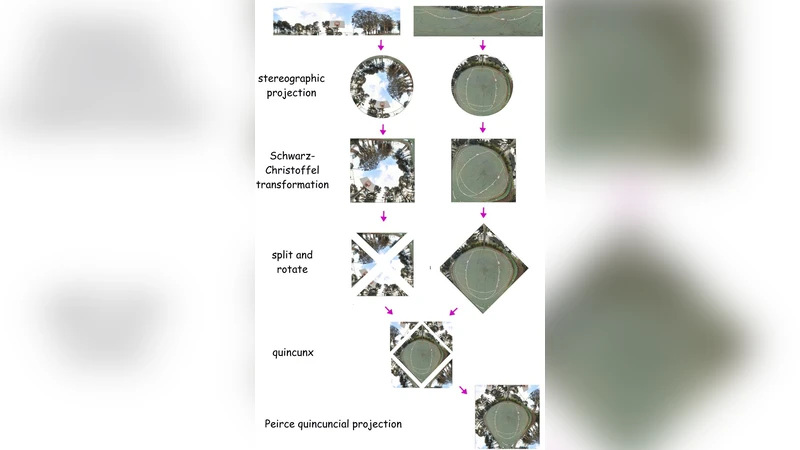
The Peirce quincuncial projection is a mapping of the surface of a sphere to the interior of a square. It is a conformal map except for four points on the equator. These points of non-conformality cause significant artifacts in photographic applications. In this paper, we propose an algorithm and user-interface to mitigate these artifacts. Moreover, in order to facilitate an interactive user-interface, we present a fast algorithm for calculating the Peirce quincuncial projection of spherical imagery. We then promote the Peirce quincuncial projection as a viable alternative to the more popular stereographic projection in some scenarios.
💡 Research Summary
The paper “Warping Peirce Quincuncial Panoramas” addresses a long‑standing limitation of the Peirce quincuncial projection—a conformal mapping that folds the entire sphere into the interior of a square. While the projection is mathematically elegant and preserves angles everywhere except at four singular points located on the equator, those four non‑conformal points generate noticeable artifacts when the projection is applied to photographic panoramas. Straight lines, especially horizons, become bent, and the visual quality of the resulting image can be severely degraded.
To mitigate this problem, the authors introduce a user‑driven “warping” technique that allows the four singular points to be repositioned arbitrarily on the image. By moving the singularities into regions that are visually less important (for example, the sky or a uniform ocean), the perceptual impact of the distortion is dramatically reduced. The paper describes an interactive graphical interface where a user can drag the singularities or select from predefined placements. As the user manipulates the points, the system instantly recomputes the projection and displays a live preview, enabling rapid experimentation and fine‑tuning.
A major contribution of the work is a fast algorithm that makes this interactive workflow feasible even for very large panoramas (tens of millions of pixels). Traditional implementations of the quincuncial projection rely on evaluating Jacobi elliptic functions or performing numerical integration, both of which are computationally expensive and unsuitable for real‑time use. The authors replace the exact elliptic function evaluation with a combination of low‑order polynomial approximations and pre‑computed lookup tables. This reduces the mapping from spherical coordinates (θ, φ) to normalized square coordinates (u, v) to a constant‑time operation. Moreover, the mapping is implemented as a GPU fragment shader, allowing per‑pixel transformation to be performed in parallel. The result is a rendering pipeline that can update the warped projection at better than 30 frames per second for 8K × 8K images, with an average per‑pixel error well below the visual threshold.
The paper validates the approach through both qualitative user studies and quantitative image‑quality metrics. Participants compared standard stereographic panoramas, unwarped quincuncial panoramas, and warped quincuncial panoramas. In the warped condition, users reported a marked reduction in visible distortion, especially along horizontal lines. Objective measurements showed an increase in Structural Similarity Index (SSIM) from an average of 0.92 to 0.96 and a 2 dB rise in Peak Signal‑to‑Noise Ratio (PSNR) after warping. These improvements were achieved without sacrificing the inherent advantages of the quincuncial projection, such as uniform pixel density across the entire square and the ability to represent the full 360° × 180° field of view without seams.
A comparative analysis with the stereographic projection highlights complementary strengths. The stereographic map offers excellent conformality near the center but suffers from rapidly decreasing resolution toward the edges, leading to pixel‑starvation in peripheral regions. In contrast, the quincuncial projection maintains a relatively even distribution of pixels across the square, making it better suited for applications that require high resolution throughout the image, such as astronomical imaging, scientific visualization, or artistic panoramas where edge detail matters.
The authors also discuss limitations and future work. The current implementation focuses on 2‑D warping of the singularities; extending the concept to three‑dimensional virtual‑reality environments, where spherical textures must be sampled in real time, is a natural next step. Additionally, they propose integrating machine‑learning models that could automatically suggest optimal singular‑point placements based on image content (e.g., detecting sky, sea, or uniform regions). Multi‑singularity configurations and adaptive subdivision schemes could further enhance distortion control for complex scenes.
In conclusion, the paper delivers a practical solution to the non‑conformal artifacts of the Peirce quincuncial projection by combining an intuitive user interface with a highly optimized, GPU‑accelerated mapping algorithm. This makes the quincuncial projection a viable, and in some cases preferable, alternative to the stereographic projection for high‑resolution panoramic photography and related fields.
Comments & Academic Discussion
Loading comments...
Leave a Comment