Two-Dimensional Indirect Binary Search for the Positive One-in-Three Satisfiability Problem
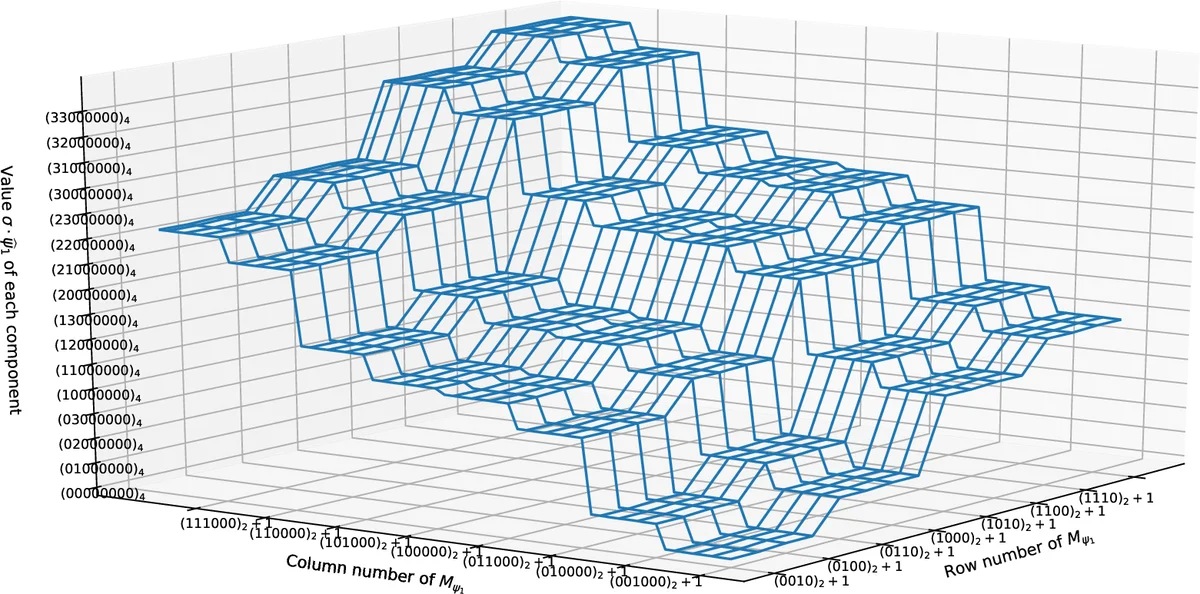
In this paper, we propose an algorithm for the positive one-in-three satisfiability problem (Pos1in3SAT). The proposed algorithm can efficiently decide the existence of a satisfying assignment in all assignments for a given formula by using a 2-dimensional binary search method without constructing an exponential number of assignments.
💡 Research Summary
This paper proposes a novel algorithm for solving the Positive One-in-Three Satisfiability (Pos1in3SAT) problem, which is known to be NP-complete. The core innovation lies in a two-dimensional indirect binary search method that avoids the explicit construction of an exponential number of variable assignments.
The algorithm operates in two main phases. First, in a preprocessing phase, the input positive 3CNF formula ψ is transformed into an equivalent positive 3CNF formula φ. This transformation involves sorting variables based on an encoded integer value, (ψ, z_i)_4, which represents the clauses containing z_i in base-4. Subsequently, for each original clause, three new clauses are constructed using additional variables. This specific transformation ensures a crucial property needed for the next phase.
The second phase is the search phase. The variables of the transformed formula φ are partitioned into two groups. Let the number of variables in each group be k1 and k2 (k1+k2 = k). The algorithm conceptually constructs an implicit 2^{k1} by 2^{k2} matrix M_φ. Each row corresponds to a possible partial assignment to the first group of variables, and each column corresponds to a partial assignment to the second group. The entry at position (i, j) in this matrix is the value σ · Ξ_φ, where σ is the complete assignment formed by combining the i-th row assignment and the j-th column assignment, and Ξ_φ is the vector of encoded integers (φ, z_i)_4 for all variables. The paper proves that every row and every column of this implicit matrix is sorted in ascending order (Observation 4).
The goal is to determine if this matrix contains the target value T = ∑_{i=1}^{m} 4^{i-1}, which corresponds to an assignment satisfying the 1-in-3 condition for all m clauses. Instead of materializing the entire exponential-sized matrix, the algorithm performs a binary search in two dimensions. It identifies the middle row and middle column of the current search space within the implicit matrix. It then computes the value at the intersection point (σ · Ξ_φ) on-the-fly by summing the relevant (φ, z_i)_4 values for the variables set to 1 in σ. By comparing this computed value with the target T, the algorithm eliminates one of the four quadrants of the current search space and recursively continues the search on the remaining quadrant. This process continues until the target is found or the search space is exhausted.
The paper provides a detailed proof of the algorithm’s correctness, showing that it correctly identifies the existence of a satisfying assignment. Furthermore, it analyzes the time complexity. The dominant cost is computing σ · Ξ_φ at each search step, which takes O(m*k) time. Since the two-dimensional binary search requires O(k) steps (logarithmic in the dimensions 2^{k1} and 2^{k2}), the overall time complexity is O(m * k^2), which is polynomial in the size of the input formula (number of variables k and clauses m).
In summary, this work presents a creative algorithmic framework for an NP-complete problem. It demonstrates how a problem instance can be restructured into an implicitly defined, doubly-sorted 2D matrix, enabling an efficient indirect search that sidesteps exponential space usage while maintaining polynomial-time complexity relative to the input parameters.
Comments & Academic Discussion
Loading comments...
Leave a Comment