Collective navigation of complex networks: Participatory greedy routing
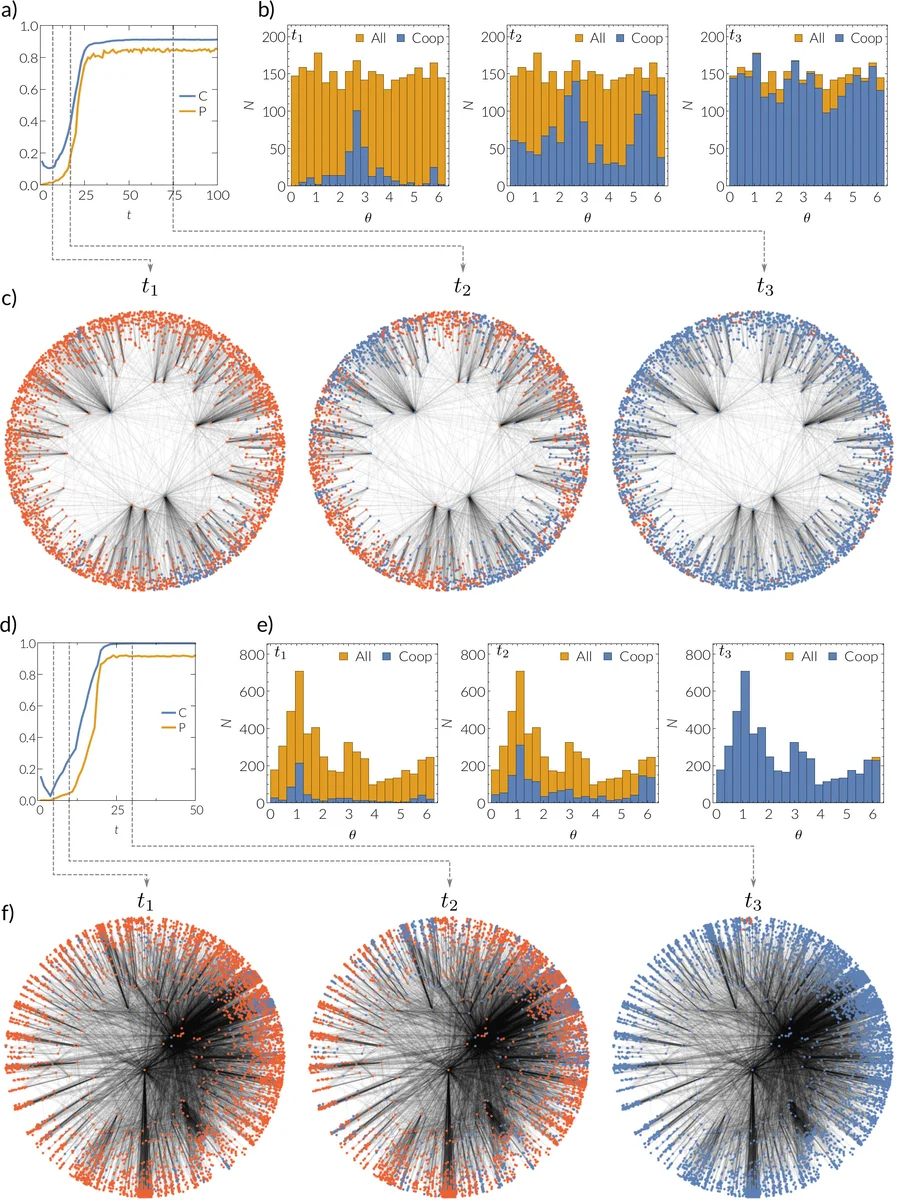
Many networks are used to transfer information or goods, in other words, they are navigated. The larger the network, the more difficult it is to navigate efficiently. Indeed, information routing in the Internet faces serious scalability problems due to its rapid growth, recently accelerated by the rise of the Internet of Things. Large networks like the Internet can be navigated efficiently if nodes, or agents, actively forward information based on hidden maps underlying these systems. However, in reality most agents will deny to forward messages, which has a cost, and navigation is impossible. Can we design appropriate incentives that lead to participation and global navigability? Here, we present an evolutionary game where agents share the value generated by successful delivery of information or goods. We show that global navigability can emerge, but its complete breakdown is possible as well. Furthermore, we show that the system tends to self-organize into local clusters of agents who participate in the navigation. This organizational principle can be exploited to favor the emergence of global navigability in the system.
💡 Research Summary
The paper addresses a fundamental scalability challenge in large‐scale networks such as the Internet and the emerging Internet of Things: efficient routing when nodes incur a non‑trivial cost for forwarding messages. Classical greedy routing, which forwards a packet to the neighbor closest to the destination in an underlying hidden metric space (typically a hyperbolic embedding), achieves high success rates but assumes that every node cooperates unconditionally. In realistic settings, forwarding consumes time, energy, or monetary resources, so nodes may refuse to forward (defect). A single defector in a forwarding chain breaks the entire delivery, making the system fragile.
To overcome this, the authors propose an evolutionary game called participatory greedy routing. The game is defined on a network whose nodes are embedded in a hyperbolic plane (coordinates (r, θ) inferred from topology). Each node can adopt one of two strategies: cooperate (forward messages) or defect (ignore them). When a source–target pair is selected, the standard greedy routing algorithm is executed. Every node that forwards a message pays a fixed cost of 1, regardless of the outcome. If the packet reaches its destination, a total value b (representing the economic or societal benefit of successful delivery) is generated and split equally among all participants in the successful chain, including the final recipient. Thus each participant receives b / ℓ_c, where ℓ_c is the chain length. If any node defects before the destination, the delivery fails, no reward is distributed, and only the nodes that already forwarded incur the cost.
After a batch of N message attempts, nodes update their strategies using replicator dynamics: each node i randomly selects a neighbor j and copies j’s strategy with probability
p_{i←j}=1/(1+exp
Comments & Academic Discussion
Loading comments...
Leave a Comment