LitStoryTeller: An Interactive System for Visual Exploration of Scientific Papers Leveraging Named entities and Comparative Sentences

Reading time: 6 minute
...

📝 Original Info

  • Title: LitStoryTeller: An Interactive System for Visual Exploration of Scientific Papers Leveraging Named entities and Comparative Sentences
  • ArXiv ID: 1708.02214
  • Date: 2017-09-13
  • Authors: Researchers from original ArXiv paper

📝 Abstract

The present study proposes LitStoryTeller, an interactive system for visually exploring the semantic structure of a scientific article. We demonstrate how LitStoryTeller could be used to answer some of the most fundamental research questions, such as how a new method was built on top of existing methods, based on what theoretical proof and experimental evidences. More importantly, LitStoryTeller can assist users to understand the full and interesting story a scientific paper, with a concise outline and important details. The proposed system borrows a metaphor from screen play, and visualizes the storyline of a scientific paper by arranging its characters (scientific concepts or terminologies) and scenes (paragraphs/sentences) into a progressive and interactive storyline. Such storylines help to preserve the semantic structure and logical thinking process of a scientific paper. Semantic structures, such as scientific concepts and comparative sentences, are extracted using existing named entity recognition APIs and supervised classifiers, from a scientific paper automatically. Two supplementary views, ranked entity frequency view and entity co-occurrence network view, are provided to help users identify the "main plot" of such scientific storylines. When collective documents are ready, LitStoryTeller also provides a temporal entity evolution view and entity community view for collection digestion.

💡 Deep Analysis

Deep Dive into LitStoryTeller: An Interactive System for Visual Exploration of Scientific Papers Leveraging Named entities and Comparative Sentences.

The present study proposes LitStoryTeller, an interactive system for visually exploring the semantic structure of a scientific article. We demonstrate how LitStoryTeller could be used to answer some of the most fundamental research questions, such as how a new method was built on top of existing methods, based on what theoretical proof and experimental evidences. More importantly, LitStoryTeller can assist users to understand the full and interesting story a scientific paper, with a concise outline and important details. The proposed system borrows a metaphor from screen play, and visualizes the storyline of a scientific paper by arranging its characters (scientific concepts or terminologies) and scenes (paragraphs/sentences) into a progressive and interactive storyline. Such storylines help to preserve the semantic structure and logical thinking process of a scientific paper. Semantic structures, such as scientific concepts and comparative sentences, are extracted using existing named

📄 Full Content

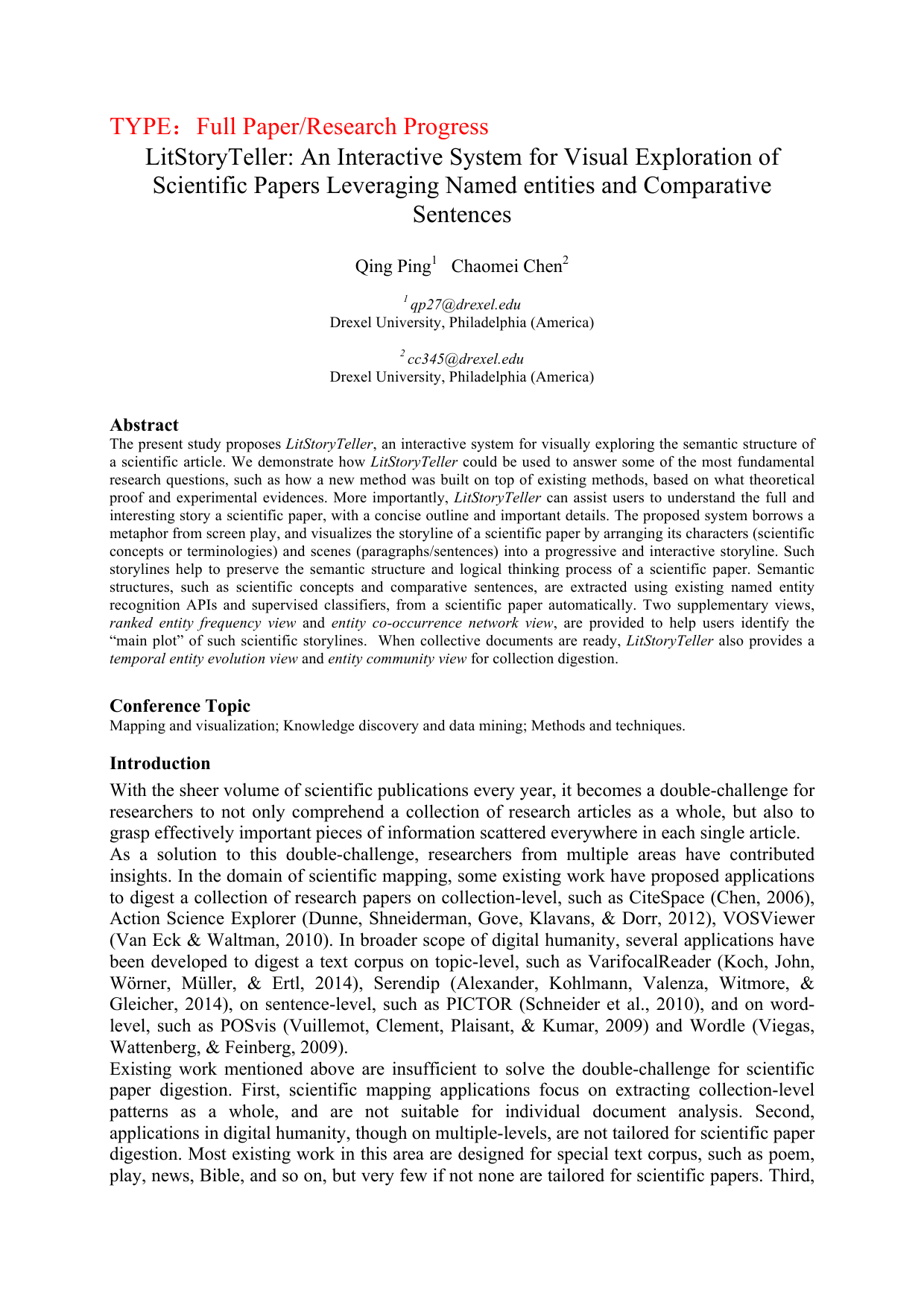
TYPEFull Paper/Research Progress LitStoryTeller: An Interactive System for Visual Exploration of Scientific Papers Leveraging Named entities and Comparative Sentences Qing Ping1 Chaomei Chen2 1 qp27@drexel.edu Drexel University, Philadelphia (America) 2 cc345@drexel.edu Drexel University, Philadelphia (America) Abstract The present study proposes LitStoryTeller, an interactive system for visually exploring the semantic structure of a scientific article. We demonstrate how LitStoryTeller could be used to answer some of the most fundamental research questions, such as how a new method was built on top of existing methods, based on what theoretical proof and experimental evidences. More importantly, LitStoryTeller can assist users to understand the full and interesting story a scientific paper, with a concise outline and important details. The proposed system borrows a metaphor from screen play, and visualizes the storyline of a scientific paper by arranging its characters (scientific concepts or terminologies) and scenes (paragraphs/sentences) into a progressive and interactive storyline. Such storylines help to preserve the semantic structure and logical thinking process of a scientific paper. Semantic structures, such as scientific concepts and comparative sentences, are extracted using existing named entity recognition APIs and supervised classifiers, from a scientific paper automatically. Two supplementary views, ranked entity frequency view and entity co-occurrence network view, are provided to help users identify the “main plot” of such scientific storylines. When collective documents are ready, LitStoryTeller also provides a temporal entity evolution view and entity community view for collection digestion. Conference Topic Mapping and visualization; Knowledge discovery and data mining; Methods and techniques. Introduction With the sheer volume of scientific publications every year, it becomes a double-challenge for researchers to not only comprehend a collection of research articles as a whole, but also to grasp effectively important pieces of information scattered everywhere in each single article. As a solution to this double-challenge, researchers from multiple areas have contributed insights. In the domain of scientific mapping, some existing work have proposed applications to digest a collection of research papers on collection-level, such as CiteSpace (Chen, 2006), Action Science Explorer (Dunne, Shneiderman, Gove, Klavans, & Dorr, 2012), VOSViewer (Van Eck & Waltman, 2010). In broader scope of digital humanity, several applications have been developed to digest a text corpus on topic-level, such as VarifocalReader (Koch, John, Wörner, Müller, & Ertl, 2014), Serendip (Alexander, Kohlmann, Valenza, Witmore, & Gleicher, 2014), on sentence-level, such as PICTOR (Schneider et al., 2010), and on word- level, such as POSvis (Vuillemot, Clement, Plaisant, & Kumar, 2009) and Wordle (Viegas, Wattenberg, & Feinberg, 2009). Existing work mentioned above are insufficient to solve the double-challenge for scientific paper digestion. First, scientific mapping applications focus on extracting collection-level patterns as a whole, and are not suitable for individual document analysis. Second, applications in digital humanity, though on multiple-levels, are not tailored for scientific paper digestion. Most existing work in this area are designed for special text corpus, such as poem, play, news, Bible, and so on, but very few if not none are tailored for scientific papers. Third, even for those applications that are not confined to one type of text, the toolkit developed for detailed investigation is still simplified. To bridge this gap, we present LitStoryTeller for better support of scientific paper digestion. On document-level, LitStoryTeller automatically extracts scientific concepts (or entities exchangeably in this paper) from full-text and visualizes entities and their co-occurrence and comparative relations in storylines. Here we use the visual metaphor of “storyline” in a play, where entities are considered as “characters”, and paragraph/sentence are seen as “scenes” where “characters” get on stage. With this visual metaphor, we are able to preserve the logical plot of a scientific paper. Moreover, this storyline is synchronized with a text viewer, so that user could navigate through the full-text using the “characters” and “scenes” in the storyline as anchors. Supplementary views are also provided to help users to get focused on the main plot of the storylines. On collection-level, LitStoryTeller visualizes all entities in a collection with two different views, i.e. entity community view and temporal entity evolution view. To our best knowledge, this paper is among the first work that is designed to support document-level exploration using a storyline visual metaphor and leveraging a variety of techniques such as entity extraction and c

…(Full text truncated)…

📸 Image Gallery

cover.png page_2.webp page_3.webp

Reference

This content is AI-processed based on ArXiv data.

Start searching

Enter keywords to search articles

↑↓
ESC
⌘K Shortcut