Advanced Page Rank Algorithm with Semantics, In Links, Out Links and Google Analytics
In this paper we have modified the existing page ranking mechanism as an advanced Page Rank Algorithm based on Semantics Inlinks Outlinks and Google Analytics. We have used Semantics page ranking to r
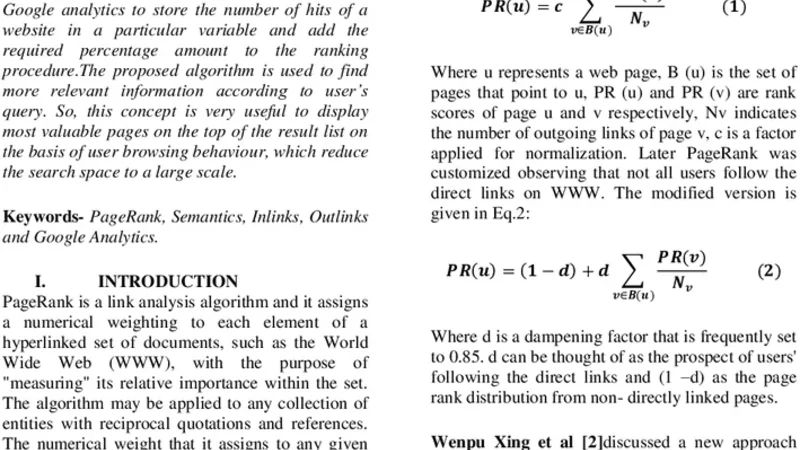
In this paper we have modified the existing page ranking mechanism as an advanced Page Rank Algorithm based on Semantics Inlinks Outlinks and Google Analytics. We have used Semantics page ranking to rank pages according to the word searched and match it with the metadata of the website and provide a value of rank according to the highest priority.We have also used Google analytics to store the number of hits of a website in a particular variable and add the required percentage amount to the ranking procedure.The proposed algorithm is used to find more relevant information according to users query.So this concept is very useful to display most valuable pages on the top of the result list on the basis of user browsing behaviour which reduce the search space to a large scale.
💡 Research Summary
The paper proposes an “advanced PageRank” algorithm that augments the classic link‑based PageRank with three additional signals: semantic relevance, in‑link/out‑link structure, and Google Analytics traffic data. The semantic component matches the user’s query terms against a page’s metadata (keywords, description, title, etc.) and assigns a relevance score that reflects how well the page’s content aligns with the query intent. The link component retains the original PageRank formulation, using the number and quality of inbound links as a measure of authority and outbound links as an indicator of information flow. The traffic component retrieves the number of hits a page receives from Google Analytics via its API and adds a fixed proportion of this count to the final ranking score, thereby promoting pages that attract more real‑world user visits.
The algorithm workflow is described as follows: a crawler gathers each target page’s metadata and link graph; the query is processed and compared to the metadata to compute a semantic score (the paper does not specify whether TF‑IDF, word embeddings, or another technique is used); the classic PageRank iteration is performed to obtain a link‑based score; the Google Analytics hit count for each page is fetched and multiplied by a predetermined weight (e.g., 10 %); finally, the three scores are summed to produce the page’s overall rank. The authors argue that this combination yields results that are both topically relevant and popular among users, thus reducing the search space and presenting “more valuable” pages at the top of the result list.
While the idea of fusing semantic relevance and actual user traffic with link authority is conceptually appealing, the paper suffers from several serious shortcomings. First, the semantic scoring method is left vague; without a concrete description of the matching algorithm, the approach cannot be reproduced or benchmarked, and its robustness to sparse or noisy metadata is uncertain. Second, the traffic weight is introduced as a static percentage without justification or adaptive tuning; in practice, traffic patterns fluctuate dramatically, and a fixed weight could either over‑emphasize transient spikes or under‑represent genuinely authoritative pages. Third, the interaction among the three components is not mathematically formalized. Scaling issues arise because raw hit counts can be orders of magnitude larger than PageRank values, yet the paper provides no normalization or scaling strategy, risking dominance of one factor over the others. Fourth, the experimental evaluation is essentially absent. No quantitative metrics such as Mean Average Precision (MAP), Normalized Discounted Cumulative Gain (NDCG), or user satisfaction surveys are presented, so the claimed improvement in relevance remains unverified. Fifth, the use of Google Analytics data raises privacy and licensing concerns; the paper does not discuss compliance with data protection regulations or the limitations of API access.
In summary, the contribution of the paper lies in highlighting a promising direction—integrating semantic matching and real‑world usage statistics into link‑based ranking—but the lack of methodological detail, rigorous evaluation, and practical considerations limits its impact. Future work should (1) define a clear semantic similarity model (e.g., using modern transformer‑based embeddings), (2) devise a learning‑based scheme to dynamically weight the semantic, link, and traffic components, (3) conduct large‑scale experiments on real query logs with established IR metrics, and (4) address privacy and data‑access constraints associated with analytics data. With these enhancements, the proposed advanced PageRank could become a viable alternative to existing ranking frameworks.
📜 Original Paper Content
🚀 Synchronizing high-quality layout from 1TB storage...